Loading...

Share This:

Global Rescue Gearing Up for Climbing Season in Nepal

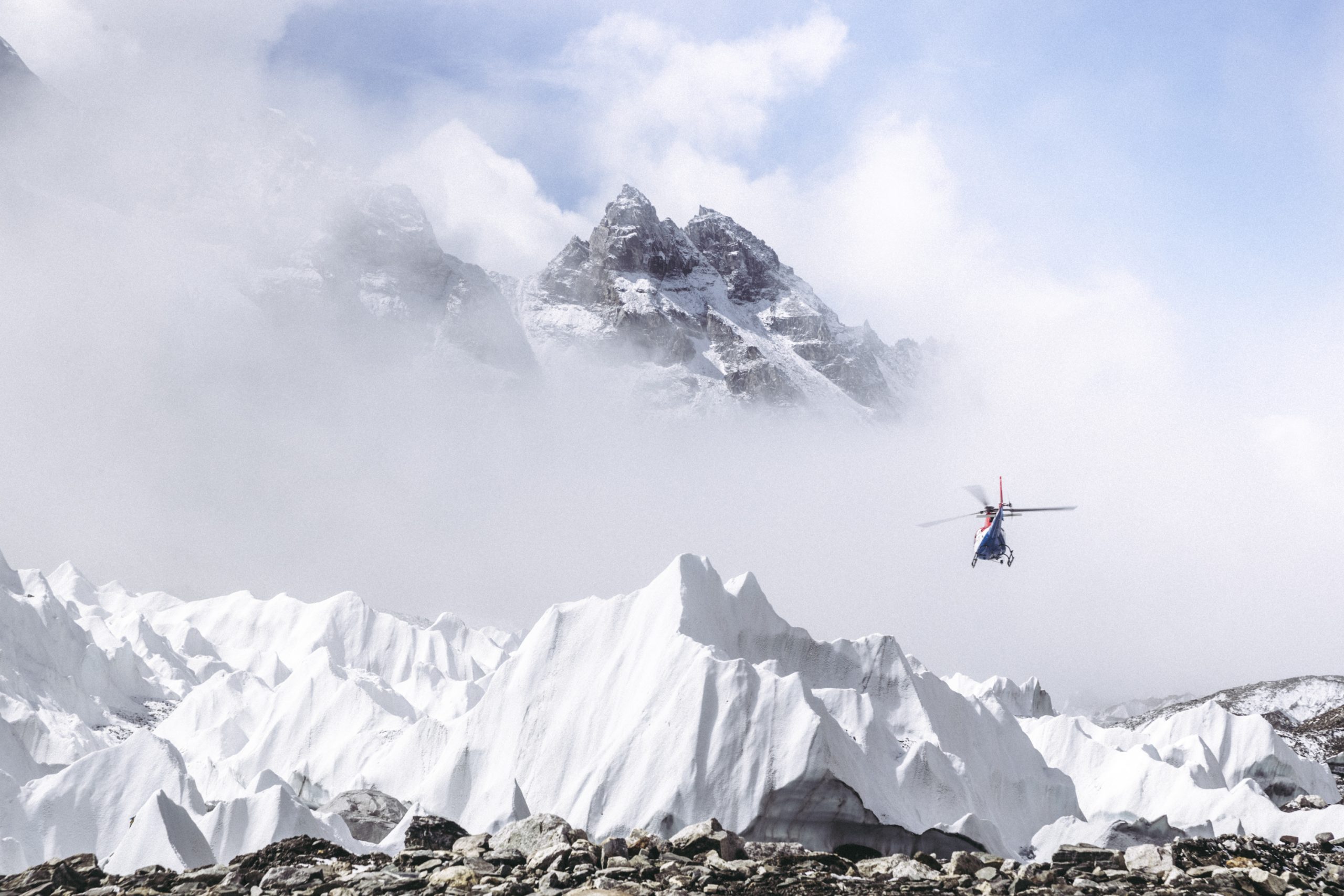
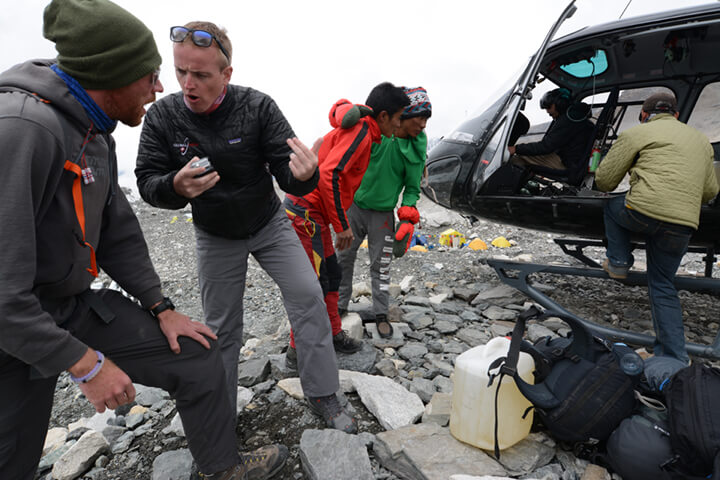
With the Himalayan climbing season approaching, Global Rescue will again deploy personnel to the region to rescue injured and ill climbers and trekkers.  

With the Himalayan climbing season approaching, Global Rescue will again deploy personnel to the region to rescue injured and ill climbers and trekkers.

“Global Rescue personnel will be ready on the ground to support our members with life-saving rescue and evacuation services,” said Dan Richards, CEO and founder of Global Rescue. “We save lives and we’ve been there for climbers pursuing their dreams for nearly 15 years.”

With more than a decade of experience providing emergency evacuation services to climbers in Nepal, Global Rescue frequently deploys personnel during climbing season to support its members.

In 2018 alone, Global Rescue performed more than 100 rescue and evacuation missions in the Himalayas, including dozens on Everest.

Global Rescue fully supports the commitment Nepal’s government has made to the security and safety of its climbing community.

Global Rescue’s experienced rescue specialists, medics and physicians frequently fly to our members to perform rescues in even the most remote environments. From an initial field assessment to hospitalization, staff members remain bedside with members overseeing their care.

Global Rescue also ensures full due diligence when it comes to flight operations by conducting site visits and physical inspections. Only contracted and vetted helicopter providers perform rescues for Global Rescue members in Nepal, with a majority of staff members physically present on the helicopter.

Heading to Nepal for your next climb? Contact Member Services at (617) 459-4200 or send an email to memberservices@globalrescue.com for details on a Global Rescue membership. Global Rescue is committed to supporting its members.


Categories:

News
Share This:

How One Man’s Daring Past Helped Make Adventure Travel Safer

Share This:

2019 South America Field Report

Global Rescue’s medical, security, and intelligence teams routinely perform boots-on-the-ground assessments of destinations that are important to our traveling members. Our teams recently returned from South America, where tourism is anticipated to grow at an…

Global Rescue’s medical, security, and intelligence teams routinely perform boots-on-the-ground assessments of destinations that are important to our traveling members. Our teams recently returned from South America, where tourism is anticipated to grow at an average rate of 6% between 2018 and 2022.

Comprehensive in-country reconnaissance and on-going intelligence reporting are just a few of the reasons why serious travelers trust Global Rescue. Use this information to best prepare for your upcoming travels and take appropriate precautions.

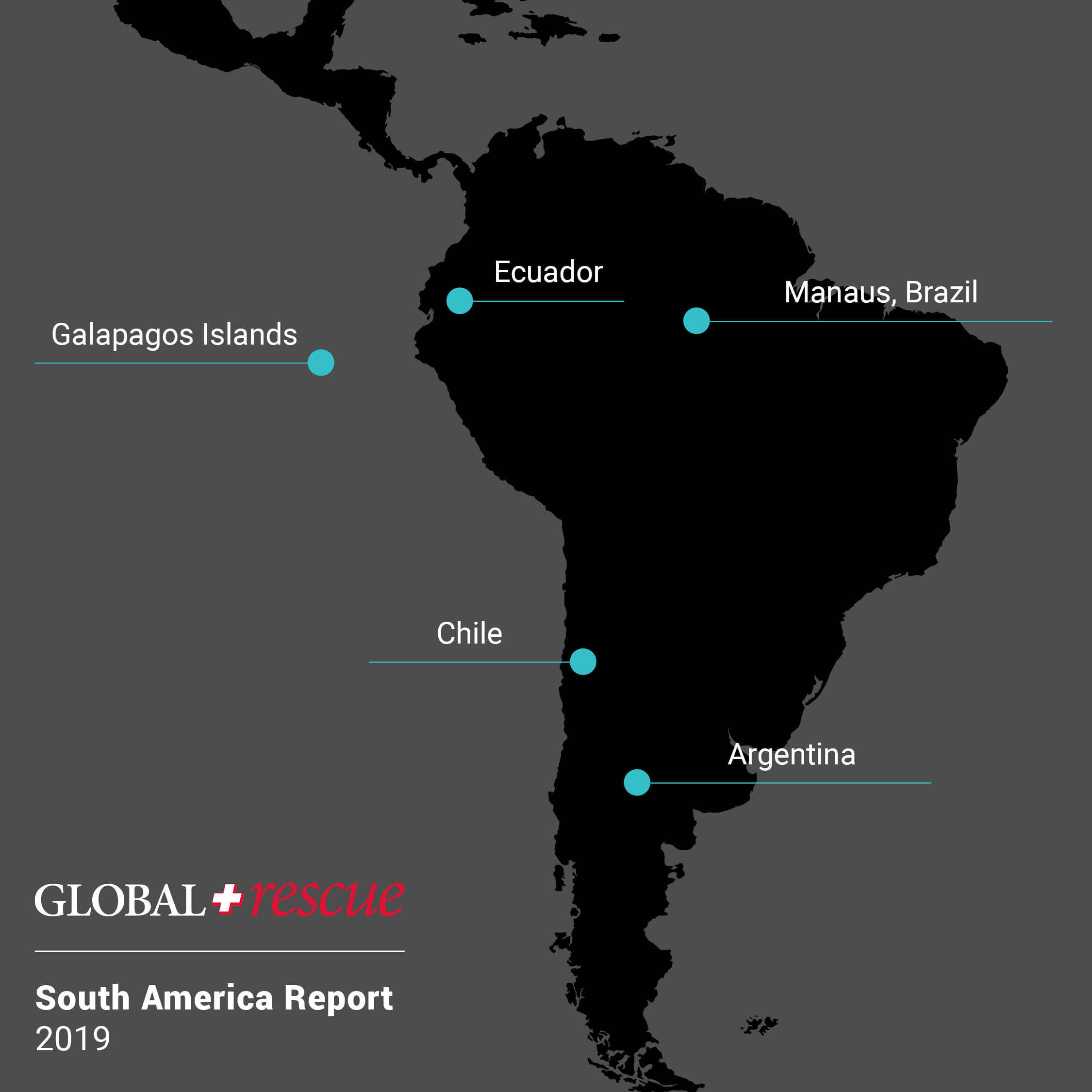
This Global Rescue Field Report provides security, medical and aviation insights for four South American countries popular with travelers, including Brazil, Argentina, Chile and Ecuador.

Manaus, Brazil (Credit: Global Rescue)

MANAUS, BRAZIL

Security – Petty crime is rife in Brazil, especially in large cities. Murders, burglaries, and carjackings are not uncommon. Favelas, or shanty-towns, have higher levels of drug-related violence, theft, and muggings. In the Amazon, and especially near the Columbian border, kidnappings by the Revolutionary Armed Forces of Colombia (FARC) have been reported. The tri-border area in western Paraná State is known for smuggling illicit goods. Many international organized crime syndicates conduct illegal drug and prostitution operations in Brazil. These groups account for much of the violent crime in Brazil, especially in the cities of Rio de Janeiro and São Paulo.

Medical – As part of the ongoing due diligence of care providers, Global Rescue recently visited several hospitals in the Manaus region. While medical care is lacking in the jungle areas, the hospitals within Manaus City are of a high standard, fully equipped and capable to diagnose and treat a wide range of complex medical problems. Manaus acts as the regional medical center for the entire Brazilian Amazon region. Members traveling into the jungle areas should ensure that their group has access to a first aid kit and basic medical supplies.

Aviation – Numerous aviation providers support Amazon fly fishing adventures and local tourism. Global Rescue has extensive assets under contract and our recent site visit reinforced the quality of maintenance and professionalism of these aviation outfits. Anglers travel deep into the Amazon and often require multifaceted rescue operations consisting of extractions by boat to basic jungle air strips.  Some areas allow for float planes to land near lodges where members can be medically evacuated to Manaus for a higher level of care. 

The major international airport in Northern Brazil, Manaus International Airport-Eduardo Gomes is the busiest in terms of the number of international passengers in this region. The airport supports local tourism with many, affordable transport options to downtown Manaus.

Mendoza, Argentina (Credit: Global Rescue)

ARGENTINA

Security –The threat from terrorism is low, yet civil unrest is common and tends to cause traffic disruptions. Demonstrations and strikes do not typically turn into violence but may disrupt road travel and public transit. However, crime is a concern, particularly in Buenos Aires and major cities. International visitors most often report non-violent thefts, especially in tourist locations and while using public transportation. 

Medical – To ensure the quality of care, Global Rescue conducted site visits at hospitals and clinics in areas ranging from Buenos Aires, Cordoba, Mendoza and the Patagonia Region. Major cities are generally well-equipped with standard facilities. While the regional hospitals are small, they are prepared to diagnose and treat a wide range of conditions. Should a member require medical transport from a regional facility, Buenos Aires has several world class facilities.

Aviation – Argentina boasts a robust number of aviation providers that support adventure tourism. To increase its fleet and support services, Global Rescue recently secured the use of more than 125 different aeromedevac fixed and rotary wing aircraft in the region. Global Rescue’s air providers can now operate in remote areas of Argentina to include the Patagonia parks. 

Santiago, Chile (Credit: Global Rescue)

CHILE

Security – While Chile has a low threat of international terrorism, it has a higher risk of domestic terrorist activity and small-scale bombings attributed to anarchist groups. Though crime is a concern, the country has a reliable police force. Demonstrations and strikes are common, and some of these events have turned violent in the past. Minefields are found in parts of the country. While most are marked, mines and signs may shift for various environmental reasons.  

Medical – As part of its thoroughness in reviewing care providers, Global Rescue visited hospitals in Santiago and Punta Arenas. Punta Arenas acts as the initial evacuation destination for the Falkland Islands and Antarctica as it is well-equipped with several high standard facilities. From all regions of Chile, members can be transported to Santiago where several world-class facilities are located.

Aviation – Many fixed and rotary wing aviation providers support adventure tourism throughout Chile. Global Rescue’s aeromedevac air providers can operate in remote areas of Chile to include the Patagonia parks.    

Amazon River (Credit: Global Rescue)

ECUADOR and THE GALAPAGOS ISLANDS

Security Ecuador is a hotspot for both petty and violent crimes, including sexual assault and homicide. It is also plagued by political instability, which sometimes manifests itself in riots and demonstrations. While no terrorist outfits operate within the country, FARC has been active since 2012 along the shared borders of the surrounding countries. The potential of violence spilling over into Ecuador does exist. 

Medical – Ecuador has invested heavily in its health care system since 2014. To ensure the level of care, the Global Rescue team conducted site visits at several facilities and found them to be predominantly of a high standard. Hospitals in Quito and Guayaquil are fully equipped, and capable of diagnosing and treating a wide range of complex medical problems.  Hospitals are limited on the Galapagos Islands and serious cases would generally be moved to Guayaquil. The capital city, Quito, is also well-equipped with medical facilities.

Aviation – Aircraft supporting tourism are modern and well-maintained, but limited in number. Currently, only one reputable commercial air ambulance provider operates inside the country, so availability can be limited. While aircraft used for extraction operations are located in Quito, they support medical evacuation operations throughout Ecuador and the Galapagos Islands.  Global Rescue’s Asset Development Team recently spent a week in the Galapagos opening up access to new aeromedical fixed and rotary wing aircraft.  Additionally, the team identified new naval assets that will provide another level of medevac coverage for our members. The airports in Ecuador are capable of handling jet aeromedevac aircraft.  While the Galapagos airports are small, they are capable of supporting some fixed wing aeromedevac aircraft.  Injured and sick members would be evacuated back to the mainland for comprehensive medical treatment when needed.


 Amazon River (Credit: Global Rescue)

Categories:

News
Share This:

China Plans Major Cut in Number of Everest Climbers

Categories:

News
Share This:

Global Rescue Renews Support of Bonefish & Tarpon Trust

Categories:

Press Release
Share This:

Global Rescue Renews Support of Bonefish & Tarpon Trust and Protects Its Members  

Coral Gables, FL, January 16, 2019 – Global Rescue, the exclusive provider of evacuation and travel insurance services for Bonefish & Tarpon Trust (BTT), has reaffirmed its support of Bonefish & Tarpon Trust's conservation efforts as…

Coral Gables, FL, January 16, 2019 – Global Rescue, the exclusive provider of evacuation and travel insurance services for Bonefish & Tarpon Trust (BTT), has reaffirmed its support of Bonefish & Tarpon Trust’s conservation efforts as a Bronze Corporate Sponsor.

“Global Rescue and Bonefish & Tarpon Trust value the importance of sustainable practices and share support for enthusiasts within the fishing world,” said Global Rescue CEO Dan Richards. “Bonefish & Tarpon Trust members travel the world advocating for healthy fisheries and we prioritize their safety.”

Anglers can enjoy peace of mind knowing that Global Rescue is ready 24/7/365 with services from travel assistance to medical advice and emergency evacuations. Since 2004, Global Rescue’s hand-picked medical and security teams have performed more than 15,000 operations for individuals, families and enterprises. With its impressive track record, Global Rescue has become the travel protection service provider of choice for many of the world’s largest companies, universities, and nonprofits.

“Global Rescue is a leader in the travel services industry,” said BTT President and CEO Jim McDuffie. “The company is a preferred provider for our members and, with this grant, is also continuing its generous commitment to the conservation of our flats fishery.”

About Bonefish & Tarpon Trust

Bonefish & Tarpon Trust’s mission is to conserve bonefish, tarpon and permit—the species, their habitats and the larger fisheries they comprise. As a science-based organization, BTT pursues this mission across the southeastern US, Gulf of Mexico, and Caribbean through research, conservation, education and advocacy. 

About Global Rescue

Global Rescue is the world’s leading provider of medical, security, evacuation and travel risk management services to enterprises, governments and individuals. Founded in 2004, the Company provides best-in-class services that identify, monitor and respond to client medical and security crises. Global Rescue has provided medical and security support to its clients, including Fortune 500 companies, governments and academic institutions, during every globally significant crisis of the last decade. For more information, visit www.globalrescue.com.


Share This:

Emergency Medical Evacuation Saves Stranded Couple in Greenland

Often thought of as a stepping stone for Antartica, an expedition in remote Greenland is not for the faint of heart. While crossing an ice cap during their 300-mile trek, Daniel and Elaine Vardamis discovered just…

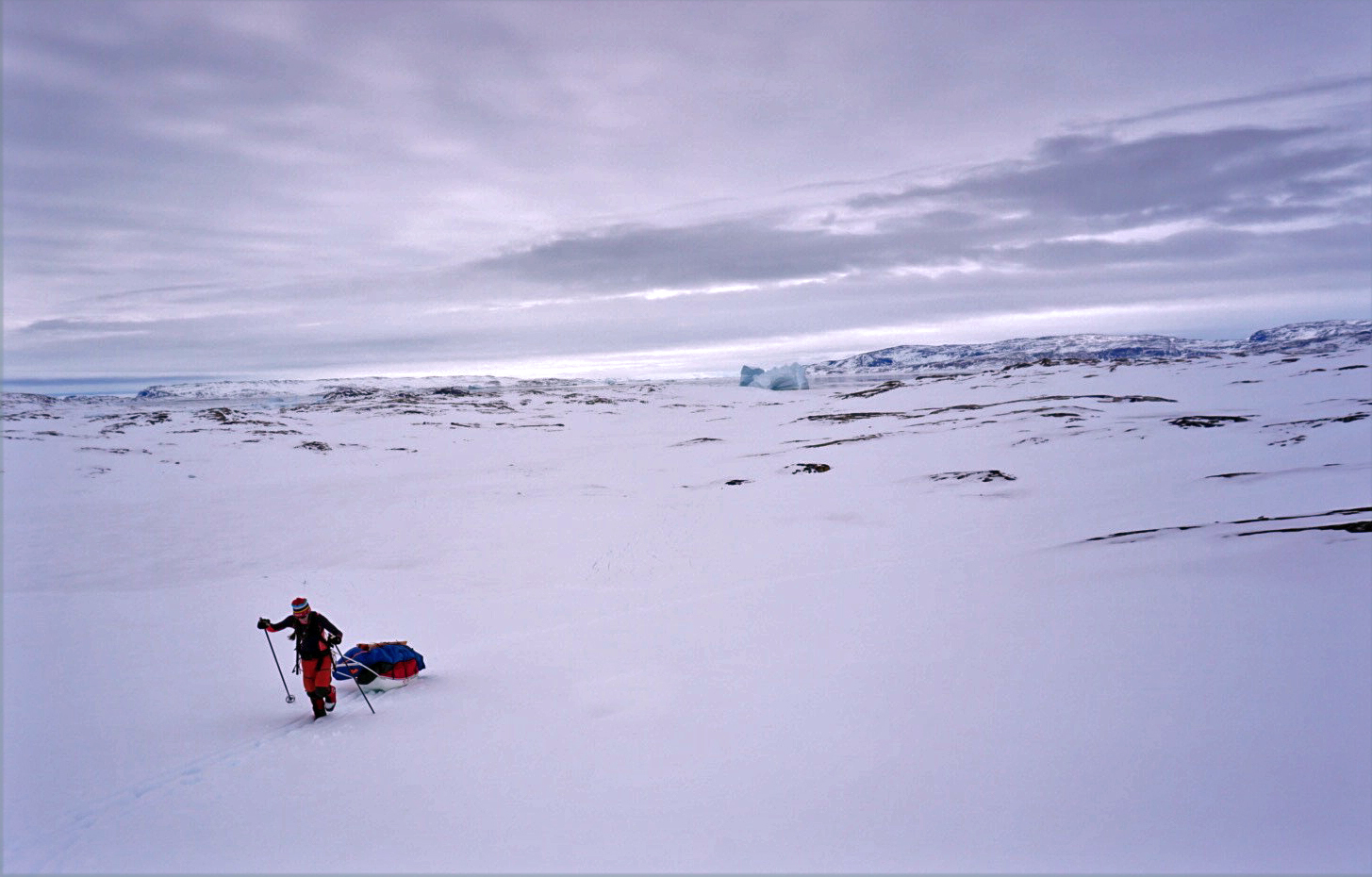
Often thought of as a stepping stone for Antarctica, an expedition in remote Greenland is not for the faint of heart. While crossing an ice cap during their 300-mile trek, Daniel and Elaine Vardamis discovered just how challenging such a trip can be.  

Having taken various trips to cold places for backcountry skiing, the Vardamis’ considered themselves experienced and prepared adventure travelers.  

The couple had been traveling for seven days, pulling their low-slung Nordic sled on skis when suddenly, the weather started to turn.

“We were doing well and getting weather [updates] from a guy in Amsterdam,” Daniel said.

The Joint Arctic Command informed Daniel and Elaine that 110 mph winds were expected to arrive over the next 36 hours.

With the wind picking up, the couple quickly set up camp.

“We spent the next 24 hours in the tent. It was a really bad storm,” Daniel said.

Daniel and Elaine were well-provisioned and started building snow walls to help deflect winds from their four-season tent. Still, they were concerned that their tent would not be able to withstand the predicted hurricane force winds.

That’s when Daniel called Global Rescue from his satellite phone.


Medical Emergency Evacuation Needed for Daniel and Elaine

Daniel told Global Rescue operations personnel they had endured strong, sustained winds for the past two days. More concerning, Daniel had frostbite from the constant shoveling and exposure to the elements.

To identify their coordinates, Global Rescue asked the Vardamis’ to send a message using their InReach device.

“Call soon. If rescue not possible we need to do extensive preparations to get through the next 96 hours unhurt & alive. Tough situation. Thanks – Dan & Elaine”

The couple then learned that another more powerful storm with stronger winds was coming and predicted to last three days.

“Global Rescue got the weather people on it,” Daniel said. “We were in the eye of the hurricane.”

Global Rescue recommended a helicopter evacuation.

“My hands and toes were frostbitten. We had a six-hour window to get out,” Daniel recalled. “That was the safest thing. It was a quick decision and we decided to go for it.”

They messaged Global Rescue from their InReach:

“Tent is red, sleds are red.

“Tent currently set up. Given fact that surface is 100% white with no landmarks at all we figure it would give good perspective for pilot in case of rescue.”

One hour later, they were in the helicopter.

“It was phenomenal,” Daniel said. “If you fly over Greenland, there’s nothing like it. The landscape is completely white, formless. It’s not easy for a helicopter to land.”

Along with their sled and skis, Daniel and Elaine were transported to the town of Tasiilaq, a small Inuit village. The tent, mostly destroyed and buried by snow, was left behind.

“Global Rescue directed us to a local clinic where they checked us out and bandaged me,” Daniel said. “Global Rescue was really good. They continued to follow up with us. We were impressed by their diligence,” he said.

While the couple rested in the village, Daniel recovered from his frostbite and made plans to get back home to Colorado.

“As an adventurer, you aim to take responsibility for yourself. But I can’t say for certain how we would have fared without Global Rescue,” he said.

The Greenland expedition was the first time the couple used Global Rescue’s life-saving services.

“It was a very good learning experience. You buy something like a Global Rescue membership and don’t think that you’ll need it,” said Daniel. “But to have it in the eye of the storm, it’s necessary. No one wants to die doing these things.  You think of home and family and ideally want to get out alive.”

Whether you’re seeking advice or immediate medical or security assistance, Global Rescue operations centers are staffed 24/7/365 to assist our members. Click here to contact us about the benefits of membership.


Categories:

Health & SafetyTravel
Share This:

5 Precautions for Traveling With Medication

For the most part, travelers who take prescription medications of all kinds can travel throughout much of the world without problems. If countries have restrictions on the types and quantities of medications that can cross…

For the most part, travelers who take prescription medications of all kinds can travel throughout much of the world without problems.

To help our members stay safe and informed while traveling, Global Rescue operations personnel have provided the following advice below for traveling with prescription medications.

Travelers should follow basic precautions:

  • Medications should be in their original container (prescription bottle) with label affixed.
  • Make a list of all your medications and their generic names in case you need to replace any medications during travel. Leave a copy with a family member or friend. Your pharmacist can create a Personal Medication Record, which lists the drug, regimen and purpose.
  • Carry a copy of the original prescription and/or a letter from the prescribing physician (ideally translated into the language of your destination country).
  • These documents should include both the brand name and the generic name.
  • Carry only a supply of medication adequate for your itinerary, with enough for a few extra days or a week to allow for unforeseen circumstances.
  • Carry medication in your carry-on baggage.

[Related Reading: 10 Reasons You Need a Travel Protection Membership]

In addition to the suggested precautions, some countries have restrictions on the type and/or quantity of medications that can cross their borders. The medications most often restricted are controlled substances: opiates, stimulants and psychotropic medications, such as antidepressants and antipsychotics.

However, even medications such as asthma inhalers and insulin may be restricted or prohibited in certain countries. Many countries allow people to bring in no more than a 30-day supply of even more routine medications. In some countries, certain over-the-counter medications are prohibited.

“Just as some medications available in the U.S. can sometimes be prohibited in other countries, there are medications restricted in the U.S. that can be easily purchased — sometimes even without a prescription — in other countries,” said Michael Lovely, operations supervisor at Global Rescue. “I recommend to speak with your treating physician to come up with multiple alternatives in case one type of medication is not carried by local pharmacies.”

traveling with medication

How does a person navigate this patchwork of individual country requirements?

  • The first step is to identify potential medication problems with your particular itinerary.
  • You should complete this step at least 2-3 months prior to your trip to allow sufficient time to remedy any concerns.
  • Check with the foreign embassy of the country you will be visiting or passing through to make sure your medications are permitted in that country.
  • You can also consult with the U.S. Embassy located in the countries on your itinerary.
  • Another resource is the individual country’s ministry of health department. Some countries that post medication restrictions will also detail the procedures you can take to bring restricted medications into that country. These procedures may include special procedures to grant permission and/or documentation requirements, among others.
  • If you are traveling with a controlled drug, you should review medication regulations on the International Narcotics Control Board website.
  • At least 6-8 weeks prior to departure, arrange a formal travel consult with an experienced travel medicine provider. This advanced timeline will allow adequate time to complete any vaccines needed for your destination, as well as to sort out specific medication issues. Your travel medicine specialist may have additional information on traveling with restricted medications and can help you complete any necessary paperwork, if applicable.

If you determine a country on your itinerary has a ban on your medication, consider these options:

  • Consult with your prescribing provider and discuss an alternative medication that is not on the restricted list. Be sure to trial the medication for an adequate period of time prior to travel to assess for efficacy and any side effects.
  • Consider obtaining your medication in the country of your destination. Some countries will not allow import of certain medications, but do allow prescribing of that same or similar medication by a licensed healthcare provider in-country.
  • Consider changing your destination. If your destination country has an absolute ban on your medication and your health requires that you continue your medication without interruption, you will not be able to travel to this destination at this time.

A Few Things to Avoid:

  • Don’t attempt to enter a country with a banned medication. If discovered, your medication will be confiscated at a minimum, placing your health at risk. Many countries have severe penalties for possessing banned medications, including prison.
  • Don’t have family or friends mail medications to you.
  • Don’t assume you can access the medication in a foreign country just by presenting at an emergency department.
  • Don’t purchase medications on the street, in open markets or from businesses that do not appear to be a legitimate pharmacy. Counterfeit and expired medications are common in developing countries.
  • Don’t purchase medication from physicians in developing countries as they are less likely to store the medication correctly or have the correct medication in stock.

“Sometimes medication packages are not written in English especially in non-English speaking countries so I suggest that travelers install an app on their mobile phones that can help with the translation,” Lovely said. “If members have concerns with the medications, they can always contact operations and we can assist.”

Members can also call if they need help finding a licensed health care provider in their destination. It’s all part of a Global Rescue travel protection membership, which includes everything from medical advisory services to field rescue at the point of injury or illness to hospital transport. Learn more about Global Rescue’s medical advisory services and how you can access them 24/7/365.

Categories:

Travel
Share This:

10 Tips for When You’re Stuck at An Airport Overnight

Your plane was delayed and now you’ve missed your connection. It’s after midnight and the next available flight doesn’t depart until dawn. A hotel room is out of the question. What do you do?

Your plane was delayed and now you’ve missed your connection. It’s after midnight and the next available flight doesn’t depart until dawn. A hotel room is out of the question. You’re clearly stranded at an airport. What do you do?

Our Global Rescue security operations personnel have developed some tried-and-true techniques for making an airport overnight a little more comfortable.

The ability to get some restful sleep on the go in places like airports and bus stations might make or break a trip when the unexpected happens. Before your next extended layover, here are a few tips to keep in mind to survive a night in the airport.

Lower Your Expectations

Aim for rest and relaxation instead of hoping for eight solid hours. Make your goal to just be as relaxed as you can be, and sleep will likely follow. If not, even the restful, quiet time will help you recharge.

Remember to Stretch

Fellow travelers might raise an eyebrow as you do light yoga on the concourse, but you’ll feel more comfortable after stretching.

Pamper Yourself with Comfort Items 

We all have a bedtime ritual and even in an alien environment you can stick to some of yours. Have your toothbrush and toothpaste handy, as well as a travel-size bottle of your daily moisturizer or lotion. Keeping some of your routine intact will give you a sense of control over the situation, which is important for your peace of mind as well as your ability to achieve meaningful rest.

[Related Reading: The Ultimate World Travel Safety Kit]

Carry Spare Clothes with You

Carry extra undergarments and a soft exercise shirt in case you get stuck sleeping somewhere. It’s as close to pajamas as you may get and an easy way to tell your brain that it’s bedtime.

Prepare to Keep Warm

Carry a small pair of gloves and a light stocking cap. They come in handy during cold nighttime flights and are worth their weight in gold when the air conditioning has you shivering.

Bring Your Earplugs

Standard foam ear plugs will suffice, although silicone ones can be cleaned easier. You don’t need much protection – just enough to lower the volume of that overhead speaker. 

airplane-at-night

The Jack(et) of all Trades

Keep a lightweight, insulated jacket in your luggage year-round. You can drape it over yourself like a blanket and a hood can help block out harsh airport light. Large pockets are perfect for securing valuables on your person while you snooze and you can stuff the jacket into its own sleeve for a crude pillow.

Make Your Bed and Lie in It

Some travelers need more creature comforts than a minimal puffy jacket thrown over them. For this, consider a small air mattress, travel pillow or sleeping bag. These are especially relevant internationally.

Protect Valuables

If you are traveling alone, put your valuables in your pockets or in a purse or backpack slung across your shoulder. Pull other items as close as possible and put your arm or leg through a strap. It’s not as secure as keeping a waking eye on everything, but it will make you feel better and help you relax.

If you are traveling as part of a group, establish a guard shift and create a roster – even for a well-lit major airport. It might feel like overkill, but you’ll feel more comfortable knowing your items are safe. As a bonus, the ‘guard’ can keep tabs on any developments with your travel.

Share This:

Mission Brief: December 2018

Every day, Global Rescue personnel are involved in medical, security, and travel operations all over the globe. Here is a snapshot of some of our recent activity.

Every day, Global Rescue personnel are involved in medical, security, and travel operations all over the globe to ensure its members are safe and sound. Since 2004, Global Rescue has conducted over 15,000 operations. From Australia to Zimbabwe, here is a snapshot of some of our recent activity. 

– MEDICAL –

ARGENTINA – Monitored the condition and supported the medical care of a member who suffered from severe acute mountain sickness (AMS).

AUSTRALIA – Provided medical advice to a couple experiencing severe upper respiratory infection signs and symptoms after disembarking from a cruise ship.

CHILE – Assessed the condition and supported the medical care of a member who suffered from oral lacerations and a possible concussion due to a skiing accident.

CHINA – Advised a member who suffered facial lacerations from a fall after temporary loss of consciousness.

ITALY – Provided medical advisory services and medical escort for a member who sustained a tibial fracture while skiing.

KYRGYZSTAN – Provided medical advisory services and hospital referral for a member who broke his leg while horseback riding. Deployed medical personnel to escort member back home.

MEXICO – Coordinated the medical repatriation by air ambulance of a member in need of urgent re-attachment surgery of severe partial amputation of fingers.

NEPAL – Supplied medical support, advice, helicopter field rescue services and mortal remains transports on dozens of missions for members participating in climbing expeditions.

NIGERIA – Coordinated air ambulance transport and provided medical advice to an employee of a client organization who suffered from a diaphragmatic hernia.

SEYCHELLES – Provided medical advice and evacuation to a member who was bitten on the foot by a giant trevally near the remote island of Farquhar.

SWITZERLAND – Provided medical advisory services to a member who fell while biking and fractured her ankle.

–  SECURITY –

BANGLADESH– Provided security advice to a client NGO that reported having workers who had been briefly detained and questioned by law enforcement.

CAMEROON Provided security advice to members who were traveling in the vicinity of a shooting incident.

HAITI – Provided security advisory services for a client with travel plans to Haiti.

INDIA – Advised and assisted a member with a lost passport in India. Arranged for an appointment at US Embassy in New Delhi.

INDIA Advised a member who was taken into custody in New Delhi for possession of a satellite phone.

LEBANON – Provided security support for a client operating in Beirut.

MEXICO – Fielded request for secure transport for individuals with upcoming travel to Cancún.

NIGER – Provided assessment of security conditions for a client.

NIGERIA – Supplied information to a client regarding potential security consequences during the Nigerian election process.

ZIMBABWE – Provided security support for an international conservation group operating throughout Zimbabwe.


Share This:

Medical Treatment When A Fishing Trip Goes Wrong

Jonathan Olch of Park City, Utah, is the author of the highly acclaimed new book, A Passion For Permit.  Over a 30-year period, Jonathan has chased or caught hundreds of Atlantic permit, along with several…

Jonathan Olch of Park City, Utah, is the author of the highly acclaimed new book, A Passion For Permit.  Over a 30-year period, Jonathan has chased or caught hundreds of Atlantic permit, along with several other prized Trachinotus species, in premier fishing destinations such as Belize, Florida, Cuba, the Bahamas, Mexico, Honduras, Seychelles, Australia, Oman, Turks & Caicos, Antigua, Guadeloupe, Venezuela and Panama. 

Olch, who is an enthusiastic advocate of a number of conservation organizations, including the Bonefish & Tarpon Trust, IGFA, Wild Salmon Center and Trout Unlimited, recently wrote to us about an experience he had with Global Rescue.

“I was traveling from the western U.S. to Oman to fish for the Southern Pompano (Trachinotus africanus). Upon departure, my health was less than optimal due to my unfortunate exposure to carbon monoxide poisoning, which in turn triggered a bout of asthma. Nonetheless, I tried to put aside my discomfort and concentrate on my fishing,” he said.

From Oman, Olch immediately traveled to the Bahamas, where he met up with his catamaran, boat captain and some friends.

“The travel was grueling, exacerbated by a canceled flight and a stressful layover in Istanbul. The respiratory illness I carried with me in Oman had not healed and I found myself wheezing and coughing constantly as we cruised around some of the Bahamian islands. At the end of one of the days, my energy waned badly.”

Then he remembered that he had signed up with Global Rescue. “I asked my captain to call Global Rescue and seek some advice on my medical condition.”

Global Rescue immediately located a clinic at Deadman’s Cay.

“My captain persuaded me to get up out of bed and out of my stupor. Thereupon we took the dingy on a wet ride across the bay and were met there by a cab driver,” he noted.

After a thorough examination, Olch was placed under an oxygen mask and hooked up to an IV drip bag. “That made me feel a lot better. The physician was fabulous and called me the next day to make sure I was feeling better.” Olch later made a donation to the clinic to help buy some much-needed blankets.

“I never expected to receive decent medical treatment at such a remote location as Deadman’s Cay. Global Rescue continued to monitor my health situation, offering suggestions and contacts until I made it back home to Utah.”

He continued, “Once home, I learned I had contracted a parasite with a case of pneumonia. Things would have been a lot worse had I continued to ignore my symptoms. I was grateful for the physician’s care and the professional assistance I received from Global Rescue. Traveling as extensively as I do, I certainly recognize the value in being a Global Rescue member.”


Share This:

Medical Evacuation from a Mountain in Nepal

Former firefighter and Global Rescue member Martin Lesperance was three days from the summit of Mera Peak in Nepal and fighting extreme weather when he developed dangerous frostbite on his feet and fingers.

Canadian Martin Lesperance was no stranger to emergency situations. The former firefighter and paramedic had responded to plenty of them in his career. Yet climbing the 6476m Mera Peak in Nepal, Martin found himself experiencing an emergency of his own. Due to the extreme weather, Lesperance had developed frostbite on his feet and fingers.

Three days from the end of his climb, Martin chose not to risk permanent damage by continuing his trip, and decided he needed help from Global Rescue.

Martin provided Global Rescue’s number to his climbing guide, who then used a satellite phone to contact the company.

Global Rescue Medical Operations personnel assessed Martin’s condition and immediately decided that a medical evacuation was needed. Global Rescue arranged a helicopter to transport Martin from his point of injury in Khare (4900m) to Lukla and then to Kathmandu, where an ambulance was waiting to bring him to the hospital.

“It was just incredibly seamless and easy,” Martin said of Global Rescue’s medical transport services. “Everything just worked out so smoothly. I was totally impressed.”

Once at the hospital, Martin received treatment for his frostbite. The Global Rescue medical team coordinated with hospital personnel throughout Martin’s stay, ensuring that his care was appropriate for his condition.

Global Rescue medical personnel followed up with Martin every day after his treatment, monitoring his progress and ensuring that his flight home went smoothly.

Global Rescue was incredible,” said Martin. “I have never experienced a service like it.”

Back home in Canada, Martin continued to recover from his frostbite, even making plans for a future climb – either South America or a return to the Himalaya.

Martin became a Global Rescue member in 2016 after learning about the company’s services from some fellow Canadian climbers who were members. Mera Peak was the first time he needed emergency assistance from Global Rescue.

“I can’t say enough about how well everything went with Global Rescue,” said Martin. “It couldn’t have been better.”


Did you know that mountain destinations attract around 15-20 percent of global tourism and are areas of important cultural diversity, knowledge and heritage? As you plan your next climb, know that mountain tourism has the potential to foster economic development in remote and isolated regions.