Categories:

News
Share This:

Traveler Survey: COVID-19 is a Concern, But Not Enough to Cancel Trips

Categories:

News
Share This:

Does Travel Insurance Cover the Coronavirus?

Categories:

News
Share This:

Coronavirus travel restrictions a concern as illness spreads

Categories:

News
Share This:

Medevacs from extreme environments

Categories:

News
Share This:

Lessons unlearned, world caught off-guard by Covid-19

Categories:

News
Share This:

Virus’s economic impact hits Upper Valley businesses

Categories:

News
Share This:

Massachusetts officials ramp up coronavirus prep, but experts say specific measures needed

Share This:

Mystery Infection Hits Adventure Racer in Fiji

Cuts, scrapes, bruises and fatigue. These are typical ailments athletes suffer following an adventure race. But for Dianette Wells, a 53-year-old competing in a Fiji-based adventure race, the post-race distress went far beyond the conventional.

Cuts, scrapes, bumps, bruises and fatigue. These are the typical ailments athletes suffer following an adventure race. But for Dianette Wells, a 53-year-old Park City, Utah resident competing in a Fiji-based adventure race, the post-race distress went far beyond the conventional.

Wells admitted she gets pretty banged up after her races but acknowledged something was different after the Fiji adventure race.

“My team was finished racing. Three of us were laying in our beds in the hotel room and the medical staff for the race was overwhelmed because so many competitors had issues going on with gashes, wounds and skin infections,” she said.

At that point, Wells wasn’t as bad off as her two teammates.

“One was having his leg debrided. Another had a fever. I didn’t feel well, but I was lying in bed eating Tandoori chicken, so I probably looked fine to the medical staff compared to the others.”

Things got worse for Wells late that night.

“I had a high fever and nonstop diarrhea. I knew something was seriously wrong. I texted my local Park City, Utah doctor,” she said. Coincidentally, prior to going to Fiji for the adventure race Wells had provided her hometown doctor with all her information and the Global Rescue contact details, too.

“I told him to call Global Rescue if something happens to me. So he made the call and that set into motion Global Rescue stepping in.”

Alone in a Foreign Country

Wells was alone in a foreign country and starting to get anxious. She was concerned about her gear, costly medical bills, her rising fever, the nonstop gastro-intestinal symptoms — and she could barely walk.

“I was panicking about so many things that I couldn’t control,” she said.

Global Rescue arranged for ground transport from the hotel to the hospital. But Wells was reluctant.

“Global Rescue kept telling me that I had to leave the room, get in the ambulance and go to the hospital. It was the last thing I wanted to do,” she said.

Global Rescue coordinated help and sent two Fijian women from the hotel up to Wells’ room with a wheelchair.

“The women convinced me to leave. I got into the ambulance and was taken to a local hospital. Then Global Rescue had a couple of people show up just to sit with me in my hospital room and help take care of me, getting juice, keeping me comfortable. These people did not leave my side,” she said.

Ultimately, Global Rescue provided air transport on a medevac equipped aircraft for Wells to a hospital in Auckland, New Zealand where she was treated for a week. Wells says she had cellulitis and was infected with ESBL, or Extended Spectrum Beta-Lactamase, a type of enzyme or chemical produced by some bacteria. Her hand was also badly infected.

Dianette Wells 2

“I still have ESBL and I could have it for a couple of years. It’s still unclear. It may have come from contaminated water. No one really knows. I feel incredibly fortunate I had such good medical care in New Zealand and a prompt evacuation out of Fiji,” she said.

Wells has raced and climbed for years but has never needed to call on Global Rescue. When she did, her expectations were exceeded. She was surprised that Global Rescue stayed with her from beginning to end.

“Global Rescue took care of everything. Little things, like when we had a few hours between leaving the hospital and getting on the airplane. Global Rescue put me in a hotel room so I could sleep before going to the airport. Every detail was taken care of. It was like being taken care of by my mother,” she said.

Wells is a longtime Global Rescue member.

“I originally got it for a climb I had in Antarctica and rescue services were required. Now, it’s just something I want since I travel a lot. I’ve bought memberships for my children and as gifts for friends. It’s one of those things I never leave home without. If something goes wrong in a foreign country and you need to get out, then why not have the Global Rescue experts in charge of all that?”

Categories:

Travel
Share This:

Flipping Frostbite

When the weather outside feels almost arctic, it can be a challenge to maintain a normal body temperature. Global Rescue experts know the secret to keeping frostnip, frostbite and hypothermia at bay.

When the weather outside feels almost arctic, it can be a challenge to maintain a normal body temperature of 98.6 degrees Fahrenheit (37 degrees Celsius). But that’s what you need to do to avoid hypothermia, which occurs when your core body temperature drops to 95 degrees (35 C).

When you step outside appropriately bundled up for your cold-weather adventure, how do you maintain the body heat you desperately need?

Global Rescue experts know the secret to keeping frostnip, frostbite and hypothermia at bay.

“It’s easier to stay warm than get warm,” said Harding Bush, associate manager of operations at Global Rescue.

How We Lose Heat

Bush, a 20-year special operations forces veteran with an additional nine years of experience in international travel security, knows how to survive in extreme environments.

“It is essential to understand how our bodies lose heat,” Bush said. “This understanding will enable you to avoid cold-weather injuries and make the best use of cold weather clothing and equipment.”

According to Bush, heat is lost through convection, conduction, radiation, evaporation and respiration.

  • An example of heat loss through convection is the wind moving across bare or poorly protected skin. This type of heat loss is prevented with windproof (or waterproof) outer layers of clothing.
  • Physically touching or contacting a colder surface creates heat loss through conduction. A foam pad between your sleeping bag and the tent floor is a method of preventing heat loss through conduction.
  • When our bodies are warmer than the air around it, we lose heat from our bodies trying to warm the colder air. This is prevented through an insulating layer of clothing when the radiating heat is trapped and retained in these layers to keep us warm.
  • When we are active, perspiration evaporates as a heated vapor, which reduces body heat and accelerates radiation. This is prevented by managing the level of exertion during an activity and taking off layers to reduce heavy perspiration. This is also why many cold-weather outer layers have zippers under the arms and along the core, allowing perspiration to vent off in a vapor.
  • We also lose heat through respiration. The more we exert ourselves, the faster we’ll lose heat once the activity stops.

Seven Cold Weather Combat Tips

All these ways to lose heat can work together, making your job to stay warm more difficult. Foil frostbite and halt hypothermia by following these cold-weather combat tips from Global Rescue’s outdoor experts.

1. Start Cold

Your body will warm up during outdoor exercise and sweat in an effort to cool down. But sweating isn’t a good thing — “it will zap body heat,” Bush said. Those wet layers will quickly make you feel cold again.

He suggests starting cold and adding or adjusting layers to reduce the likeliness of overheating. When you stop, immediately add a warming layer to hold in heat.

“I always have a fleece or a light down jacket and hat in the top compartment of my backpack for this reason,” Bush said.

If anything gets wet or sweaty, change clothing to prevent loss of body heat. Store wet gloves in a zippered pocket that doesn’t make contact with your body. Global Rescue offers more winter clothing advice here.

2. Keep Moving

A human’s metabolism continuously produces between 50 and 100 watts of heat and can release more during physical activity. Small movements and stretches will keep circulation moving and increase your metabolism.

If you’re skiing or snowshoeing, you won’t have to worry about movement for warmth. But if you’re stuck in a blizzard, it will be key to survival. Wiggle your fingers and toes, clap your hands, bend and unbend your arms — keep the blood circulating without breaking a sweat.

3. Eat Something

Eating also increases body temperature, so snack away during your outdoor activity.

Outdoor experts swear by root vegetables, complex carbs (oats and brown rice), fatty foods that take longer to digest (chocolate, cheese, nuts) and simple foods (granola or energy bars) that combine the nutrients your body needs.

4. Drink Water

You usually don’t think of dehydration as a cold weather hazard. In the winter we tend to go longer periods without drinking water and our bodies will quickly get out of balance. That imbalance will decrease metabolism and slow the flow of blood to extremities. Your body will tolerate the cold better if you stay hydrated.

5. Protect Extremities

Although it is a myth that you lose all the heat from your head, it is a fact that you will lose heat from any exposed surface — head, feet, hands, neck, the space between your sunglasses and your hat.

Gearjunkie.com suggests wearing wraparound sunglasses and well-fitting goggles to cover more of your face. Orvis recommends a two sock system: a lightweight synthetic liner sock and a heavyweight wool sock.

To make sure your hands are protected, Bush recommends wearing glove liners underneath mittens.
“Say you need to take off your mittens to tie your boots,” Bush said. “You won’t want to do this with bare hands as blood rushes to extremities to add warmth. Thin glove liners will keep you from exposing bare skin if you need to remove heavier gloves or mittens.”

6. Take A Break (Or Two)

If you are going to be outdoors for a long period of time, schedule time for breaks.

“Being tired makes you cold. Your body has to work harder to keep warm,” Bush said. “Take off your backpack and rest.”

It’s also a good time for clothing changes — adding or removing layers and adjusting goggles or a face mask — and fueling up with a drink of water and a snack.

“You are in the outdoors to enjoy the environment and the activity — but it won’t happen if you are too cold, too wet, too dry, too hot, too hungry or too thirsty,” Bush said.

7. Guard The Group

If you are with a group, make sure every group member is on the same schedule with the same breaks.

At the beginning of the break, “it is vital to add an outer or insulating layer, such as a down jacket with a hood or a wool hat, as soon as we cease activity,” Bush said.

At the end of the break, before you take off those layers, “ensure everyone is ready to step off together. Don’t be the person putting the stove away when the others have already removed layers and are beginning to shiver because they are waiting for you,” Bush said. “As you are getting ready, communicate ‘We are stepping off in five minutes.’ This allows everyone to be ready at the same time — and stay as warm as possible.”

Whether you’re seeking outdoor advice, like the warning signs of frostbite, or need immediate medical or security assistance, Global Rescue operations centers are staffed 24/7/365 to assist members with any travel request.

Share This:

Altitude Sickness Strikes Again

Robert Kay and his two friends look forward to yearly adventures as "the three amigos," traveling everywhere from Antartica to Peru and Nepal. When things went wrong during a summit push on Ama Dablam, it…

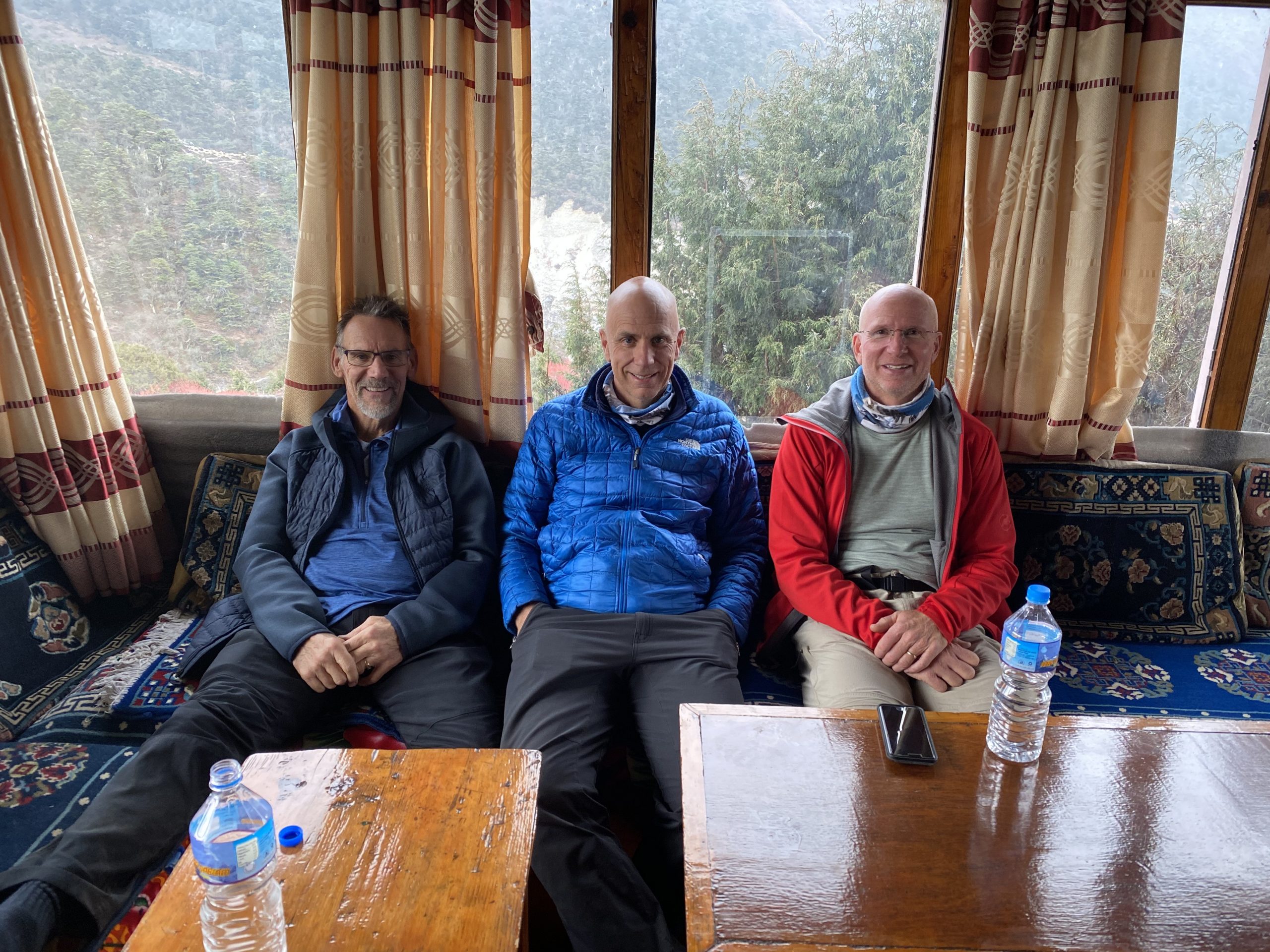
Buddy trips are a way to relax, reconnect and indulge in a little adventure. Nebraska resident Robert Kay and his buddies have been enjoying their trips for years.

“I have two friends here in Lincoln. We call ourselves the three amigos,” Kay said. “We have an adventure every year. We’ve gone to Peru, Nepal, Antarctica and other places together.”

In 2019, Kay and his friends decided to climb Ama Dablam, a 22,349-foot (6,170 m) mountain in the eastern Himalyan range in Khumbu, Nepal. Kay summitted Mount Everest in 2016, but suffered an attack of HAPE on his descent. An ascent up Ama Dablam, a smaller mountain, was equally intriguing for the group – and less dangerous.

But for Kay, altitude sickness caught up with him, again.

“We went up a little too quickly,” Kay said, explaining there’s a trend to make these expeditions faster. “Sitting around base camp acclimatizing for weeks on end is incredibly boring. I went a little too quickly,” he admitted.

Kay began his summit push from camp one at 18,372 feet (5,600 m).

“I was moving kind of slowly. At first, I thought it was just me,” he said.

The group guide concurred progress was not quick enough and recommended the team turn around.

Robert Kay 2

Kay didn’t argue.

“I take what a guide says 100 percent seriously. They are the professionals that you hired for a reason. If you don’t trust their experience and opinion, then why have them?” he said.

Kay started his descent, but he could already feel the onset of HAPE and it was happening rapidly.

“I got to the point where I had to take five or six breaths for every step,” he said.

When the team made their pre-dawn return to camp one, Kay was in rough shape. Fortunately, one of the “three amigos” was a doctor.

“He got me medicated on Dexamethasone, kept me propped up until the sun rose and warmed things up a bit,” he said.

The group continued their descent to base camp at 14,960 feet (4,560 m). “I was very slow,” Kay said.

At that point, the team leader and the doctor both agreed spending another night – even at base camp – would be risky.

“We called Global Rescue. When the helicopter showed up it was like seeing the cavalry arrive,” he said.

A Second Experience With Global Rescue

Kay’s HAPE encounters have been tough.

“When I had HAPE on Mount Everest in 2016 I had no problem thinking, or understanding what was going on,” Kay said. “I simply could not breathe. It’s like you’re trying to breathe through a garden hose. It kind of works, but not well.”

Kay successfully summitted Mount Everest that day. His altitude sickness kicked in during his descent. When he arrived at camp two at 20,997 feet (6,400 m) he contacted Global Rescue for a helicopter rescue to Kathmandu for medical intervention.

“I’m super happy with Global Rescue. You guys have saved me twice,” he said.

Kay said his two friends are Global Rescue members, too. He admits that he doesn’t understand why anyone would neglect to be a member.

“If you’re a person who’s active, who’s outdoors, who travels, it’s crazy to not have Global Rescue. The membership is so valuable compared to the potential expenses. My rescue on Mount Everest (in 2016) would have cost me about $20,000, compared to the few hundred dollars I paid for the membership,” he said.

The “three amigos” will continue to do an adventure every year. Kay admits he’ll be scaling back on the big climbs.

“My high-altitude days are behind me. I’m going to stay below 20,000 feet. That seems to be where I start getting in trouble.”

Whether you’re planning a solo expedition or an annual adventure with friends, Global Rescue travel memberships provide access to medical and security advisory and evacuation services 24/7/365. 

Share This:

How the Travel and Tourism Industry Plays a Crucial Role in Disaster Preparedness

We recently partnered with the World Travel & Tourism Council to take a deep dive into how the world of travel and tourism handles the risks associated with travel. Take a look at the highlights…

When we think of travel, we often think of checking off our bucket list, making memories, trying new foods and experiencing new cultures. We don’t want to think of the risks that may dramatically change our plans.

We trust outside sources to do that for us. But are they ready to protect us? Have they done the hard work of anticipating crisis and do they know what to do when, inevitably, it comes? Recently, Global Rescue partnered with the World Travel & Tourism Council to take a deep dive into how the world of travel and tourism handles the risks associated with travel. Some of our findings may surprise you and one thing is for sure:

In order to adequately prepare for a crisis, the travel and tourism industry must have a seat at the table in crisis preparedness, management and recovery.

In order to understand why input from the industry is so important, we first have to look at the reality of tourism in 2020—specifically, its global nature. Never before have natural disasters had such a huge impact on economies. Never before have diseases been so easily spread from country to countries.

Why?

Because travel is more global than ever. When a natural disaster occurs, travelers must often cancel or delay their travel plans. When a disease strikes a country, travelers think twice before visiting. These days, countries rely on tourism for the health of their economy and it takes a big hit if disaster strikes. The impact on a country’s wealth can be staggering.

Contributing 10.4% of global GDP, supporting 1 in 10 jobs on the planet the travel and tourism industry is a pillar of financial security around the world. Governments must bring the industry into the conversation around crisis mitigation, or risk losing billions in the event of a crisis.

Natural disasters and epidemics are just a couple examples of crises that impact tourism and therefore economies. Our study also looked at the impact of terrorism and political unrest on tourism, as well as petty theft and minor illnesses. We also recognized security and resource scarcity as increasing risks that will play a bigger role in the future.

Often, it’s simply the perceived level of safety, rather than an actual event that influences a tourist’s destination. Low probability, high impact events, such as a threat of terrorism, cause travelers the greatest angst. That’s why it’s so important for the tourism industry to help manage the reputations of destinations.

While we may not always be able to predict the nature of the next crisis – let’s be ready, together.

The value of tourism in the conversation around crisis preparedness is clear. So, what would it look like for public and private sectors to work together on this issue?

Our report proposes the public and private sector work together to prepare for crisis by building trust-based coalitions, assessing readiness and developing emergency actions plans, as well as enhancing education.

In order to do these things well, we must be responsive, accurate and transparent in our communication. Success in these areas means a stronger, more collaborative approach to crisis preparedness.

If a disaster strikes, having these systems in place will mean a shorter recovery time for the country and its economy. Supported by the travel and tourism industry, countries will have the tools to be confident in the face of crisis, will be transparent as destinations are rebuilt and will be creative as they consider new opportunities post-crisis to woo travelers back.

Our report includes several examples of countries, post-crisis, who are rebuilding, even improving their tourism industry.

If these stories, or the findings of the report resonate with your experiences, let’s connect.