Categories:
Health & SafetyTravelAugust 28, 2015
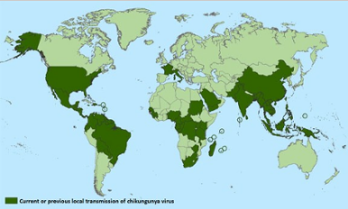
Centers for Disease Control and Prevention, March 10, 2015
If you haven’t heard of chikungunya yet, you will soon. The mosquito-transmitted disease chikungunya has made quite a few headlines recently:
–A woman in the U.S. lost vision in one eye after contracting the disease in the Caribbean.
–Mexico reported more than 3,000 cases across 16 states.
–The World Health Organization (WHO) confirmed the first locally acquired case of chikungunya in Spain.
–Nicaragua reported its first death from the disease.
What is chikungunya and can it be prevented?
Chikungunya is a painful but largely non-lethal disease that causes severe joint pain and fever. The disease is often mistaken for dengue fever, which mirrors both its symptoms and geographic distribution. Like dengue, chikungunya is spread by the Aedes family of mosquito. The disease is rarely lethal except in vulnerable populations such as the elderly, young, and immunocompromised.
For someone bitten by an infected mosquito, symptoms typically start within 4-8 days. Older patients can also be misdiagnosed as having arthritis due to joint pain being the most prominent symptom. Most patients will feel better within a week of symptoms starting. While most people recover fully from the virus, some do have lasting joint pain for months or even years after infection.
Chikungunya originated in East Africa and has spread throughout the continent and to South and Southeast Asia. In the past year, the virus has spread rapidly throughout the Caribbean and into Latin America. Isolated cases of the virus have also been reported in Europe and North America after travelers returned from endemic areas. In recent months, there has been an uptick in cases in southern states, including Florida. As of February 2015, there were at least 1.24 million cases of chikungunya in the Americas.[1]
While progress is being made, there is currently no vaccine or cure for chikungunya. Treatments for the disease focus on decreasing symptoms with fluids and anti-inflammatories such as ibuprofen or acetaminophen to reduce fever and pain.
The best way to prevent infection? Avoid mosquito bites altogether, sincemosquitoes are the primary means of transmission.
To help avoid mosquito bites:
–Make sure that any open doors or windows have fully intact screens.
–Use bug spray. When going outside, wear bug repellent such as DEET or Permethrin.
–Wear long sleeves and pants to make it difficult for mosquitoes to bite you.
–Reduce the breeding grounds of mosquitoes in and near your home by getting rid of any standing water in areas like pools, gutters, or flower pots.
–If you become infected, continue to avoid contact with mosquitoes to reduce the spread of the disease.
While the headlines about chikungunya will likely continue, following these precautionary steps can help ensure that you don’t become infected.
For more information, review the CDC Fact Sheet. Contact Global Rescue Operations with any questions at 617-459-4200 or operations@globalrescue.com.
[1] From MedPage Today
August 21, 2015
This year’s devastating earthquake in Nepal understandably has raised concerns for people planning to travel to the region. The tragedy – and the possibility of another quake – is on the minds of those thinking of heading to Nepal for the fall trekking season.
Global Rescue Operations personnel regularly field a variety of questions from our members, including the recent inquiry below about upcoming travel to Nepal. Our team responded with advice which may be of interest to other like-minded Global Rescue members.
Q. I’m planning to travel to Nepal and have a few questions about earthquake safety. There have been several articles about another large earthquake hitting western Nepal. I will be in Kathmandu soon and then planning a trek to the Annapurna Base Camp. The area has been cleared as “safe” for trekking, but I’m worried about another earthquake.
Do you have information or advice about earthquake safety and the situation in Nepal? I don’t want to cancel my plans, but I also want to stay safe.
A. Earthquakes cannot be predicted with certainty by modern day science. Four quakes above magnitude 6 have occurred in the region in the past century, according to the U.S. Geological Survey (USGS). The next quake is impossible to predict.
Global Rescue suggests the following for travel to Nepal:
–Take with you any equipment you may need to survive should you not be able to depend on local resources in the event of infrastructure collapse during a disaster (e.g., water purification, fire ignition devices, flashlights, etc.).
–If you are staying in hotels, try to stay in lower rise buildings and close to the bottom floor. Evaluate the outside of the building for structural damage that may have occurred from the last quake to determine the risk of collapse should there be another quake. The number one hazard in an earthquake is falling debris and collapsing buildings.
–You should shelter in-place under a piece of sturdy furniture in the event of an earthquake, according to current protective measures.
–Always have a go-bag packed with essential survival equipment in case you need to leave in a hurry.
–Be sure that you have a method of two-way communication (e.g., satellite phone, satellite hotspot such as Iridium GO, etc.) in the event of an emergency. These types of devices are also good in a large disaster as you will not be able to depend on the local communication infrastructure.
Wherever you travel, the Global Rescue Mobile App can help you stay safe, informed and connected. Free for Global Rescue members, the app provides critical medical, security and other essential travel intelligence. In an emergency, the app puts Global Rescue members in immediate contact with our medical and security teams. The Global Rescue Mobile App is now available on the App Store, Google Play, and BlackBerry App World.
Before you head off on your travels, consider a Global Rescue securitymembership, which includes security evacuation in the event of a crisis such as an earthquake. For more information, contact Global Rescue Member Services at memberservices@globalrescue.com or 617-459-4200.
Categories:
NewsAugust 7, 2015
Categories:
Health & SafetySecurity & IntelligenceTravelAugust 5, 2015

With increased security threats around the world, many parents of study abroad students may be concerned about their child’s safety. Cities typically considered “safe” are now under greater scrutiny. While studying abroad, the unexpected can occur, just as it can at home. Unfamiliar surroundings can magnify the distress and confusion.
To stay safe while traveling abroad, students must take time in advance to be as prepared as possible, ensure a reliable means of communicating in an emergency, and be proactive in keeping informed and maintaining awareness at all times.
Preparedness
Before departure, parents and students should study the areas where the student will be traveling. Learn a basic layout of the area and the major landmarks. Your student should enroll in the State Department’s STEP program to receive alerts on developing situations.
Global Rescue members can use GRIDSM, our travel intelligence system, to obtain detailed Destination Reports to help assess safety. We offer detailed information on over 200 countries, including health and security risk assessments, entry and exit requirements, exchange rates, important phone numbers, weather conditions and other essential information.
Strongly consider adding a Global Rescue security membership. By upgrading a medical-only membership to a medical and security membership, members have access to advice from our in-house security teams, which includes former military Special Forces personnel. In the event of threats to your student’s safety which could result in bodily harm, or if there is a government order to evacuate, Global Rescue will extract the student to safety.
Parents should ensure that their own passports are up-to-date and that any necessary visas are secured. In the event of an emergency, it is wise to be prepared to travel on short notice.
Communication
Be sure your student has the ability to call for help, knows how to call for help, and knows where to go for help. Outside of the U.S., dialing “911” does not work. It is critical to know what number to call for emergency medical services, and know how to dial that local number based on international calling configurations. Students should keep emergency contact information with them at all times. Students who are members of Global Rescue are able to access our operations centers for medical and security support 24/7/365.
Consider purchasing a cheap local prepaid phone which includes international capabilities. With this type of phone, you know that you have something in place as back up.
If your student is bringing his or her own phone, be sure that it works locally. Contact your provider in advance to verify areas of coverage. Upon arrival, test the phone: call, text, and email home. It is imperative to do this before any emergency situation.
Consider bringing an extra battery or portable charger for the phone or, with a smart phone, buying a battery phone case that will extend the phone’s battery life to avoid being caught with no way to communicate in an emergency.
The Global Rescue mobile app offers emergency notification, a one-touch emergency button that instantly alerts Global Rescue’s operations teams that a traveler is in distress. The app offers status and location updates which allow the traveler to indicate that he or she is okay by “checking-in” using a smartphone, and to transmit GPS coordinates to the Global Rescue operations teams and anyone else designated.
Imagine that your student is in Guatemala when an earthquake occurs. Reducing reaction time can make all the difference. With GPS, it could be as little as a few minutes before you have your child’s location details and can send help. Without GPS and without any other means of communication, reaction time could stretch to hours or days until a specific location can be determined.
Finally, consider purchasing or renting a satellite phone. For most any scenario – a storm, natural disaster, or a government shut-down of cell networks – your student will be prepared. Cellular networks may be the first to crash and/or become overloaded in an emergency or disaster situation. In these situations, satellite networks are much more reliable.
Awareness
Students traveling abroad should exercise caution when sharing personal details. Discussing plans could lead to becoming a target for criminals. Advise students to trust their instincts and leave as soon as possible if they begin to feel uneasy in a situation. Avoid large crowds or environments that could quickly turn violent, such as political protests. If a student notices someone following them, stay on a well-traveled street and find the nearest safe place within reach. Criminals seek out weak targets so it is best to prevent the appearance of vulnerablity.
Whether it is a natural disaster, political instability, or a personal injury, Global Rescue is experienced in responding to crises. In 2011, Egypt’s civil unrest prompted corporations and colleges to turn to Global Rescue and its highly trained former special operations personnel to evacuate students there.
If you have concerns about your student’s safety or if a crisis does occur, contact Global Rescue immediately at 617-459-4200 or operations@globalrescue.com.
Categories:
NewsAugust 5, 2015
Categories:
NewsAugust 1, 2015
Categories:
NewsAugust 1, 2015
Categories:
Press ReleaseJuly 27, 2015
Boston, Mass., July 27, 2015 – As threats to global travelers increase in countries throughout the world, Global Rescue has developed an app to help keep travelers safe and support enterprises in meeting their legal Duty of Care responsibilities. The Global Rescue app puts critical medical, security and other essential real-time travel intelligence at travelers’ fingertips. In an emergency, the app also puts travelers in immediate contact with Global Rescue’s medical and security teams which are comprised of the paramedics, physicians and military special operations veterans who staff the company’s global operations centers.
“The need for real-time travel intelligence and crisis response services has never been greater,” said Dan Richards, CEO and founder of Global Rescue. “To stay safe while traveling abroad, travelers must have immediate access to critical information and a system that can be tailored to efficiently deliver that information. Mobile applications have also become an important asset for enterprises seeking to meet their Duty of Care responsibilities and our new app provides a combination of functionality and services currently unavailable anywhere else in the marketplace.”
Travelers are increasingly relying on mobile devices for updates during their travels. According to a recent survey by TripAdvisor, more than 87% of the 30,000 people surveyed reported using a smart phone while on their trips.
While many organizations recommend that travelers download applications that provide personal travel details such as airline or hotel booking applications, many travelers lack immediate access to travel intelligence information or communication capabilities that may be life-saving in the event of a medical or security emergency.
Global Rescue mobile app features include:
-
Destination Reports – Detailed information on over 200 countries, including: health and security risk assessments, entry and exit requirements, exchange rates, important phone numbers, weather conditions and other essential information. Travelers can access recent regional events, compiled by Global Rescue’s in-house intelligence analysts.
-
Real-time Alerts – Travelers can review real-time alerts delivering critical information on locations of interest. Global Rescue enterprise clients can configure their alerts by event severity, category and destination and immediately know which travelers are impacted.
-
Status and Location Updates – Travelers are able to indicate that they’re okay or in need of assistance by “checking-in” by using their mobile device to transmit their message with their GPS coordinates to Global Rescue’s operations centers and those they designate.
-
In-App Text Messaging – Secure two-way text messaging with Global Rescue’s operations professionals who are standing by 24/7 to answer travelers’ questions.
-
Emergency Notification – A one-touch emergency button that immediately alerts Global Rescue’s operations teams that a traveler is in distress with the GPS coordinates of the traveler’s location.
The Global Rescue app is designed for iOS (iOS 5 and above), Android (4.4 and above) and BlackBerry 10.2 and above) platforms. The app is now available on the App Store, Google Play, and BlackBerry App World.
For more information on the Global Rescue app or on the company’s services, call +1-617-459-4200 or visit www.globalrescue.com.
About Global Rescue
Global Rescue is a worldwide provider of integrated medical, security, intelligence, travel risk management and crisis response services to corporations, governments and individuals. Founded in partnership with Johns Hopkins Medicine, Global Rescue’s unique operational model provides best-in-class services that identify, monitor and respond to potential threats. Global Rescue has provided medical and security support to clients during every globally significant crisis of the last decade. Memberships start at $119 and entitle members to rescue and transport services to their home hospital of choice.
For more information, call +1-617-459-4200 or visit www.globalrescue.com.
Categories:
NewsJuly 23, 2015
Categories:
NewsJuly 11, 2015
Categories:
Missions & Member TestimonialsJuly 10, 2015
In a July 6th USA Today article, travel columnist Everett Potter explored common myths about medical evacuations. Is medical evacuation really just another name for travel insurance? Do credit cards offer the same type of coverage as medical evacuation? In Potter’s latest column, Global Rescue CEO Dan Richards debunks these myths with the real facts about medical evacuations. Read the article, here.