Categories:
Missions & Member TestimonialsMay 13, 2014
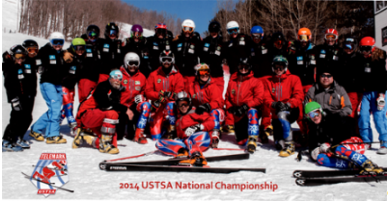
Global Rescue is proud to support the United States Telemark Ski Association, a non-profit that aims to promote the sport of telemark skiing through both educational sessions and competitions. Recently, USTSA president Joshua Patrick Lanzetta wrote Global Rescue a letter of thanks for a successful collaboration this season:
Thank you for supporting USTSA and our athletes during the 2013-2014 ski season. We hope that you enjoy the enclosed team photo, taken last month during USTSA’s National Championships, held at Bromley Mountain Resort in Peru, Vermont.
The U.S. Telemark Ski Team had an excellent competitive season this year. In total, 11 of our team members competed in FIS World Cup events, including 4 World Cup races hosted by USTSA and the Steamboat Springs Winter Sports Club in Steamboat Springs, Colorado. Our highlights include:
- Tanner Visnick’s Bronze medal at Junior World Championships and 9th place finish at World Championships;
- Madi McKinstry’s 5th place World Cup finish;
- 4 athletes with top 20 World Cup finishes.
Additionally, we hosted a few excellent domestic races this season helping us secure new members and create partnerships with new venues in the Northeast. Ultimately, our season culminated in a closely contested National Championships, with Cory Snyder and Madi McKinstry winning the 2014 titles. We are excited about this year’s results, as both champions are under the age of 22 and show huge potential to develop into successful World Cup athletes!
Again, a heartfelt thank-you for supporting USTSA this year. We look forward to working with you next season.
Sincerely,
Joshua Patrick Lanzetta
President
Global Rescue is honored to work with such talented athletes and looks forward to the 2014-2015 season!
Categories:
Missions & Member TestimonialsMay 2, 2014
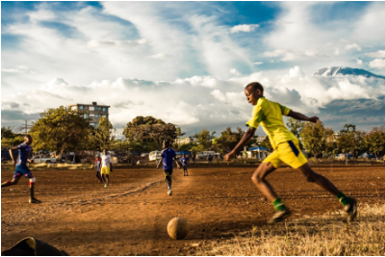
“Global Rescue Member in Action” April Mayhew submitted this “Ballers of Moshi-Town, Tanzania” image to our photo contest. Read about her trip to Mt. Kilimanjaro, her surprise encounter with the scenery and natives, and her game of soccer with the boys.
“I shot this picture in Moshi, Tanzania, while walking along the abandoned train tracks with a group of clients that had just arrived in country and were preparing to begin climbing Mt. Kilimanjaro the following day. We passed by the field, and I looked back to watch the boys play. Mt. Kilimanjaro had just appeared through the clouds (the backdrop), and the clients oohed and awed their delight bedside me.
“This game was the first in which the ‘Ballers of Moshi-town’ were wearing proper jerseys. To my surprise, the shadows and clouds captures the overall busyness of the moment, and I was able to fit in details like the old rubber tires lining the field and Kilimanjaro in the distance.
“This photo captures the movement and light while showcasing some of the exquisite qualities of one of my favorite places in the world.
“Once during a walk, the Ballers invited me to join them. I’m not sure what surprised me more: that my skills hadn’t withstood the test of time, or that the boys could truly dribble a ball up one side of me and down the other.”
Do you have a great story to share about your travels? We want to hear about it! If you (or someone you know) would like to be considered as a “Global Rescue Member in Action,” tell us why in an email to press@globalrescue.com.
Categories:
Health & SafetyTravelApril 25, 2014
April 25 is World Malaria Day. Malaria is caused by a bite from a parasite-infected mosquito. Malaria symptoms can include fever, chills, sweats, body aches and muscle pain. Fever that goes away and comes back is fairly common. Nausea, vomiting, abdominal pain, backache and dark urine are also possible symptoms. More severe forms involving altered mental status and organ dysfunction typically require hospitalization. Left untreated, malaria can be fatal.
In 2019, nearly half of the world’s population was at risk of malaria. Most malaria cases and deaths occur in sub-Saharan Africa, but the regions of Southeast Asia, Eastern Mediterranean, Western Pacific and the Americas are also at risk. Six countries accounted for approximately half of all malaria deaths worldwide: Nigeria (23%), the Democratic Republic of the Congo (11%), United Republic of Tanzania (5%), Burkina Faso (4%), Mozambique (4%) and Niger (4%).
Malaria cases have been on the decline globally — 238 million in 2000 to 229 million in 2019 — but a study from the London School of Hygiene & Tropical Medicine found climate change is having an impact on mosquito-borne diseases, like dengue and malaria. An estimated 8.4 billion people could be at risk from dengue and malaria by the end of the century as the world gets warmer and more urbanized.
Dr. Phil Seidenberg, who spent five years living and working in Zambia as Global Rescue’s African Regional Medical Director, has treated many malaria patients in the course of his career. Seidenberg answers six common questions travelers may have about the risks, prevention and treatment of malaria.
How do I know if malaria is an issue where I’m traveling?
For updated information on countries with malaria, use the resources available through either the Center for Disease Control (CDC) or the World Health Organization (WHO). Both of these organizations have maps with malaria risk levels indicated by country and regions within countries. Global Rescue members can contact Global Rescue for specific malaria advice.
Travelers headed to Africa should be aware that, while progress has been made in controlling malaria on the continent, an estimated 94% of deaths from malaria in 2019 were in the African Region. The population in this region increased from about 665 million in 2000 to 1.1 billion in 2019 and disease transmission interpretation has become more complex.
It is important to consider the time of year of your travel. If a country has malaria, there is usually some seasonality to it. Typically malaria follows the rainy season, and is particularly active in the middle to the late part of the rainy season when water is pooling in areas as standing water allows malaria-carrying mosquito larva to populate.
Who are the people greatest at risk?
Anyone who is not native to an area faces an increased susceptibility to malaria. There is a level of tolerance that develops over time in those who are born and live in areas with malaria. Global statistics show 67% of people who die from malaria are kids under 5 years old. If you are thinking of bringing kids along to areas with malaria, it is not a definite no-no but it is something to weigh carefully. The elderly and pregnant women are also at-risk populations.
If I go to a malarial area, should I take medication?
There are anti-malarial prophylactic medications (preventative therapies) that one can take. It is important to note, however, that none of these treatments is 100 percent effective. You should seek advice from your regular healthcare provider, or a provider experienced in travel medicine to help decide which of these medications might be best for your individual health profile.
The primary recommendation I usually give is to choose a simple option such as Doxycycline, which is available everywhere. It needs to be taken only one to two days prior to travel, and the dose is just 100 milligrams once a day. It is contraindicated for kids younger than 8 and not a first choice medication for pregnant women. The major side effect with its use is sun sensitivity. It causes a small number of people to burn really quickly and often the locations with malaria are sunny and tropical.
Malarone is another great option. It is a very good, safe medication and very well-tolerated, although a little bit more difficult to find outside of travel clinics. Malarone is taken daily, and needs to be started only one to two days before travel. Side effects are minimal. Importantly, Malarone consists of a two-drug punch that greatly reduces the chance of contracting a resistant malarial strain. This medication cannot be used by pregnant women. Malarone is more expensive than the other options, and since it is taken daily, cost could be a factor for some, especially on longer trips.
Are there other steps I can take to help prevent malaria?
Definitely. Take precautions such as wearing long sleeves, using DEET insect repellants to ward off mosquitoes, and sleeping under netting. Most countries typically have mosquito nets in stores and even supermarkets, but if you’re concerned that you won’t be able to find them, it is a good idea to buy them in advance. The insecticide treated nets are really the ones to use. People sometimes pre-treat their clothing, too.
It is important to know that the two peaks for malaria transmission are right at dusk and then right before sunrise. These are times when the mosquitoes are a little bit more active and more people are in contact with active mosquitoes, which is probably why transmission occurs most frequently between those two periods. Be especially cautious at these times.
What do I do if I’m traveling and think I may have malaria?
The first step is to determine if you have malaria. In most African capital cities, you can go into almost any pharmacy and pick up a blood test called a Rapid Diagnostic Test (RDT). It involves a simple finger prick, a few drops of blood, and a 15-minute wait for results. RDTs are part of the reason that malaria is under control, because we are no longer indiscriminately treating kids and people with non-malaria related fevers. Be cautious about the expiration dates, however, and do not buy anything that has expired.
Another option is to go to a clinic. Almost any clinic operating in malarial countries will be able to do a very quick blood smear or a Rapid Diagnostics Test, too. The RDTs are no different for kids versus adults.
What do you do if you have malaria?
Most hospitals in malarial countries are more than capable of diagnosing and treating malaria. For treatment, the WHO recommends Artemisinin Combination Therapy, or ACT. However, do not assume that ACT is necessarily what you will receive. Absolutely ask for ACT by name. Most health care providers should know what that means, even though there are different trade names in some parts of the world.
It is worth knowing that for almost all simple malaria, even complicated malaria, artemisinin compounds are the ones to use. Those that only have single artemisinin are, over time, quite bad for our malaria treatment options because the parasite develops resistance early. Emerging artemisinin resistance is a major concern in certain areas of the world.) The combination therapy hits the parasite with two active medications working against it.
For severe malaria, usually defined by altered mental status or organ dysfunction, in some places they are starting to do artemisinin IV drips. This approach has been shown to be better than good old quinine, which still is effective. But typically if someone were hospitalized with severe malaria, quinine versus artesunate are the only real options for treatment.
What should I look out for when I return home?
About 2,000 cases of malaria are diagnosed in the United States annually, mostly in returned travelers. It is extremely important to be vigilant upon returning home. It is extremely important to be vigilant upon returning home.
First, if travelers are taking a prophylactic that requires them to continue to take it for a few weeks afterwards, they must make sure to do that.
Second, and even more dangerous in my view, is that it is hard to get malaria diagnosed in the States unless someone really thinks about it. In fact, this happened to friends of mine when they came back with their kids from Africa. It is an easy thing for a lab to take a look at a blood smear under with a microscope, but when medical professionals don’t ever see malaria that often, they’re not going to think about it. So, if someone comes back, gets sick and they’re worried about malaria, they need to really be careful that they tell whoever is seeing them, “By the way, I was in Haiti. Can you check me for malaria?” It could be a couple of months before travelers should consider themselves no longer at risk after returning home.
Categories:
NewsApril 23, 2014
Categories:
Missions & Member TestimonialsApril 18, 2014
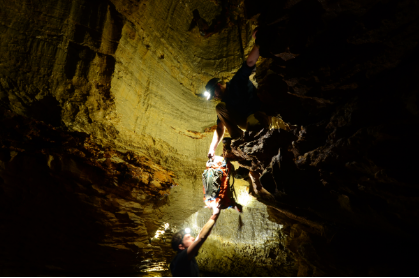
The next featured adventurer in our “Global Rescue Members in Action” series is Josh Aldridge, who was captured in an inspiring moment of teamwork during a climb in an Arkansas cave. Josh, a finalist in Global Rescue’s “In the Spirit of Adventure” photo contest, shares some background on his experience:
“The photo was taken in Eden Falls Cave in Arkansas’ Lost Valley. We were climbing behind the interior falls, searching for a route up to an unexplored, offshoot tunnel. The rich gold light comes from headlamps and flashlights placed in and reflecting from the wet rock.”
Do you have a great story to share about your travels? We want to hear about it! If you (or someone you know) would like to be considered as a “Global Rescue Member in Action,” tell us why in an email to press@globalrescue.com.
Categories:
Press ReleaseApril 16, 2014
Boston, Mass. – For the fourth consecutive year, executives from Global Rescue, a worldwide provider of integrated medical, security, transport, intelligence and crisis response services for corporations, governments and individuals, will participate in the Risk Management Society (RIMS) Annual Conference. The 2014 event is slated for April 27-30 in Denver, Colorado.
Global Rescue will showcase the latest developments in its industry-leading travel risk and crisis management SaaS offering, GRID. Company executives will be at booth #550 to offer RIMS attendees a preview of significant new features in GRID’s latest software, release 2.0.
RIMS is the preeminent organization dedicated to advancing the practice of risk management. Founded in 1950, the global not-for-profit organization has a membership of more than 11,000 risk management professionals who are located in more than 60 countries.
Session topics at RIMS 2014 include Enterprise Risk Management, Global Risk Management, Risk Control, and Strategic Risk Management. For more details on Global Rescue or GRID 2.0, visit www.globalrescue.com or call +1-617-459-4200.
About Global Rescue
Global Rescue is a worldwide provider of integrated medical, security, intelligence, travel risk management and crisis response services to corporations, governments and individuals. Founded in partnership with Johns Hopkins Medicine, Global Rescue’s unique operational model provides best-in-class services that identify, monitor and respond to potential threats. Global Rescue has provided medical and security support to clients during every globally significant crisis of the last decade. Memberships start at $119 and entitle members to rescue and transport services to their home hospital of choice.
For more information, call +1-617-459-4200 or visit www.globalrescue.com.
Categories:
Press ReleaseApril 14, 2014
Boston, Mass. — Daniel L. Richards, founder and CEO of Boston-based crisis response firm Global Rescue, will present at the upcoming University Risk Management and Insurance Association Northeastern Regional Conference. The conference will be held at the Babson Executive Center, Babson Park, Mass., on April 22, 2014.
The mission of URMIA is to advance the discipline of risk management in higher education. URMIA’s vision is to be the preeminent source of innovative and effective risk management ideas and solutions to the challenges facing institutions of higher education in their pursuit of academic, social, and economic goals.
In “Mass Evacuations: Pre-planning Your Safety,” Richards will draw from the experiences of Global Rescue, a worldwide provider of integrated medical, security, transport, intelligence and crisis response services for corporations, governments and individuals. The presentation will highlight the company’s involvement in the 2011 Egyptian uprising, managing the evacuation of students studying abroad. Richards will address the major challenges with large-scale evacuations and the importance of proactively pre-planning in case disaster strikes. The session will highlight the duty of care educational institutions have to provide their students, faculty and staff with the necessary information and resources to ensure their health, safety, and security. The discussion will also include an analysis of the Hotchkiss case in which a student was awarded $42 million as a result of the failure of her school to meet its duty of care obligations.
Joining Richards in presenting will be Jeffrey Cason, dean of international programs, Middlebury College.
To learn more about Global Rescue and its integrated crisis response services, visit www.globalrescue.com or call 617-459-4200.
About URMIA
The University Risk Management and Insurance Association (URMIA) is an international non-profit educational association serving colleges and universities. Its core purpose is to promote the advancement and application of effective risk management principles and practices in institutions of higher education. URMIA represents over 2,100 individuals at 570 institutions of higher education and over 100 companies with members ranging from small schools and community colleges to the largest educational institutions. The URMIA National Office is in Bloomington, Indiana, at Indiana University. For more information, visit www.urmia.org or call 812-855-6683.
About Global Rescue
Global Rescue is a worldwide provider of integrated medical, security, intelligence, travel risk management and crisis response services to corporations, governments and individuals. Founded in partnership with Johns Hopkins Medicine, Global Rescue’s unique operational model provides best-in-class services that identify, monitor and respond to potential threats. Global Rescue has provided medical and security support to clients during every globally significant crisis of the last decade. Memberships start at $119 and entitle members to rescue and transport services to their home hospital of choice.
For more information, call +1-617-459-4200 or visit www.globalrescue.com.
Categories:
Missions & Member TestimonialsApril 11, 2014
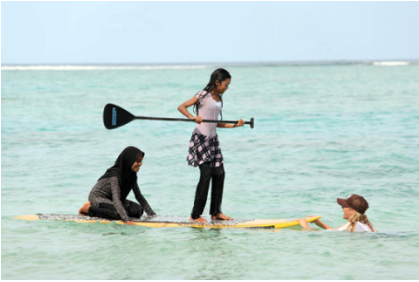
This week’s “Global Rescue Members in Action” entry is an empowering photo submitted by Mary Osborne from her trip to the Maldives. Read about the moment of triumph she shared with her spontaneous surfing students:
“This photo was taken off the coast of a small island in the Maldives. I was paddling around the island at sunset when I came across this group of ladies swimming. They kept staring at me and I was very curious. In the Maldives you typically don’t see the women out and about much so this was one of the first times I saw women swimming in the ocean. I slowly paddled over to them and waved for them to try the paddle board. Due to the language barrier, there were no words exchanged, only smiles and laughter. As a professional surfer, I have been fortunate enough to travel around the world documenting various adventures, however this image is one of my personal favorites. When I look at this picture, it reflects the innocence and freedom for all women in the Maldives.”
Categories:
Missions & Member TestimonialsApril 7, 2014

Global Rescue is honored to announce that it has been selected by the Wilderness Medical Society as its official medical and security evacuation provider.
Founded in 1983, the Wilderness Medical Society (WMS) is the world’s leading organization devoted to wilderness medical issues and challenges, exploring health risks and safety issues in extreme situations such as mountains, jungles, deserts, caves, marine environments, and space.
WMS CEO Loren Greenway, Ph.D., noted, “Over the years, the Wilderness Medical Society and its membership have had experience with Global Rescue and the breadth and depth of their capabilities. I’m happy that this agreement has come to pass.”
“The Wilderness Medical Society is the worldwide authority on wilderness medicine,” said Global Rescue CEO Dan Richards. “We believe our partnership is an outstanding fit.”
Global Rescue will participate in the Wilderness Medicine Conference and Annual Meeting in Wyoming this summer, August 1-6.
Categories:
Press ReleaseApril 7, 2014
Lebanon, New Hampshire – Global Rescue, a worldwide provider of integrated medical, security, intelligence, travel risk management and crisis response services to corporations, governments and individuals, today announced its selection as the official medical and security evacuation provider for the Wilderness Medical Society.
Founded in 1983, the Wilderness Medical Society (WMS) is the world’s leading organization devoted to wilderness medical issues and challenges, exploring health risks and safety issues in extreme situations such as mountains, jungles, deserts, caves, marine environments, and space. With a long-standing commitment to education and research, the Society covers wilderness medicine topics including expedition and disaster medicine, dive medicine, search and rescue, altitude illness, cold- and heat-related illness, wilderness trauma, and wild animal attacks.
“The Wilderness Medical Society selected Global Rescue as our official medical and security evacuation services provider for all our adventure travelers,” said Loren Greenway, PhD, CEO of WMS. “Over the years, the Wilderness Medical Society and its membership have had experience with Global Rescue and the breadth and depth of their capabilities. I’m happy that this agreement has come to pass.”
“The Wilderness Medical Society is the worldwide authority on wilderness medicine,” said Global Rescue CEO Dan Richards. “We believe our partnership is an outstanding fit.”
Global Rescue will participate in the Wilderness Medicine Conference & Annual Meeting in Jackson Hole, Wyoming, August 1-6, 2014.
About Wilderness Medical Society
The Wilderness Medical Society (WMS) was founded in 1983 by physicians for physicians and allied health professionals. The WMS is the world’s leading organization devoted to wilderness medical issues and their challenges. The Society supports research and outreach with its many programs. Yearly Research Grants are funded by the Society and awarded to young investigators at the Annual Meeting. The WMS encourages community involvement and public service, mentoring, and recruiting medical students by way of our many active Student Interest Groups.
About Global Rescue
Global Rescue is a worldwide provider of integrated medical, security, intelligence, travel risk management and crisis response services to corporations, governments and individuals. Founded in partnership with Johns Hopkins Medicine, Global Rescue’s unique operational model provides best-in-class services that identify, monitor and respond to potential threats. Global Rescue has provided medical and security support to clients during every globally significant crisis of the last decade. Memberships start at $119 and entitle members to rescue and transport services to their home hospital of choice.
For more information, call +1-617-459-4200 or visit www.globalrescue.com.
Categories:
Missions & Member TestimonialsApril 4, 2014
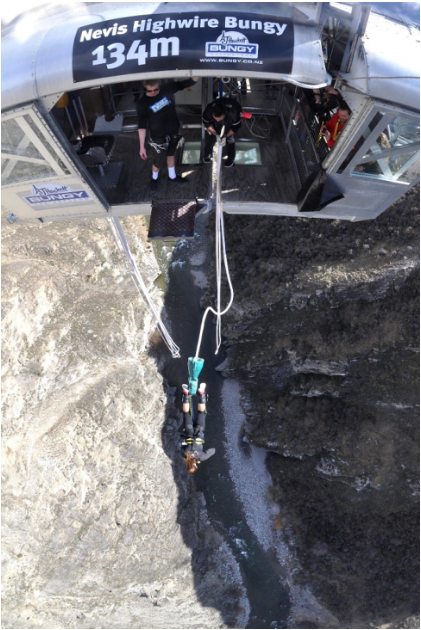
Fourteen-year-old and national champion alpine athlete Storm Klomhaus welcomed a different kind of challenge and traded in snow for sky in this week’s entry of “Global Rescue Members in Action.” While training in New Zealand with the U.S. Ski and Snowboard Association Team Academy, Storm took a jump of over 100 meters and proved that with courage and a spirit of adventure, almost anything is possible. Read on for supportive words from parent Jaime Klomhaus.
“The picture is of our daughter, Storm Klomhaus. At the U16 Rocky/Central Junior Championships in Steamboat Springs, Colorado, Storm won all four alpine ski races and received first place overall. She recently competed in the U16 National Championships in Park City, Utah.
“Storm was one of 12 alpine athletes invited to the newly formed USSA Team Academy two years ago based upon her performance in the National Championships in 2012. We moved Storm away from home at 13 years old to live with a host family in Park City, Utah, in August 2012. She attends a private high school formed to provide academic and athletic opportunities for up-and-coming skiing and snowboarding athletes. The kids travel all over the world to train and Storm travelled to New Zealand in August 2013 for a ski camp.
“While in New Zealand, the kids took a day off from training to go bungee jumping in Queenstown. This is a picture of her jumping out of a cable car for a 134 meter plunge at 14 years of age. She said it was terrifying to jump but, after the initial shock, she had a blast.
“Storm travels all over the world in her pursuit to become a World Cup skier. Needless to say, Storm has a yearly membership with Global Rescue to help make mom and dad more comfortable with her activities abroad.”
Do you have a great story to share about your travels? We want to hear about it! If you (or someone you know) would like to be considered as a “Global Rescue Member in Action,” tell us why in an email to press@globalrescue.com.