Categories:
Missions & Member TestimonialsApril 7, 2014

Global Rescue is honored to announce that it has been selected by the Wilderness Medical Society as its official medical and security evacuation provider.
Founded in 1983, the Wilderness Medical Society (WMS) is the world’s leading organization devoted to wilderness medical issues and challenges, exploring health risks and safety issues in extreme situations such as mountains, jungles, deserts, caves, marine environments, and space.
WMS CEO Loren Greenway, Ph.D., noted, “Over the years, the Wilderness Medical Society and its membership have had experience with Global Rescue and the breadth and depth of their capabilities. I’m happy that this agreement has come to pass.”
“The Wilderness Medical Society is the worldwide authority on wilderness medicine,” said Global Rescue CEO Dan Richards. “We believe our partnership is an outstanding fit.”
Global Rescue will participate in the Wilderness Medicine Conference and Annual Meeting in Wyoming this summer, August 1-6.
Categories:
Press ReleaseApril 7, 2014
Lebanon, New Hampshire – Global Rescue, a worldwide provider of integrated medical, security, intelligence, travel risk management and crisis response services to corporations, governments and individuals, today announced its selection as the official medical and security evacuation provider for the Wilderness Medical Society.
Founded in 1983, the Wilderness Medical Society (WMS) is the world’s leading organization devoted to wilderness medical issues and challenges, exploring health risks and safety issues in extreme situations such as mountains, jungles, deserts, caves, marine environments, and space. With a long-standing commitment to education and research, the Society covers wilderness medicine topics including expedition and disaster medicine, dive medicine, search and rescue, altitude illness, cold- and heat-related illness, wilderness trauma, and wild animal attacks.
“The Wilderness Medical Society selected Global Rescue as our official medical and security evacuation services provider for all our adventure travelers,” said Loren Greenway, PhD, CEO of WMS. “Over the years, the Wilderness Medical Society and its membership have had experience with Global Rescue and the breadth and depth of their capabilities. I’m happy that this agreement has come to pass.”
“The Wilderness Medical Society is the worldwide authority on wilderness medicine,” said Global Rescue CEO Dan Richards. “We believe our partnership is an outstanding fit.”
Global Rescue will participate in the Wilderness Medicine Conference & Annual Meeting in Jackson Hole, Wyoming, August 1-6, 2014.
About Wilderness Medical Society
The Wilderness Medical Society (WMS) was founded in 1983 by physicians for physicians and allied health professionals. The WMS is the world’s leading organization devoted to wilderness medical issues and their challenges. The Society supports research and outreach with its many programs. Yearly Research Grants are funded by the Society and awarded to young investigators at the Annual Meeting. The WMS encourages community involvement and public service, mentoring, and recruiting medical students by way of our many active Student Interest Groups.
About Global Rescue
Global Rescue is a worldwide provider of integrated medical, security, intelligence, travel risk management and crisis response services to corporations, governments and individuals. Founded in partnership with Johns Hopkins Medicine, Global Rescue’s unique operational model provides best-in-class services that identify, monitor and respond to potential threats. Global Rescue has provided medical and security support to clients during every globally significant crisis of the last decade. Memberships start at $119 and entitle members to rescue and transport services to their home hospital of choice.
For more information, call +1-617-459-4200 or visit www.globalrescue.com.
Categories:
Missions & Member TestimonialsApril 4, 2014
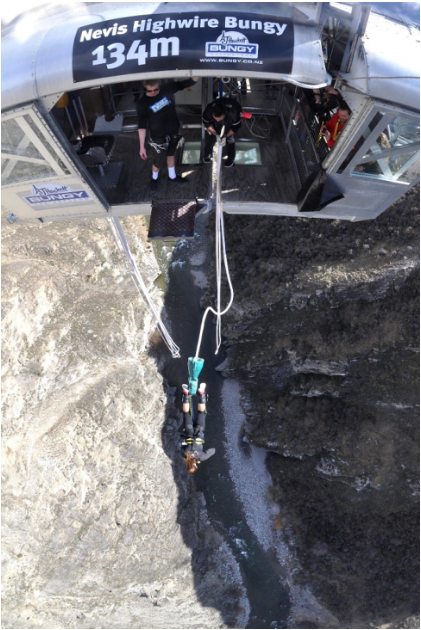
Fourteen-year-old and national champion alpine athlete Storm Klomhaus welcomed a different kind of challenge and traded in snow for sky in this week’s entry of “Global Rescue Members in Action.” While training in New Zealand with the U.S. Ski and Snowboard Association Team Academy, Storm took a jump of over 100 meters and proved that with courage and a spirit of adventure, almost anything is possible. Read on for supportive words from parent Jaime Klomhaus.
“The picture is of our daughter, Storm Klomhaus. At the U16 Rocky/Central Junior Championships in Steamboat Springs, Colorado, Storm won all four alpine ski races and received first place overall. She recently competed in the U16 National Championships in Park City, Utah.
“Storm was one of 12 alpine athletes invited to the newly formed USSA Team Academy two years ago based upon her performance in the National Championships in 2012. We moved Storm away from home at 13 years old to live with a host family in Park City, Utah, in August 2012. She attends a private high school formed to provide academic and athletic opportunities for up-and-coming skiing and snowboarding athletes. The kids travel all over the world to train and Storm travelled to New Zealand in August 2013 for a ski camp.
“While in New Zealand, the kids took a day off from training to go bungee jumping in Queenstown. This is a picture of her jumping out of a cable car for a 134 meter plunge at 14 years of age. She said it was terrifying to jump but, after the initial shock, she had a blast.
“Storm travels all over the world in her pursuit to become a World Cup skier. Needless to say, Storm has a yearly membership with Global Rescue to help make mom and dad more comfortable with her activities abroad.”
Do you have a great story to share about your travels? We want to hear about it! If you (or someone you know) would like to be considered as a “Global Rescue Member in Action,” tell us why in an email to press@globalrescue.com.
Categories:
NewsMarch 31, 2014
Categories:
Missions & Member TestimonialsMarch 28, 2014
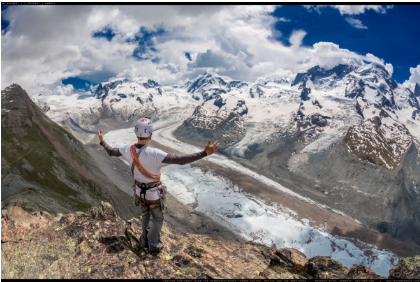
Next up in our “Global Rescue Members in Action” series is “In the Spirit of Adventure” photo contest finalist Brandon Riza, who travelled to the Pennine Alps of Switzerland. Brandon’s testimonial about this trip to the top of the world and the snowy sky landscape follows below. Congratulations, Brandon. Global Rescue hopes to accompany you on many gorgeous ascents to come.
Brandon Riza: Photo Location: 45.981322° 7.761510° 9285ft
“This photo was shot near the summit of the Riffelhorn, above the Gornergletscher in the Pennine Alps of Switzerland near Zermatt. My wife and I traveled to the French and Swiss Alps to climb Mont Blanc, the Matterhorn, Aiguille du Tour and some others.
“On one of our rest days, during our stay in Zermatt, we decided to take the train up to Riffelalp and get in some rock climbing on the Riffelhorn. This photo was just me taking in the amazing view.
“We ended up getting rained and hailed on, rappelling and down-climbing with wet rocks and soggy snow in our climbing shoes. Perfect day.
“Our trip to the Alps was amazing, as it was our first time climbing large objectives together, and her first time on big glacier climbs. I planned out all the climbing logistics and she handled the travel details, and we did it from different sides of the International Date Line, as she was living in New Zealand at the time and I was in Los Angeles.”
Categories:
Missions & Member TestimonialsMarch 21, 2014
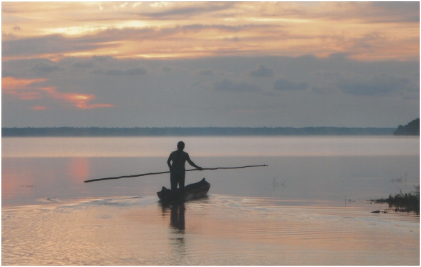
Continuing our “Global Rescue Members in Action” series, today we feature John Atchley, who entered our “In the Spirit of Adventure” photo contest with the sunrise piece presented below, taken in La Mosquitia, Gracias a Dios, Honduras. Read on for a glimpse into Atchley’s escape to a simpler world on his fishing excursion.
“The photo was taken on the southeast coast of Honduras, a region called La Mosquitia. The area is very remote. The local Indian group still moves around in dugout canoes. This lady happened to come by just as the sun was coming up to the east. I happened to be at this location in a tent camp on a fishing excursion. To me, it is like you go back in time when you visit this area of Honduras. It would probably resemble Florida back around 1900 or so. When you get out to the local lagoons to fish, you find you are the only outboard in any of the lagoons. So needless to say, you get away from it all, which is what I like to do — no noise, light, pollution, nothing but stars at night and plenty of sounds coming out of the jungle. I must say that little photo on a point and shoot camera had plenty of worthy competition.”
Do you have a great story to share about your travels? We want to hear about it! If you (or someone you know) would like to be considered as a “Global Rescue Member in Action,” tell us why in an email to press@globalrescue.com.
Categories:
NewsMarch 16, 2014
Categories:
Health & SafetySecurity & IntelligenceTravelMarch 13, 2014
As college students head out on spring break to popular locations this month, it is important to be aware that a real threat to personal security exists in many international locations. This threat can be minimized if individuals are prepared to recognize the risk, adjust their lifestyle and routines, and follow simple, sensible precautions. Personal security is ultimately an individual responsibility and any advice given to individuals will only be effective if taken seriously.
Crisis response firm Global Rescue offers these 5 tips to help keep safety a priority:
- Be vigilant
Do not discuss personal matters with strangers, including your itinerary, place of lodging or mode of transportation. Limit knowledge of your travel plans and daily activities to those who need to know. Be aware that excess consumption of alcohol increases your risk of being a target of crime. Do not accept food or drink from strangers; would-be criminals often try to drug their victims through food and drink consumption. Ignore attempts by locals to provoke an argument. Change the topic of discussion and, if possible, remove yourself from the situation. Maintain an appearance of purpose and awareness. Do not look lost or refer frequently to a map in plain view. Walk as if you know where you are headed even if you do not know. - Exercise caution with taxis
Taxis ordered by phone are safer than those hailed on the street; ask for the cab number when ordering. Use only properly marked taxis and beware of unmarked cabs. Do not get into a taxi if there is a person sitting in the front passenger seat next to the driver. Know the route or general direction to your destination. If you’re unhappy about the direction in which the taxi is traveling, speak firmly to the driver. If there is no positive response from the driver, get out at the next stop. It is always safer to travel with an acquaintance than alone. - Be hotel-savvy
Request a room using the following criteria:
- Located on the side of the hotel farthest from the entrance (reduces the amount of traffic around your room)
- Located on the lowest floor above ground level (makes it difficult for entry from the outside, while maintaining a lesser distance for travel in the event of an escape becoming necessary)
- Without balcony, decreasing the number of entry points
- Not overlooked by another room, lessening the number of opposing vantage points into your room
Say as little as possible to overly curious hotel staff. When you get to your room, check all available escape routes. Identify a simple evacuation route in the event of an emergency. This will greatly increase your survivability during an emergency situation. Lock the windows, and door(s) using the double lock system, if available use security chain. Check to ensure that the telephone works. Always keep a flashlight handy. Never leave important documents such as passport, air tickets, or money anywhere visible. Utilize the hotel or room safe when storing all unneeded personal documents and excess cash.
- Take steps to prevent crime
Avoid carrying a purse or a wallet. If carrying a wallet is a must, something as simple as wrapping a rubber band around it helps prevent theft; this creates friction making it more difficult to pickpocket. At night only take sufficient money and one identity card. Leave the rest of the contents of your wallet in a secure place (hotel, apartment, etc.)
Criminals seek out those they feel are the weakest targets. A person travelling alone is extremely vulnerable to attacks. Individuals who are out of place, do not fit in, or have an apparent weakness are often targeted (i.e. intoxicated foreigners, female, handicapped). If you are being followed on a well-traveled street, indicate to your pursuer that you are aware of being followed. Then go straight for help or to a public area.
If confronted, stay calm, cooperate and surrender your valuables (at minimumproducing a large monetary note hidden somewhere on your person). Do not attempt to fight your attacker as many robberies can end without violence.Safety is the most important thing. Attempt to study your attackers without being obvious, so that you can provide information to aid in identifying them to the police.
Kidnapping is a real threat to travelers everywhere, especially those who are perceived as wielding significant power or wealth. There are many actions that can be taken to decrease the chances of becoming a kidnap victim. Don’t become a creature of habit. Avoid predictable behavior by departing at different times and taking different routes. Be cautious. Be suspicious of anything unusual, and don’t be reluctant to report all such observations to the corporate security manager. Avoid obvious danger. Stay away from such as areas at night and locations with a reputation for being unsafe. If travel in a dangerous area is unavoidable, keep your awareness at the highest level.
- Research before you go
Be familiar with security concerns relevant to your destination. Visit the US State Department site for travel alerts and warnings.
Global Rescue offers the travel intelligence tool GRID, providing information and resources necessary to ensure travelers’ health, safety, and security. GRID offers comprehensive details to help travelers prepare in advance and to stay informed once they have arrived at their destination. Travelers can view information by filters including environment, health, infrastructure, unrest and violence. Security assessments include a security risk rating, security risk overview, details on events of terrorism or civil unrest, and advice for staying safe.
To learn more, visit www.globalrescue.com or call +1-617-459-4200.
Categories:
Missions & Member TestimonialsMarch 13, 2014
Today we launch a new series, “Global Rescue Members in Action,” in which we highlight amazing accomplishments and soul-satisfying journeys undertaken by the Global Rescue community. It’s thrilling to have Global Rescue members so spirited in their journeys and so committed to visiting every corner of the globe, eking out every last bit of adventure. These stories are too good to keep to ourselves.
To kick off the series, we begin with some of the stand-outs from the Global Rescue “In the Spirit of Adventure” photo contest to hear more about how they captured such compelling images.
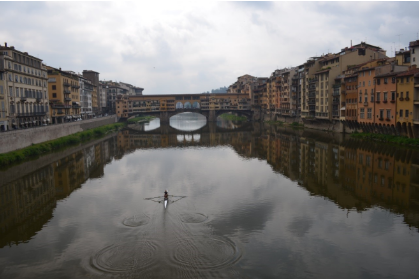
Our first profile is of Doug Paulding, a photographer who submitted a stellar shot of the Arno River in Florence. Read about the rower he happened upon on a calm, Italian morning.
“I travel and write about wine and spirits and was on a wine press trip to Chianti Classico in May. My flight home was from Florence, Italy, in the early afternoon so I had most of the morning to explore the city.
“I went for a walk on the Arno River, stopping frequently to take photos. I stood on several of the bridges framing some beautiful scenes with my camera. From an adjacent bridge, I snapped a few pictures of Florence’s most famous bridge, Ponte Vecchio. It was a beautiful, serene, subtle light, cloudy morning. The picture needed something more. I looked the other way and saw a rower coming my way. I got my angle and camera settings, framed the picture and waited for the scull to come under my bridge. The cloudy reflection in the water, the rower’s oar circles and the setting gave the picture the “action” I was looking for. My Nikon D5100 with a Nikkor 18-55 mm zoom lens set at 55mm captured the moment perfectly.”
Do you have a great story to share about your travels? We want to hear about it! If you (or someone you know) would like to be considered as a “Global Rescue Member in Action,” tell us why in an email to press@globalrescue.com.
Categories:
Press ReleaseMarch 13, 2014
Boston, Mass.– As college students head out on spring break to popular locations this month, it is important to be aware that a real threat to personal security exists in many international locations. This threat can be minimized if individuals are prepared to recognize the risk, adjust their lifestyle and routines, and follow simple, sensible precautions. Personal security is ultimately an individual responsibility and any advice given to individuals will only be effective if taken seriously.
Crisis response firm Global Rescue offers these 5 tips to help keep safety a priority:
1. Be vigilant Do not discuss personal matters with strangers, including your itinerary, place of lodging or mode of transportation. Limit knowledge of your travel plans and daily activities to those who need to know. Be aware that excess consumption of alcohol increases your risk of being a target of crime. Do not accept food or drink from strangers; would-be criminals often try to drug their victims through food and drink consumption. Ignore attempts by locals to provoke an argument. Change the topic of discussion and, if possible, remove yourself from the situation. Maintain an appearance of purpose and awareness. Do not look lost or refer frequently to a map in plain view. Walk as if you know where you are headed even if you do not know.
2. Exercise caution with taxis Taxis ordered by phone are safer than those hailed on the street; ask for the cab number when ordering. Use only properly marked taxis and beware of unmarked cabs. Do not get into a taxi if there is a person sitting in the front passenger seat next to the driver. Know the route or general direction to your destination. If you’re unhappy about the direction in which the taxi is traveling, speak firmly to the driver. If there is no positive response from the driver, get out at the next stop. It is always safer to travel with an acquaintance than alone.
3. Be hotel-savvy Request a room using the following criteria: –Located on the side of the hotel farthest from the entrance (reduces the amount of traffic around your room) –Located on the lowest floor above ground level (makes it difficult for entry from the outside, while maintaining a lesser distance for travel in the event of an escape becoming necessary) –Without balcony, decreasing the number of entry points –Not overlooked by another room, lessening the number of opposing vantage points into your room
Say as little as possible to overly curious hotel staff. When you get to your room, check all available escape routes. Identify a simple evacuation route in the event of an emergency. This will greatly increase your survivability during an emergency situation. Lock the windows, and door(s) using the double lock system, if available use security chain. Check to ensure that the telephone works. Always keep a flashlight handy. Never leave important documents such as passport, air tickets, or money anywhere visible. Utilize the hotel or room safe when storing all unneeded personal documents and excess cash.
4. Take steps to prevent crime Avoid carrying a purse or a wallet. If carrying a wallet is a must, something as simple as wrapping a rubber band around it helps prevent theft; this creates friction making it more difficult to pickpocket. At night only take sufficient money and one identity card. Leave the rest of the contents of your wallet in a secure place (hotel, apartment, etc.) Criminals seek out those they feel are the weakest targets. A person travelling alone is extremely vulnerable to attacks. Individuals who are out of place, do not fit in, or have an apparent weakness are often targeted (i.e. intoxicated foreigners, female, handicapped). If you are being followed on a well-traveled street, indicate to your pursuer that you are aware of being followed. Then go straight for help or to a public area.
If confronted, stay calm, cooperate and surrender your valuables (at minimum producing a large monetary note hidden somewhere on your person). Do not attempt to fight your attacker as many robberies can end without violence. Safety is the most important thing. Attempt to study your attackers without being obvious, so that you can provide information to aid in identifying them to the police.
Kidnapping is a real threat to travelers everywhere, especially those who are perceived as wielding significant power or wealth. There are many actions that can be taken to decrease the chances of becoming a kidnap victim. Don’t become a creature of habit. Avoid predictable behavior by departing at different times and taking different routes. Be cautious. Be suspicious of anything unusual, and don’t be reluctant to report all such observations to the corporate security manager. Avoid obvious danger. Stay away from such as areas at night and locations with a reputation for being unsafe. If travel in a dangerous area is unavoidable, keep your awareness at the highest level.
5. Research before you go Be familiar with security concerns relevant to your destination. Visit the US State Department site for travel alerts and warnings. Global Rescue offers the travel intelligence tool GRID, providing information and resources necessary to ensure travelers’ health, safety, and security. GRID offers comprehensive details to help travelers prepare in advance and to stay informed once they have arrived at their destination. Travelers can view information by filters including environment, health, infrastructure, unrest and violence. Security assessments include a security risk rating, security risk overview, details on events of terrorism or civil unrest, and advice for staying safe.
To learn more, visit www.globalrescue.com or call +1-617-459-4200.
About Global Rescue
Global Rescue is a worldwide provider of integrated medical, security, intelligence, travel risk management and crisis response services to corporations, governments and individuals. Founded in partnership with Johns Hopkins Medicine, Global Rescue’s unique operational model provides best-in-class services that identify, monitor and respond to potential threats. Global Rescue has provided medical and security support to clients during every globally significant crisis of the last decade. Memberships start at $119 and entitle members to rescue and transport services to their home hospital of choice.
For more information, call +1-617-459-4200 or visit www.globalrescue.com.