Categories:
Health & SafetyMissions & Member TestimonialsAugust 4, 2022
When is a good time to call Global Rescue? Anytime, as David Lane discovered during a five-day hike in the Dolomite Mountains in Italy. Here is his travel story and how our emergency medical assistance saved the day.
The trip to Italy was a long-awaited family vacation.
“We planned a five-day hike among the Dolomite Mountains back in 2019 with DolomiteMountains. After a two-year COVID delay, me, my wife Karen, my brother Robert and sister-in-law Janet left for the Great Ladin Valley Traverse in June 2022,” said David Lane, a retired librarian from Minnesota.
Lane, who stays in shape with stretching and exercise, had previous hiking experience, including a six-day walk along the West Highland Way in Scotland. But when his back seized up on the fifth day of his Dolomite adventure, he called his travel insurance company.
“They were unhelpful and clearly more interested in having the literally five forms they sent filled out,” he said.
From Alpine Walking to Rocky Ascents
The trip started smoothly.
“We had an initial day hike to acclimate, which was wonderful, about a six-hour excursion,” Lane said. “The following day, we were taken to the base of Sassolungo and sent up the top pass via cable car to start a three-day overnight hike among an array of mountains in that range, about a 36-mile journey.”
After a stay at the first Refugio (a mountain hut typically found on trails), the second day included more wooded and alpine walking — and added steep rocky descents and ascents.
“There was a climb, maybe 100 yards, up along an almost vertical rocky face requiring a cable to hold onto. I made it up but was deeply frightened by the experience,” Lane said. “It was very stressful and really shook my confidence.”

On the third day, the group hiked from the second Refugio at a high point of 9,500 feet (2,895 meters) and hiked down that afternoon. A shuttle transported everyone to Canazei for a stay at Hotel El Ciasel.
“Overnight my back seized up — this had never happened before — and by morning I was barely able to walk,” Lane said. “There was a day hike but my wife Karen and I stayed back as my brother and his wife went on. We attempted to shuffle through town in hopes of my back loosening up but I was virtually immobilized by pain.”
No Assistance from Travel Insurance
Instead, the Lanes planned to travel to Corvara, their final destination, with the luggage transport. They called their travel insurance company for travel medical assistance and received no help. Then they called Global Rescue.
“I almost did not call, as I assumed Global Rescue was for more serious emergencies like broken limbs and helicopter rescues in the Amazon. But I was at a loss and so called,” Lane said. “The response was immediate. The person I spoke with interviewed me to understand what my situation was, where exactly we were, where we were going to be, medical history and contact details.”
Field rescue and medical evacuations are a large part of Global Rescue’s travel protection memberships. But medical advisory — when you just have a medical question — and travel assistance services — for any other safety or travel questions — are always available to Global Rescue members.
“She was incredibly supportive and called back about 30 minutes later, having located a trauma clinic 10 minutes from our hotel in Corvara. She contacted the clinic to confirm their hours and location, even giving them notice that I might be coming. She took charge of the situation with clear expertise.”
Lane was treated for acute lower back pain with an injection of a pain and muscle relaxant. “The treatment was successful and I was able to walk without pain by dinner time that evening,” Lane said.
Lane visited the clinic the next morning for a second recommended injection as well as to get instructions and medications for the upcoming journey home, which included a long car ride and an international flight.
Now he is back home, will Lane schedule another trip to the Dolomites?
“It is unlikely I will go on a similar venture in the future, as this was clearly outside my comfort zone,” Lane said. “We are more multi-day town-to-town walkers. Scotland was perfect.”

Glad to Have Global Rescue
Lane may not hike in the Dolomites again, but he will renew his Global Rescue membership for future travels.
“Especially after the frustration with the travel insurance company, I had fairly low expectations thinking my situation would not qualify as a rescue,” Lane said. “The immediate, professional and action-oriented response at the first call was a huge relief. It was clear my case was being treated as a priority, above any bureaucratic concerns, and we were able to hand over the problem solving to Global Rescue.”
Lane notes Global Rescue followed up after the initial call, and encouraged Lane to call for any reason.
“I cannot express the relief — I was in some of the worst pain I had ever been in, and navigating a solution was not something I felt competent to do on my own,” Lane said. “I just was skeptical my injury qualified as the kind of rescue you all provide. I was wrong, thankfully. Rescue is precisely what I received.”
Lane advises fellow travelers to purchase Global Rescue.
“For anyone in our age range (mid-60s), stuff can happen even off of a mountain, like a sprained ankle or other medical need,” Lane said. “I will be forever appreciative of Global Rescue’s assistance.”
Get a price estimate
Estimate
$0.00
Please answer all questions for estimate.
Categories:
Press ReleaseAugust 3, 2022
Lebanon, N.H. – August 3, 2022 – Whether it’s monkeypox or any other infectious disease, Global Rescue will provide rescue and emergency transport services for travelers to their home hospital of choice in the event they are hospitalized or in need of hospitalization.
“When it comes to managing patients infected with monkeypox, Global Rescue does not make any distinctions between monkeypox and other infectious diseases regarding our services. If members have questions related to monkeypox or become ill from the virus while traveling, our services still apply. This always has been the case, including for COVID-19,” said Dan Richards, CEO of Global Rescue, the world’s leading provider of medical, security, evacuation and travel risk management services and a member of the U.S. Travel and Tourism Advisory Board at the U.S. Department of Commerce.
“Whether a traveler needs a monkeypox screening and testing regimen for a trip or needs help finding a monkeypox-prepared health care facility, Global Rescue can assist before, during and after travel,” Richards said.
Monkeypox is a rare disease caused by infection with the monkeypox virus. Monkeypox symptoms are similar to smallpox symptoms, but milder, and monkeypox is rarely fatal. It is not related to chickenpox.
The Centers for Disease Control and Prevention (CDC) is tracking the outbreak across several countries that don’t normally report monkeypox, including the United States. The World Health Organization declared the monkeypox viral outbreak a public health emergency of international concern.
The monkeypox virus spreads mostly through close, intimate contact with someone who has the virus. The CDC recommends vaccination for people who have been exposed to monkeypox or who are at higher risk of being exposed to the disease. According to the CDC, many people affected in the current global outbreaks identify as gay or bisexual and these populations represent the majority of global cases. Monkeypox can spread to anyone through close, personal, often skin-to-skin contact.
“Should an emergency occur, our medical and security experts can fully coordinate all aspects from advisory to evacuation, allowing travel companies to focus on delivering the best possible experience for their guests,” Richards said.
“Seven-out-of-10 travelers are much less concerned about travel compared to the beginning of the pandemic. They feel safe enough to plan trips and vacations because they’re vaccinated, borders are open and they have confidence they’ll be able to get home if the worst happens,” Richards said.
Contact Bill McIntyre at bmcintyre@globalrescue.com or 202.560.1195 (phone/text) for more information.
About Global Rescue
Global Rescue is the world’s leading provider of medical, security, evacuation and travel risk management services to enterprises, governments and individuals. Founded in 2004, Global Rescue has exclusive relationships with the Johns Hopkins Emergency Medicine Division of Special Operations and Elite Medical Group. Global Rescue provides best-in-class services that identify, monitor and respond to client medical and security crises. Global Rescue has provided medical and security support to its clients, including Fortune 500 companies, governments and academic institutions, during every globally significant crisis of the last two decades. For more information, visit www.globalrescue.com.
August 2, 2022
A few seemingly weird things that are illegal in parts of the world: camo attire in the Caribbean, chewing gum in Singapore, swearing in public in the U.A.E. It’s true: All are banned in the aforementioned countries…and some punishable with jail time. A Global Rescue security expert fills us in on a handful of unusual laws and illegal items so you are in the know before you go.
Years ago, former Navy SEAL and Global Rescue’s Operations Manager Harding Bush almost found himself in a jam in Jordan. There to provide protection for the prime minister of Iraq, he had flown into the country on military air, but was to depart on a commercial flight. And, on his way out, customs quickly halted him.
“I had two-way radios in my carry on,” he said, which are usually illegal to have in that country. “I was sent to a small secondary room and questioned. Luckily, I was working with the Jordan secret service and had the business card of the King’s detail leader as proof. Without it, I probably would have been sent to jail.”
Bush was fortunate. But other civilian travelers often aren’t when they discover they’ve traveled with an item or are doing something frowned upon or downright illegal in another country. At best, the item could be confiscated. At worst, you could be slapped with a fine, arrested, expelled and even jailed.
The laws of your home country don’t travel with you — that’s why knowing the local laws of the destination is critical prior to traveling.
“The U.S. Department of State’s travel information web page for overseas travel advice explains you are subject to local laws while abroad,” said Bush. “You are bound by those laws. You can’t just say, ‘Oops, I didn’t know.’ Ignorance is not an excuse.”
The following are a handful of examples of what, to some, may seem like the weirdest laws in the world, their explanations and tips to research local laws before traveling.
1. Satellite Phones and Messaging Devices [India]
It has been illegal for foreigners to bring satellite phones and devices into India for many years under the Indian Telegraph Act. And after the Mumbai terror attack in 2008 was coordinated with satellite phones, stricter regulations around these devices were put into place.
“That’s because satellite phones circumvent India’s cellular phone system and are difficult for the government to surveil or track,” Bush explained.

Bringing an unauthorized and unregistered satellite phone into India can lead to significant legal complications, including arrest and detention. However, if you are traveling to remote regions in the country, satellite phones can be e-registered and licensed with the Department of Telecommunications.
“You should check with your guide or tour service regarding cellular phone connectivity, and if they have satellite phones themselves for emergency communications,” Bush said.
Satellite phones and devices are also illegal or strictly regulated in China, Cuba, Bangladesh, Myanmar, Nigeria, North Korea, Chad, Russia, Sri Lanka, Sudan and Pakistan.
2. Walkie Talkies or Two-Way Radios [Europe and Japan]
Your family may often use walkie talkies during ski vacations to communicate around the mountain (especially if cell service is spotty). But these two-way radios have also been used by terrorists, criminals or rebels to support violent activities against a government or population. They can also interfere with licensed communication systems, such as police, infrastructure or emergency services.
For that reason, European countries (like the U.K., France and Germany) closely regulate various frequencies, and unlicensed use can result in confiscation and or arrest. Even certain walkie talkie apps for smartphones may be illegal. They are also strictly prohibited in Japan.
3. Certain Prescription and Over-the-Counter Medications [Various Countries]
Many prescriptions and even over-the-counter medications are illegal in various countries. A few examples: Ambien (particularly in Nigeria and Singapore), pain medications containing tramadol or codeine, attention-deficit drugs, as well as psychiatric or opiate medicines. In Japan and Greece, Sudafed and Vicks are also illegal.
Travelers should carefully research the laws around their required medicine in countries they plan to visit and consult medical guidance on substitute medications. Even if a medicine is legal, travelers should always keep it in the original container and have a copy of a prescription.
[Related Reading: 5 Precautions for Traveling with Medication]
4. Camouflage, Olive Drab or Equipment with Military Uses [The Caribbean, the Middle East and Africa]
Your camo joggers may be comfortable to travel in, but it’s best to leave them at home. Popular Caribbean tourist destinations (Antigua, Barbados, Grenada, Jamaica and Saint Lucia) have strict laws prohibiting the wearing of camouflage clothing. Having it in your luggage or as the pattern on bags or backpacks also falls within the ban’s limits.
“These bans exist in countries that have experienced internal conflict from rebel groups or terrorists and don’t want civilians to be confused as armed combatants,” said Bush.
Travelers on safari to African countries, such as Zimbabwe or Zambia, should be aware camouflage hunting equipment will also fall into this category. Possession of equipment for military uses, such as binoculars, especially if this equipment has night vision, should also be avoided in these countries (plus Egypt and Cuba).
5. Actions or Items Considered to be Rude
What’s the first action travelers often take when they arrive somewhere new and different? Fishing out their camera to capture the scene.

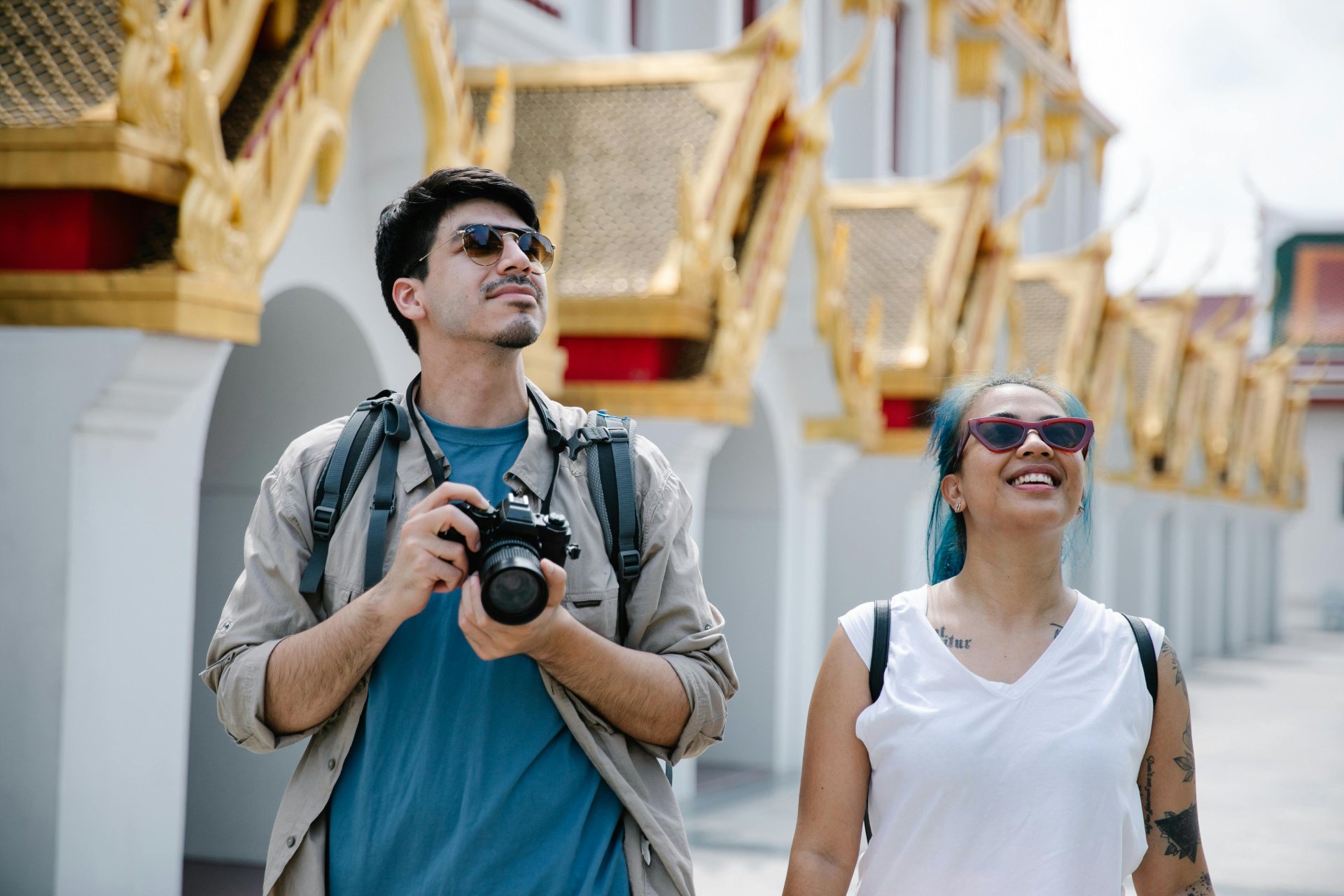
But it’s considered rude or disrespectful to take pictures of people without their permission in many countries, and it may be illegal to take photos of national cultural (largely museums) or religious sites. For example, there’s a photography ban inside India’s Taj Mahal and popular mosques in Saudi Arabia. It’s also frowned upon in many of Southeast Asia’s Buddhist temples.
Many countries forbid taking photographs of government buildings, police or military activity/equipment such as checkpoints and vehicles. That also includes major industrial and logistics areas, like factories, harbors, airports and rail yards. Why? Because it could potentially be interpreted as surveillance. Travelers should research the legal restrictions and cultural considerations around photography where they plan to visit — or risk arrest or confiscation of their pricey photography equipment.
Other examples of disrespectful actions or items that could get you into hot water:
- Swearing. Using the “F-word” is strictly prohibited in the U.A.E. — even when it comes to your online activity.
- Making offensive comments against the local government. Particularly in Turkey, “insult laws” have been around for some time, but are being more harshly enforced because of social media.
- E-cigarettes. Vaping products are banned in Thailand.
- Shooting TikTok Content. Nepal recently banned the shooting of TikTok videos at some heritage sites by would-be social media influencers.
- Chewing gum. Singapore is famous for its ban on gum.

6. Traveling as an Unmarried or LGBTQ+ Couple
Unmarried couples in the U.A.E. and Qatar often face legal complications, and, in many countries, women may not be able to check into a hotel with a man who is not their husband or father. In Jordan, public displays of affection (even if you’re married) are frowned upon. Many countries in the Middle East have no laws prohibiting violence against women and have arrested individuals for breaking laws around extra-marital activity.
Even in 2022, members of the LGBTQ+ community should carefully research laws pertaining to their situation in any country they plan to visit. According to Equaldex, 69 countries have laws Westerners would consider homophobic.
Know Before You Go: Ignorance is Not an Excuse
If you’re a member of Global Rescue, the best place to start your research regarding the rules and laws of a country is with our destination reports. Maintained by our travel intelligence analysts, these reports cover 215 countries and principalities — and they are always accessible in your member portal or on your My Global Rescue App.
Not a member? You can download one free destination report on our Travel Intelligence Center.
Categories:
Press ReleaseAugust 1, 2022
Lebanon, NH – August 1, 2022 – Comfort levels for cruising climbed 21%, according to the world’s most experienced travelers responding to the Global Rescue Summer 2022 Traveler Safety and Sentiment Survey.
Nearly a quarter (23%) of respondents feel much safer or safe enough to cruise compared to only 19% of respondents earlier this year. Forty percent of respondents have already taken a cruise since the pandemic started or, if they haven’t, they plan to this year.
“Confidence in cruising safety is reflected in traveler perception and behavior. The cruise industry will continue to rebound since the Centers for Disease Control and Prevention (CDC) discontinued its COVID-19 Program for Cruise Ships on July 18,” said Dan Richards, CEO of Global Rescue, the world’s leading provider of medical, security, evacuation and travel risk management services and a member of the U.S. Travel and Tourism Advisory Board at the U.S. Department of Commerce.
Cruise industry officials welcomed the end of the mandatory program in favor of a voluntary set of guidelines for public health.
“This is an important step forward in the CDC aligning the guidelines for cruise with those it has established for other travel, hospitality and entertainment sectors,” said Cruise Lines International Association spokeswoman Anne Madison. The CDC will continue to publish guidance to help cruise ships continue to provide “a safer and healthier environment” for passengers, crew and communities.
“Travelers are eager to make up for lost travel and they want to do it as safely and confidently as possible so they can regain their family vacations and adventure travels. Seven-out-of-10 travelers are less concerned about travel, including cruises, compared to the beginning of the pandemic. They are going forward with international and domestic travel despite rising costs and travel industry staff shortages,” Richards said.
Contact Bill McIntyre at bmcintyre@globalrescue.com or 202.560.1195 (phone/text) for more information.
About the Global Rescue Traveler Sentiment and Safety Survey
Global Rescue, the leading travel risk and crisis response provider, conducted a survey of more than 2,100 of its current and former members between July 12 and 16, 2022. The respondents exposed a range of behaviors, attitudes and preferences regarding international and domestic travel.
About Global Rescue
Global Rescue is the world’s leading provider of medical, security, evacuation and travel risk management services to enterprises, governments and individuals. Founded in 2004, Global Rescue has exclusive relationships with the Johns Hopkins Emergency Medicine Division of Special Operations and Elite Medical Group. Global Rescue provides best-in-class services that identify, monitor and respond to client medical and security crises. Global Rescue has provided medical and security support to its clients, including Fortune 500 companies, governments and academic institutions, during every globally significant crisis of the last two decades. For more information, visit www.globalrescue.com.
Categories:
NewsJuly 30, 2022
Categories:
Health & SafetySecurity & IntelligenceJuly 29, 2022
The last three years have been a show-stopping, re-orienting series of events that fundamentally changed how many of us view the world. First the pandemic, then civil unrest, natural disasters, cybersecurity threats, the war between Ukraine and Russia.
In response, companies have zeroed in on risk management in an effort to protect employees and preserve business in a time of sustained uncertainty. If you are a risk manager, you’ve felt the pressure more than anyone else. If you were behind the scenes before, you — and the policies you create — are now in the spotlight.
That’s why we want to share the four crucial policies every risk manager needs. None of these policies can replace each other, and they can’t operate sufficiently on their own. They build on one another, making your company more prepared and more able to respond to crises.
One: Standard Operating Procedure
Standard operating procedures (SOPs) are the bones of business operations. They shape company culture by outlining how everyday practices should be performed so service and products are delivered consistently and employees and customers are safe. SOPs are a step-by-step guide for all personnel to ensure tasks are performed the same way across an organization.
Documented SOPs for a corporate office could be as basic as new employee orientation, background checks, building entry safe guards or a list of travel expenses covered by the company.
“The better your initial standardized everyday policies and procedures are, the safer and more effective your organization will be,” said Harding Bush, manager of security operations at Global Rescue. “It’s about creating a culture that effectively balances productivity with safety.”
In the past, SOPs may not have included specific cybersecurity protocols, like frequent password updates or two-step verification. They may have had less extensive pre-travel planning and limited during-travel risk monitoring.
But these days, updating existing SOPs to include such measures has become critical. For example, the pandemic opened the floodgates on remote work, forcing companies to amp up their SOPs to cover a remote workforce, digital nomads and bleisure travel. These updates weren’t just about employee perks, they also beefed up cybersecurity measures to protect their assets while employees worked out of the office and put measures in place to ensure staff work product was safe while traveling.

Policies should now include extensive pre-trip analysis. Global Rescue members can take advantage of Global Rescue’s in-depth destination reports as a part of their SOPs in this new era of remote work and travel. Reports tip off travelers and risk managers to potential risks on the ground and how to avoid them. Alerts, issued during travel, keep everyone apprised of current events — and potential health and safety risks.
[Related Reading: What Are Travel Alerts?]
SOPs are the most foundational of the four policies. But they can’t fully protect from an unexpected emergency.
“Risk managers need to plan ahead and lead the charge,” Bush said . “An effective SOP will reduce the likelihood of an emergency and an effective emergency action plan (EAP) will lessen the impact and consequences of an emergency.”
Two: Emergency Action Plan
Emergency action plans are more important than ever these days. For many, COVID-19 was the unexpected emergency that couldn’t be avoided — the very reason EAPs are created.
EAPs are procedures around safety that go into effect when an emergency actually happens and the standard operating procedures fail or are no longer sufficient.
“Some emergencies, like contracting COVID or suffering a heart attack during a work trip, cannot be avoided,” Bush said. “But a good EAP will lessen the impact and consequences of the emergency.”
While SOPs are proactive procedures that can help avoid an emergency, EAPs are reactive, dealing directly with a situation.
Take a classic example: An employee is on a business trip abroad and gets food poisoning following a client lunch. There needs to be a plan in place to make sure they can get medical care should things go south. Dehydration, if not addressed, can quickly lead to a hospital visit. Does your employee know where they can get clean water to help them stay hydrated? How can they assess if a hospital trip is needed? And where can they go to get the right medical care? The answers will come from following the EAP.
These days, EAPs provide a depth to duty of care that employees are beginning to expect. Especially if employees are traveling for your company, they want to know there is a plan in place should an emergency arise. Global Rescue helps its clients plan for travel emergencies, often going ahead of the company to do a risk assessment on the ground.
In the case of conference planning, “the process starts months ahead,” Bush said. “We liaise with organizers, review, assess and assist with development of medical and security protocols, visit the site, and look at all the involved entities: airport, transportation companies, hotels, various restaurants. We’ve made the appropriate relationships with everyone involved to identify and avoid any escalating security situations.”
When creating your EAP, widespread involvement is imperative. At a corporation, risk managers will need to build their EAP team with colleagues from human resources, operations, finance, legal and logistics. These leaders can identify potential emergencies across geographic locations, types of worksites, structural features and local emergency resources and response time. The earlier this involvement happens, the more successful planning, creation and implementation will be.
Does your organization have an EAP? If not, it’s time to get one, and the security experts at Global Rescue can help.
“From creating an emergency action plan or blueprint for best practices to reduce the risk of liability and keep people safe during an emergency, Global Rescue provides intelligence capabilities customizable to your business needs,” Bush said.
[Related Reading: Legal Duty of Care]
Three: Business Continuity Plan
Unexpected emergencies happen. They can be scary for employees and disruptive for business operations. But they don’t have to shut everything down. With a strong business continuity plan (BCP), businesses have specific protocols to get them back on track.
BCPs include systems of prevention and recovery to maintain operations during or just after an emergency, like a natural disaster.

What if a city needs to be evacuated due to a Category 4 hurricane on the horizon — and it is the location of your business headquarters? Do you have a plan to scale up IT to quickly secure the influx of remote workers? If your work must be done in person, can it happen at an interim location? Is there any company support for the hardship your employees are experiencing, such as gas mileage reimbursement, funds for housing, etc.?
Having a BCP doesn’t mean there won’t be gaps in productivity. It means those gaps don’t have to be permanent because there is a clear path to full business function, even if you are not yet back in the office.
Most importantly, a BCP must be rehearsed in advance.
“The business continuity plan should be carefully reviewed and validated,” Bush said. “An example is a company rehearsing work-from-home protocols department by department, on a regular basis, so they are ready for such a situation.”
Four: Disaster Recovery Plan
The hurricane hit, and it hit hard. Your employees followed the BCP that they rehearsed several times before and business has stabilized. But what is your plan to return to the office and get things back to normal? That’s when your disaster recovery plan sets in. It helps companies get back to work after a major disruption. It provides guidance and sets rules around the re-opening of your facility and the return of employees to the office.
What if a portion of your building was flattened during the hurricane and needs to be rebuilt? A disaster recovery plan will set a timeline for the build, allowing employees back into the office when it is repaired and safe again. This could happen all at once or in phases, depending on the building and the type of work. The disaster recovery plan will guide your company through that process.
Disaster recovery plans must be made inherently flexible so employers can respond nimbly to situations — like delays in building repairs. It must have buy-in from all responsible parties so updates can be communicated clearly and promptly to employees.
“The plan and its procedures must be current,” Bush said. “Its effectiveness must be validated and it needs to be understood and acknowledged throughout the organization, especially those with key roles and responsibilities during an emergency.”
Travel Risk and Crisis Management
The challenges companies face today are great. But your strength as the risk manager is in being able to turn those challenges into opportunities for your organization.
These policies will empower you to do just that. An enhanced standard operating procedure with more IT support for remote work allows your organization to offer perks like bleisure travel — which can help retain employees — while protecting yourself from cybersecurity threats. An emergency action plan helps your employees feel safe to take business trips in today’s complicated world — a real competitive advantage against other companies who don’t create safe environments for their traveling employees. Your business continuity plan will keep your business alive through the next disruption. And your disaster recovery plan will help you restore business to normal.
Don’t have a risk manager? Need extra support? Global Rescue can help you create, communicate and execute on these policies with our customizable travel risk and crisis management services. Every day, we help companies large and small around the world to stay prepared and stay safe. Let us help you, too.
Categories:
Health & SafetyTravelJuly 28, 2022
You may know Ed Viesturs and Kristin Harila by their climbing achievements, but do you know their most important piece of equipment? Safety tips they live by? Their favorite mountain snacks? Global Rescue asked these questions — and more.
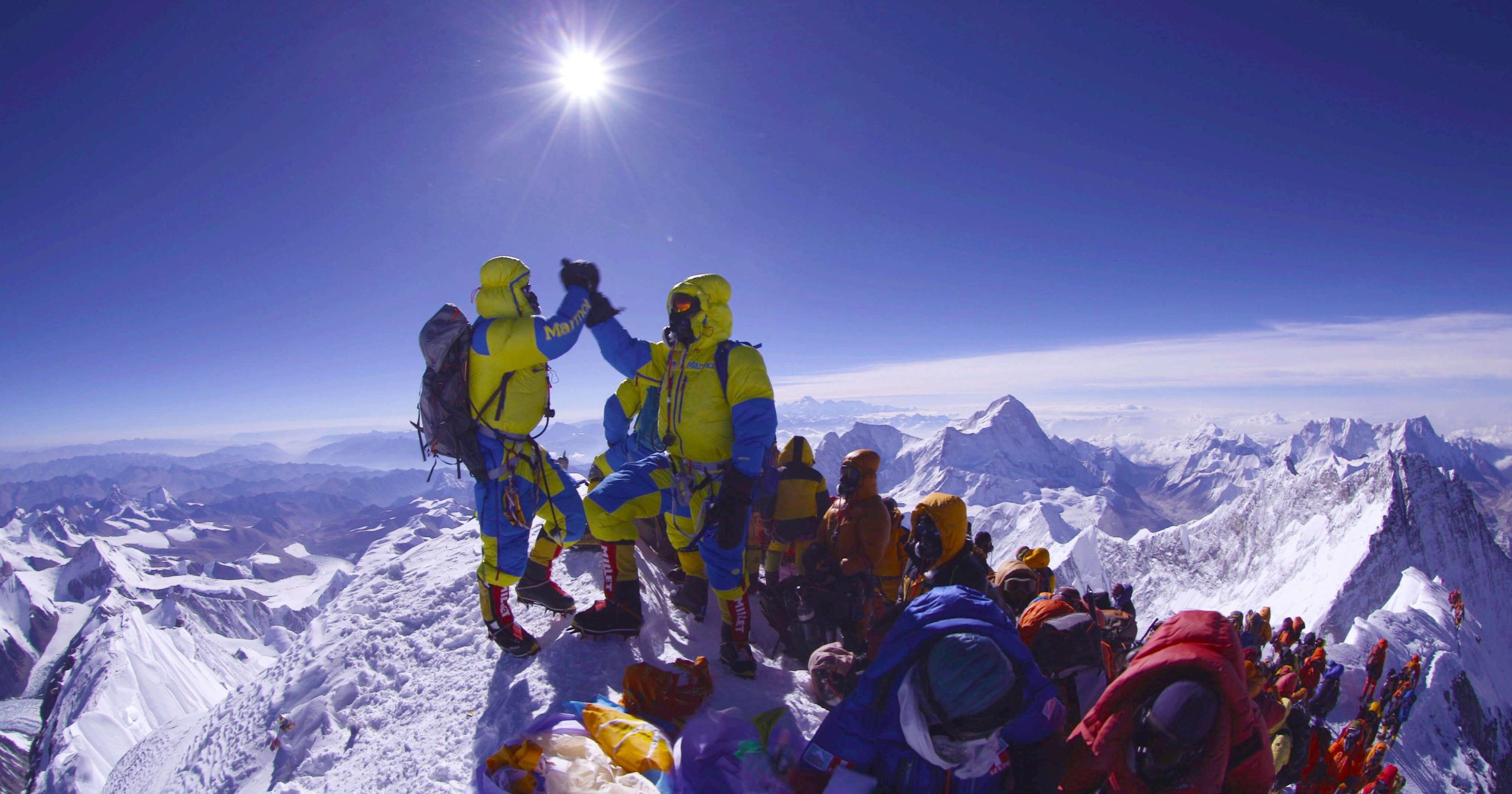
Ed Viesturs is a legendary mountaineer and a member of the Global Rescue Mountain Advisory Council. He is the only American to have climbed all 14 of the world’s 8,000+ meter peaks, and the fifth person to do so without using supplemental oxygen. Viesturs checked in with Global Rescue after returning from leading expeditions in South America’s Andean Peaks.
Kristin Harila is a former cross-country skier from Norway. She’s new to mountaineering but has already broken climbing records. In the spring of 2022, she summited six 8,000+ meter peaks in 29 days, breaking the speed record set three years ago by Nimral “Nims” Purja, a member of the Global Rescue Mountain Advisory Council. We caught up with Harila a few days before her trip to Pakistan where she will assault the five 8,000+ meter peaks in the Himalayan, Karakoram and Hindu Kush mountain systems. It’s part of her campaign to break Nims’ speed record to successfully climb all 14 mountains over 8,000 meters.
[Related Reading: Mission Brief – The Himalayas Special Edition]
Global Rescue asked each mountaineer a few questions to help you get to know them beyond their high climbing achievements.
What are three safety tips you live by?
Ed Viesturs: Plan your descent whether it’s your return or your exit strategy, even before planning the ascent. The latter depends on the former. Prioritize safety over success. Prepare yourself physically before a climb for a long-term, demanding event, you’ll be faster and stronger and therefore safer.
Kristin Harila: Don’t go alone. Keep a strict turnaround time. Make certain to have a two-way satellite communications device with a SOS capability.
What are the three most important questions you should always ask your guide?
Viesturs: What is your level of experience and training? What is the goal of the trip — success or safety? What are your plans for contingencies?
Harila: Do we have enough oxygen? Is there a rope all the way? Is my Sherpa among the best?
Do you have a mountaineering good luck charm, superstition or golden rule?
Viesturs: I have a small pouch I call my Juju bag. I carry it on summit ascents in my front pocket. It contains small mementos from my wife, kids and my travels. On longer expeditions, it feels as if my family and friends are with me.
Harila: I have a pair of favorite gloves that I always wear.
What’s your go-to snack while climbing?
Viesturs: Cliff bars, cashews, mini-Babybel cheese, semi-sweet chocolate and Shot Blocks.
Harila: I don’t eat much when I climb, but I do eat a lot of gel blocks. They provide quick carbohydrates for exercise endurance and recovery.
What’s your favorite post-summit celebratory meal, drink or habit?
Viesturs: Pizza, salad and beer seem to be the usual.
Harila: It’s always sushi or King Crab. If I can’t get that, then it’s pizza.
What is your favorite, most important piece of equipment?
Viesturs: An ice ax is probably my most useful and important piece of equipment for what I climb. It gives me a third point of balance and also security on steep slopes — not only to protect myself from a fall, but also to anchor a rope partner should something happen. I feel insecure and naked without it.
Harila: It’s difficult to choose but, for me, it would have to be my harness.
What mountain gear isn’t necessarily needed?
Viesturs: Personally, especially when speaking about climbing above 8,000 meters, I’ve always shied away from supplemental oxygen. I enjoyed the freedom of not being encumbered or dependent on this mechanical device. True, it is way harder to climb without supplemental oxygen, but to me, it seemed more fulfilling. I don’t have anything against climbers that use supplemental oxygen, I’ve also used it, especially when guiding 8000ers, but the simplicity of climbing without it is a unique experience.
Harila: The pee bottle. It’s very nice to have but you can do without it. [NOTE: Mountaineers drink lots of water to help with acclimatization. The side effect is frequent urination. To avoid having to put on your jacket and boots, exit the tent, and find the toilet every time, climbers use a pee bottle while inside the tent. It’s convenient after you overcome shyness or embarrassment.]
[Related reading: Rescue Ready on Mount Everest]
Would you ever want to summit the highest point on the moon, the Selenean summit (35,387 feet/10,786 meters)? It’s nearly 20% taller than Earth’s Mount Everest.
Viesturs: I’ve not contemplated climbing a peak on the moon. I would be very interested in going to the moon even if it was just to do an orbit and then return to Earth.
Harila: I’d love to do it. It would be amazing. If I ever have the opportunity I would do it, for sure.
Categories:
NewsJuly 27, 2022
Categories:
Health & SafetyPlaces & PartnersTravelJuly 25, 2022
What are the benefits of a museum visit? Whether it’s a science center, art museum, children’s museum or historical society, travelers are immersed in local history, culture, art or nature. You’ll be educated, entertained and inspired about the country you are visiting.
Most travel itineraries usually include at least one museum — Safe Travel Partner Atlas Obscura history tours always include a stop at a local museum — and some itineraries are entirely based on museum visits. Paris, for example, offers 130 museums within city limits and Washington, D.C., a mecca for school field trips, has 70.
In fact, 76% of all U.S. leisure travelers participate in cultural or heritage activities, such as visiting museums. More people visited an art museum, science center, historic house or site, zoo, or aquarium in 2018 than attended a professional sporting event, according to the American Alliance of Museums. Pre-pandemic, the top 100 museums in the world had 230 million visitors in 2019.
[Related Reading: Best Learning Vacations for Families]
A Revenge Travel Must-Have
There’s a reason that museums, large and small, are included on everyone’s revenge travel list. These hubs of knowledge and culture have something for everyone — at any age. According to Mastercard Economic Institute’s annual travel report, it’s all part of the “experience economy” in which travelers are investing in experiences — like museum visits — instead of things.
Each museum offers its own individual experience. The Louvre in Paris, visited by 9.6 million people in 2019, has mapped out museum trails based on interests — masterpieces, the Richelieu wing, the Tuileries Garden — and a Louvre passport for kids is available at the information desk under the Pyramid.
Visitors of all ages can tour the open-air exhibits of the Inhotim Museum in Brumadinho, Brazil by foot or by golf cart. The colorful contemporary art is featured in a natural setting, including forests, mountains and botanical gardens.
The Science Museum in London has more than 15,000 science and technology objects on display and the Wonderlab exhibitions give kids a hands-on chance to interact with scientific phenomena.
Iceland offered up a variety of educational activities from a geothermal tomato farm and restaurant to seeing two tectonic plates (Eurasian and North American) above ground, but Global Rescue member Lucy Thompson enjoyed the Lava Centre, a high-tech interactive volcano and earthquake museum located near Iceland’s volcanoes: Eyjafjallajökull, Katla and Hekla.

Photo by Lucy Thompson
“The museum was informative and Instagram-able,” said Thompson, who traveled to Iceland during her senior year of high school. “Every display was touchable, and you could learn about tectonic plates, earthquakes and volcanoes at your own pace.”
Low COVID Transmission Risk
And, guess what? It’s safer to be in a museum than most public places. A study by the Berlin Institute of Technology in Germany determined the risk of COVID-19 transmission is far lower in museums and theaters than in supermarkets, restaurants, offices or public transportation. The criteria: having the museum at 30% capacity with everyone wearing a mask and following proper precautions.
COVID aside, there are few risks to visiting a museum. A few areas to keep in check:
- Research the parking situation before you go. Smaller museums may not have their own lots and the parking could be in a questionable area or far away.
- Provide safety education. Don’t start the adventure without children knowing what to do in an emergency, memorizing phone numbers, having contact info/ID on them at all times, and holding hands with adults in public areas.
- You’ll want to avoid visiting the museum at its most crowded periods, such as Saturday and Sunday, and keep an eye on your kids at all times.
- Be prepared for a security screening, with either magnetometers or hand wands. It is wise to limit the number of items you bring with you. Some museums have quick, easy lines for people with no bags and long, slow lines for people who bring a bag.
- Have a plan. Look at a map of the museum ahead of time and prioritize the exhibits you really want to see.
- Choose a meeting place if you get separated. “Identify two potential rally points where you can gather if you are separated. Cell phone service might be disrupted, especially if there’s an incident, so find two spots that are easily found a distance away from the venue. Make sure they are well-lit and not impacted by the crowd,” said Harding Bush, manager of operations at Global Rescue.
- Be aware of museum fatigue. You may want to spend all day at the museum, but studies show you stop seeing the exhibits after 30 minutes. Take breaks, especially for the kids, by stopping at the café.
- Make sure you have a travel protection membership. Not particularly for the museum visit, but for your trip in general. Global Rescue memberships include personalized advisory services, 24/7/365 emergency assistance and evacuation services at no additional cost to you. Learn more about the benefits of a travel membership.
Weird, Wild and Wonderful Museums
Most travelers will visit the well-known museums in their destinations and see exhibits like art at the Rijksmuseum in Amsterdam, South African history at the Apartheid Museum in Johannesburg, sculpture at the Acropolis Museum in Athens, or Egyptian artifacts at the Egyptian Museum in Cairo.
For those looking for something a little less traditional, there’s a wild world of museums with off-the-beaten path topics from a museum of mummies in Mexico to an international museum of toilets in India to a museum of taxidermied frogs in Croatia to a museum of bad art in Massachusetts. We’ve curated a few unique collections across the globe:
London, England and Washington, D.C., United States: Interested in British postal history? Check out the Postal Museum with tells the history of Britain via the medium of post. In the United States, philatelists will want to visit the National Postal Museum, which is actually located in a historic city post office building.
Notting Hill, London: By using exhibits of advertising and packaging from Victorian times to modern day, the Museum of Brands provides a different way of looking at history — via the marketing trends of toys, candy, cereal and other consumer products.
Zagreb, Croatia: It’s probably not the place to visit on Valentine’s Day, but The Museum of Broken Relationships has a collection of almost 3,000 objects, each with its own story. You can even add yours, if you’d like.
Toronto, Canada: The Bata Shoe Museum has a collection of 14,000 shoes from “Chinese bound-foot shoes and ancient Egyptian sandals to chestnut-crushing clogs and glamorous platforms.” There’s more than 4,500 years of history in this one-of-a-kind footwear museum.

Photo by Emmely van Mierlo and Corné Clemens
Utrecht, Netherlands: The Miffy Museum, based on Dick Bruna’s picture books, offers a series of miniature worlds for kids to explore. There are 10 rooms, each dedicated to a different subject, such as going to the doctor or visiting the zoo. It’s a great museum for kids ages 2 to 6.
Yokohama, Japan: The Cup Noodles Museum has four stories of history about the inventor Momofuku Ando and his invention, chicken ramen. There’s even a factory where you can create your own ramen recipe.
Springfield, Massachusetts, United States: Can you still recite Green Eggs and Ham by heart? Do you watch the Grinch every holiday season? Then add the Amazing World of Dr. Seuss Museum to your travel list where you will learn all about Theodor Geisel, aka Dr. Seuss.

Branson, Missouri, United States: As you enter the Titanic Museum, you’re given a boarding pass. Will you be a crew member or a passenger? You walk through a replica of the ship, complete with sloping decks, and view hundreds of artifacts. At the end of the tour, you learn if you survive, or go down with the ship.
Categories:
Press ReleaseJuly 22, 2022
Lebanon, NH – July 18, 2022 – The International Organization for Standardization (ISO) awarded Global Rescue, the world’s leading provider of medical, security, evacuation and travel risk management services, ISO 9001:2015 certification.
“The ISO 9001:2015 certification demonstrates Global Rescue’s historic and ongoing ability to consistently provide outstanding service,” said Dan Richards, CEO of Global Rescue and a member of the U.S. Travel and Tourism Advisory Board at the U.S. Department of Commerce.
Global Rescue’s overall customer satisfaction is consistently over 95% and greater than 9 out of 10 customers would recommend Global Rescue to their friends or family.
“The certification verifies Global Rescue’s commitment to quality and customer satisfaction. The ISO certification reflects adherence to requirements for organization-wide quality management systems that focus on continuous improvement, customer satisfaction and active involvement of both management and employees,” said Stephanie Diamond, Global Rescue’s vice president of Human Capital Management and a veteran international human resources expert.
ISO 9001 is a quality management system standard that was developed by the International Organization for Standardization, which is an association of governmental and nongovernmental organizations from many countries. ISO 9001 certification requires an organization’s quality management system to consistently provide services that meet customer requirements through enhanced customer satisfaction facilitation by addressing risks and opportunities.
Geneva, Switzerland-based ISO is an international standard development organization comprised of representatives from the national standards organizations of member countries. ISO is an independent, non-governmental organization that develops standards to ensure the quality, safety and efficiency of products, services and systems.
Contact Bill McIntyre at bmcintyre@globalrescue.com or 202.560.1195 (phone/text) for more information.
About Global Rescue
Global Rescue is the world’s leading provider of medical, security, evacuation and travel risk management services to enterprises, governments and individuals. Founded in 2004, Global Rescue has exclusive relationships with the Johns Hopkins Emergency Medicine Division of Special Operations and Elite Medical Group. Global Rescue provides best-in-class services that identify, monitor and respond to client medical and security crises. Global Rescue has provided medical and security support to its clients, including Fortune 500 companies, governments and academic institutions, during every globally significant crisis of the last two decades. For more information, visit www.globalrescue.com.
Categories:
Missions & Member TestimonialsJuly 21, 2022
Traversing the Greenland ice sheet is not for the faint of heart, but Ada Myhren, a top tier athlete from Norway, was ready. Then the unexpected happened, resulting in a call to Global Rescue. Read her travel story.
From Norse explorer Erik the Red’s discovery in the 980s to the first crossing in 1899, traversing Greenland’s ice sheet is not for the faint of heart. According to Hvitserk and Eventyrreiser, a tour operator with the most Greenland crossings and a Global Rescue Safe Travel Partner, “there is no reason to underestimate the physical challenge. This expedition requires you train systematically over time on the two things that apply: skiing and pulling something heavy after you.”
The Greenland expedition was the trip of dreams for Ada Myhren, a top tier athlete who has participated in many endurance events.
“I am from Norway — born with skis on my feet — and love being outdoors. I have about 50 to 100 nights in a tent a year. I have been on several skiing and hiking trips in Norway and other places in the world,” said Myhren, a digital business developer. “I have prepared myself in all possible ways for crossing the Greenland Ice for about a year. Some of it exercising with tires, preparing the equipment, and going on training trips in Norway.”
But Greenland’s glacial land ice was a tough adversary. Myhren’s guide Morten Johansen called Global Rescue on day 16 when she collapsed.
A Year of Training
It takes anywhere from 22 to 30 days to cross Greenland’s ice sheet. Explorers/adventurers/travelers must be prepared to travel approximately 20 kilometers (12 miles) each day. Skiers should have cross country ski experience, a history of shorter ski expeditions, and mandatory sled hauling experience. Many guides require training course completion as well as shorter crossings, like Hardangervidda Crossing (130 km/80 miles over a high arctic plateau in Norway) and the Svalbard Crossing (10 days on skis pulling your equipment).

“Crossing the Greenland ice is an adventure that takes one month — 26 days on the ice,” Myhren said about her April 2022 trip. “You take the equipment and food for all the days. Total weight is about 70 kg (154 pounds) to start with.”
With a year of training under her belt, Myhren was ready to cross Greenland’s historic and impressive inland ice — 600 kilometers (372 miles) from coast to coast.
The first half of her trip was exactly what she expected. Myhren posted some details on Facebook: “A walk through fantastic glacier falls, white ice surface as long as the eye can reach, swaying uphill to 2,500 meters. A trip to the abandoned American station DYE2, which was a great time travel back to the 1980s for those of us who remember it. It is amazing to go on such a trip that is the same every day, where every day is more and more about the absolutely necessary routines such as melting enough snow, eating at every opportunity, and sleeping beyond walking every day. For me, the trip stopped abruptly on day 16 and changed to a trip to the hospital in Nuuk.”
The Unexpected Happens
Everyone reacts differently to days on the ice sheet. The group, working as a team, makes travel decisions depending on the route, the temperature and how everyone feels.
“The night before it was about -40 degrees Celsius. When we started skiing it was -27 degrees and windy. We had passed the highest point on the ice,” Myhren said. “At the middle of the day, I just collapsed — I lost consciousness for several minutes. At that point they didn´t know the reason for the collapse.”
Her guide made contact with Global Rescue, activating a field rescue from the point of illness or injury. In this case, the location was in the middle of an ice sheet in remote Greenland (Latitude 66.355619, Longitude -44.154997). The message: “If possible, they should bring oxygen with the helicopter, and possibly a doctor.”
“Her group reported Myhren had lost consciousness for about five minutes, and had just woken up. A nurse on scene reported a very weak and slow pulse with shallow respirations,” said Jeffrey Weinstein, operations supervisor at Global Rescue. “Rescue was facilitated by rotary wing aircraft to the only real hospital in Greenland.”
Recommendation without Hesitation
Myhren spent three days in Queen Ingrid’s Hospital, the central hospital in Greenland, where she recovered to a point where she was deemed medically fit to fly home. Global Rescue provided medical advisory services from start to finish — following her progress from Kangerlussuak, Greenland to Oslo, Norway.

“I was surprised about the degree of service you delivered after the rescue. It was so nice the way you followed up on how I was doing until I got home,” said Myhren, who slept on the plane any chance she could. “I felt so comfortable Global Rescue was there the whole time — it could not have been better. I really felt that you were doing your absolute best.”
Myhren’s expedition is a good example of how even if you are prepared physically, disaster can still strike when you least expect it.
“I will absolutely recommend having a Global Rescue membership without hesitation,” Myhren said. “I will use you on my trips in the coming years — Greenland is fantastic and deserves more visits — but I hope this was the only time I will need to use it.”