Categories:
Health & SafetyTravelJune 21, 2022
The summer season is a wonderful time to go outdoors, but be wary of the array of dangerous bugs, insects, arachnids and myriapods. Here is a list of insects that sting and bugs that bite as well as tips on how to avoid insect bites and stings in the woods, on the trail or on your outdoor deck.
The spring and summer seasons are an annual explosion of color repainting the browns and greys of winter. Fluorescent green leaves burst from tree limbs, hillsides are ablaze in wildflowers, and mountain ranges shed their snow-white blankets in exchange for verdant peaks kissing azure skies.
But the colorful outdoor show, and the warmer climate that naturally comes with it, also brings an array of dangerous summer insects, arachnids and myriapods — that is, bugs that bug you. Poet Ann Zwinger penned a succinct accounting of the seasonal reality: “Flies are the price we pay for summer.”
Serious problems with biting insects vary from region to region, said Lynn S. Kimsey, Ph.D., professor of Entomology and director, Center for Biosystematics, and director, Bohart Museum of Entomology. In general, pests become more active at a temperature above 60 degrees F/15 degrees C. “The warmer it is, the more active they are, and the more of them come out.”
[Related Reading: What to Do if You Get a Dangerous Illness Abroad]
Spring and summer bring an uptick in the aggressive nature of a few stinging insects. If you’re not careful, then you could find yourself on the wrong end of an attack — and what you think is the right thing to do may be the worst plan of all. The following are a few examples of dangerous summer bugs and how to avoid insect bites and stings in the woods, on the trail or on your outdoor deck.
Wasps
Paper wasps and yellow jackets are not antagonistic insects in general unless their nest is traumatized. Stings hurt, no doubt, and pose a risk of allergic reaction for some. Paper wasps are a problem in the summer when they get big.
“Yellowjackets can be dangerous as we move into the later part of summer because they get aggressive, territorial and more intolerant, especially if you get close to their nest,” says Howard Russell, Entomologist, Department of Plant, Soil and Microbial Sciences at Michigan State University.
Bumble Bees and Carpenter Bees
Hikers and trekkers are likely familiar with the threat of bees. They are difficult to spot and, generally, will leave you alone if you leave them alone. But if you step on a nest, they will come out in force to defend their home. That’s when you need to get away as quickly as possible.
There is a risk of anaphylaxis or a deadly allergic reaction to a bee sting. “It is rare, but some people are extra sensitive to bee stings. If you know you are at risk for anaphylaxis from a sting, you should be carrying your prescribed epinephrine auto-injector with you anytime you go outdoors during spring, summer or fall,” said Jeff Weinstein. a paramedic and a medical operations supervisor for Global Rescue.
Weinstein recommends hikers throw a bottle of Benadryl into their bag when hiking. “If you get stung and start to become itchy or have some hives appear, you can take some and mitigate your body’s histamine response,” he said.
Mosquitoes
Mosquitoes are prevalent in late spring and early summer, especially if there’s been plenty of rain, and common in the woods and near rivers. Their population decreases in warmer, drier weather. Mosquitos can carry several infectious diseases as well as viruses and parasites. Mosquito-spread diseases include malaria, Eastern equine encephalitis (EEE), West Nile virus, Zika, elephantiasis, Dengue fever and yellow fever are a few.
One Global Rescue member traveling in Uganda was unconscious and seizing when Global Rescue got the call for a medical evacuation. Without quick response and continual bedside monitoring by Global Rescue’s paramedic, the diagnosis of cerebral malaria would have been fatal.
Remember: When you are far away from home, the best course of action is to prevent the bug bite of summer from happening in the first place.
“You can minimize the chance of mosquito bites by wearing long-sleeved shirts, long pants and socks; use EPA-registered insect repellent; and cover sleeping areas with mosquito nettings,” said David Koo, associate director of operations at Global Rescue.
Black Flies and Fleas
Any New Englander will share stories of the seasonal black fly influx and their annoying behavior. Hats, long sleeve shirts and pants can be an effective defense against them, and their bites can cause swelling.
Fleas are more active as the weather gets warmer. When they bite, you won’t know it for a few hours, there will be several bites in a single area and it will likely promote itching. The bite site may appear like a red sore or bump. Typical flea bites tend to occur in the bend of an elbow, the back of the knee, at the waist, ankles and armpits. Avoid scratching to reduce the likelihood of infection.
Ants
Ant bites are an annoyance in the northern region of the U.S. but more serious in the south. Fire ants sting and dispense a toxin that can cause severe reactions among some people, especially if they are stung multiple times. “If you were stung, you will get a rapid, painful feeling,” said Dr. Ned Walker, professor at Michigan State University in the Department of Entomology and the Department of Microbiology and Molecular Genetics.
Ticks

Ticks thrive in humidity. If you have a wet year, mild winter and early spring then you have ideal conditions for an increase in the tick population. Tick populations are growing across many parts of the U.S. and abroad in places like Europe, Africa, the Middle East, and Asia. That translates to higher possibilities of tick-borne diseases — most notoriously Lyme disease — and the need to be ever vigilant to spot these arachnids, often as small as a sesame seed, before they attach to you or another host in your household, like a child or a pet.
Consider using a tick repellent, especially if you’re going to be in the backcountry for a few days. It’s a good idea to apply insecticide permethrin to your gear and clothing as it will still remain protected after several washes (in case things get damp out there). You can also use repellent sprays on skin not covered by clothing — just be sure they’re EPA-registered repellents.
[Related Reading: How to Protect Yourself From Ticks This Season]
Spiders
Global Rescue member Linda Hanks suspected she had a brown recluse spider bite and used the Global Rescue Mobile App to request a TotalCare urgent consult. Within 10 minutes, a physician from the Elite Medical Group confirmed the diagnosis and provided Hanks with remedies.
The black widow is really the most dangerous spider, but you are not very likely to come across it, according to Russell. The female black widow spider is known as the most venomous spider in North America. House spiders are the ones most likely to be hanging around the dark corners of your home in the spring. They are not considered a danger because they do not have venom strong enough to evoke much of a reaction. Spiders usually bite only if they feel threatened.
Millipedes and Centipedes
Large centipede bites may cause intense pain and discomfort for people, but fatalities are extremely rare. Although not generally considered dangerous to humans, many millipedes produce noxious secretions which, in rare cases, can cause temporary blistering and discoloration of the skin.
Prepare and Protect Yourself
The spring and summer seasons are a wonderful time to explore the outdoors — but be prepared to protect yourself against the dangers that may come with it. This means having the right attitude, the appropriate gear and a Global Rescue membership.
Global Rescue expanded its membership services to include medical and evacuation services within 100 miles of home — as well as everything beyond 100 miles. No matter where you are, a travel protection services membership will ensure you and your loved ones are ill or injured and are unable to get to safety on your own.
Get a price estimate
Estimate
$0.00
Please answer all questions for estimate.
Categories:
Missions & Member TestimonialsJune 20, 2022
After a strong downdraft from a developing storm pushed his paraglider into a remote mountainside in The Himalayas, injured pilot Steven Mackintosh knew he couldn’t get out of the situation by himself. And it’s precisely why he’s now a Global Rescue member for life. Here’s his adventure travel story.
A crash can happen to even the most seasoned paragliding pilots. Sometimes, the conditions during the flight suddenly turn chaotic, forcing you to make an emergency landing in a spot you’d never — in your right mind — choose: trees, rocks, water. And the consequences can be critical.
That’s the situation U.K. resident and Global Rescue member Steven Mackintosh found himself in during his 2022 500-mile (800-kilometer) solo paragliding trip across Nepal. The result: A crash 55 miles (90 kilometers) west of Pokhara that left him with multiple injuries to his left side, including a broken wrist.
“It was quite a blur, but I can now recall a few moments,” he said. “And I remember thinking ‘I’m in the middle of nowhere, and I’m not going to get out of here myself.’”
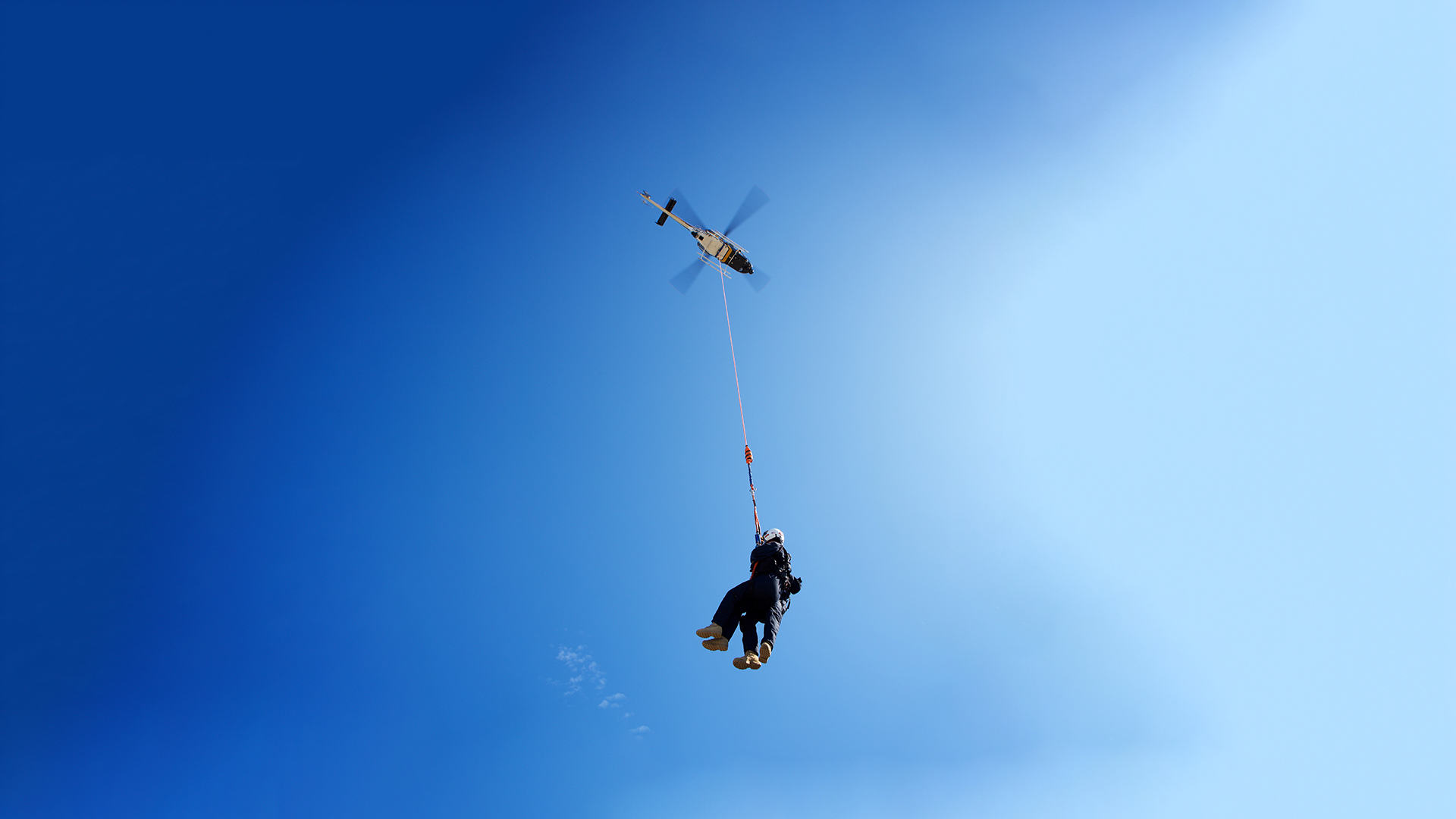
But that’s why he said he’s now “signed up for Global Rescue for life.” Within a few hours, he was positioned in the back of a five-seater heli and headed to a private clinic in Pokhara. “I could’ve cried, really,” he confessed. “What a real point of relief. Things were going to get better from here.”
Bitten By the “Vol-Biv” Paragliding Bug

Mackintosh, whose friends refer to him as “Tosh,” is no novice paraglider — he boasts 30 years of experience under his wing. But within the last 15 years, he has fallen in love with the cross country discipline of the sport, having flown all over the U.K., different parts of Europe (extensively in the Alps), Morocco, Turkey, Columbia (“the place to be in January,” he said), even New Zealand.
[Related Reading: Is Cross Country Paragliding Safe?]
In 2019, he embarked on his first vol-bivouac adventure in Nepal. Regularly shortened to just “vol-biv,” the French term translates to “fly-camping,” where cross country paragliders carry all the gear (tent, camping gear, food, etc.) they need on their backs and head off for days and weeks into the wilds.
Not only did he fall in love with vol-biv, but Nepal and its culture, too. “They’re so happy to invite you into their homes for tea and put the tilaka mark on your forehead,” he said. “I came back from that four-day paragliding trip buzzing and thinking ‘Okay, I need to do more flying out there.’”
That was precisely what he did, returning in 2020 with the plan to complete what he refers to as “The Nepal Traverse,” a flight across the length of the Nepal Himalayas, from Darchula on the far western border to Sikkim on the eastern border. “Few people have done it, and, when they have, they’ve done it in pairs,” said Mackintosh.
But Mackintosh wanted to be the first to do it solo.
Two Traverse Attempts, One Paragliding Crash Landing
Mackintosh’s first attempt at paragliding across Nepal took place in February 2020. Despite the weather being poor for flying several days, by day 21, he had reached Pokhara (about the halfway mark of his journey). “Given that COVID was really kicking off, I thought it would be foolish of me to carry on. I didn’t want to get stuck, so I decided I should head back to the U.K. while I still could,” he said.
When he resumed his mission in early 2022, he decided to start from the far western border again (rather than pick up where he left off, near Pokhara). By the end of the first week, he was flying ahead of schedule as the weather was better than it had been in 2020. “I had a couple of days where I experienced some of the best paragliding of my life,” he said.
But things took a turn on day 13. After taking off around 10:30 a.m., in an attempt to avoid a developing storm, he got stuck inside a valley he could not navigate out of. “[The valley] was probably 80% trees with a river and massive boulders at the bottom,” he said. “There were zero landing choices. I attempted to push back to the valley entrance to target some small, old paddy fields.”
That was when his glider took a massive frontal tuck — meaning the wing collapsed amid the turbulent air, and he lost critical height. After regaining control of the glider, he found himself facing a hill and two strands of power lines.
“Power lines are lethal to hit,” he said. “My decision making was to bank left, get away from the lines, and get my glider into wherever I could.” While he avoided the power lines, his right wing caught a tree, catapulting him against the hill — hard.
“I should have just flown into the tree,” Mackintosh said. “It would have been softer.”
Global Rescue Dispatches a Heli Fast
Despite being winded, his wilderness first aid training kicked in. He knew right away his twisted, out-of-line wrist was broken, so rather than be distracted by the obvious, he moved on to a self-assessment to determine if he was bleeding, and the state of his legs, spine, back, neck and head. After, it was time to contact help.
“I’ve been carrying this Garmin inReach Mini for years,” he said. “It was surreal to flip the cap over and press the SOS button for the first time.” It was programmed with the message there may have been “a possible fall from height” and to contact Global Rescue for evacuation, plus two other points of contact (Mackintosh’s wife and brother).
When he hit the SOS, it was 1:51 p.m. local time. Within three-and-a-half hours, a helicopter was dispatched. By 6:30 p.m., Mackintosh was at the clinic in Pokhara, where they did a full inspection of his condition, including replacing the SAM Splint he had applied with a slab cast.
“I would not have been back before nightfall without Global Rescue’s input, for sure,” Mackintosh said. “And it was key for me to be hospitalized that night for pain relief, stabilization and hydration.”

The Future of The Nepal Traverse
While a close friend flew out to Nepal to escort Mackintosh back to his home hospital, Global Rescue never left his side.
“Global Rescue kept in touch with me until my wife and daughter were driving me back from the airport,” he said. “The guys in my local paragliding circle were blown away by how [Global Rescue] operated.”
As for the future of his solo Nepal Traverse, the accident hasn’t put him off flying that kind of terrain. “It’s unfinished at the moment,” he said. “But it has the elements of another chapter.”
Categories:
Health & SafetySecurity & IntelligenceJune 16, 2022
If planning travel around a sporting event, it’s important to prep for crowd safety and what to do if violence breaks out or an assault occurs. A Global Rescue security expert provides nine essential pointers.
Up until recently, the biggest concern attending a public sporting event was potentially returning home with more than a foam finger. But as COVID-19 cases decrease and sporting venues respond by easing their capacity limits in North America and Europe (Spain, Canada, Italy — to name a few), there’s a need for renewed awareness around another threat common to large public gatherings: crowd safety and what to do if violence breaks out.
[Related Reading: Are Sporting Events Safe From COVID-19?]
Despite being a unifying force, sporting events have been marred by violence — both in terms of fan aggression and terrorism — for decades. But when stadiums and arenas first re-opened in March 2021, after being shuttered for roughly 15 months, The Washington Post reported the “episodes of disturbing misbehavior” had increased with the return. In mid-March of this year, USA Today reported there were nearly daily incidents in the stands, from high school to the pros, leading with the example of a recent Mexican soccer match, where 22 were injured during a brawl.
If you’re planning a special trip around a sporting event, it’s important to be prepared. Harding Bush, security expert and operations manager at Global Rescue, offers a few pointers to prep yourself leading up to the event and what actions to take if an incident occurs.
Before Attending
Research the Venue: You will always be safer if you have reviewed the layout of the venue ahead of time. “Go to the event website and look at the maps,” Bush said. “Where is parking? Where are the entrances and exits? What about stairs, elevators or ramps? How are the crowds controlled?”
Carefully Select Your Seats: “If the event is in a stadium, think about exits when selecting your seat, just as much as you think about how ‘good’ the seats are,” he said. How quickly could you reach the exits if there were a fire or a large fight broke out?
Wear Proper Footwear: Should an incident take place requiring evacuation of the venue, it may not be possible to take the most direct route back to your transportation. So practical footwear (no heels or flip flops) is important as you may have to walk longer distances than anticipated or be able to walk quickly or run.
Have a Fully Charged Phone: Make sure your phone is fully charged on arrival and consider taking a back-up battery pack.
Upon Arrival
Locate a Rally Point: “On the way in, establish a place where everyone in your family or group would meet in case of an emergency,” Bush said. “It could be a specific exit, a particular vendor, the car, or a specific address or intersection.”
Practice Situational Awareness: Situational awareness is being alert to your immediate environment. “Be aware and observant and think about some emergency contingencies as you arrive and move into the venue,” he said. “Notice how the traffic flow of people is managed and where emergency services are located.”
If the Worst Occurs
If Spectator Violence Breaks Out: If you see a disturbance, it can be human nature to want to get closer out of curiosity to figure out what’s going on. But, like rubbernecking at a car accident while driving yourself, it can lead to trouble.
“We always advise our members to avoid all areas of demonstration and public unrest when they are traveling. It’s the same idea at a sporting event,” Bush said. “Don’t engage, go the opposite direction and, since you already have situational awareness and know where the authorities are, alert them to the issue.”
If An Explosion Occurs: You have situational awareness, so you know where the nearest exits are, but that doesn’t always mean you should head straight to that exit.
“There may be a second explosive located where emergency responders may arrive to or from, or where the attackers may think additional targets may move to,” Bush said, referencing the 2017 Manchester Arena Ariana Grande concert bombing, where the attacker intentionally targeted the busiest exit. “It may often be best to pause and evaluate, rather than hastily move. The best exit may not be the one closest to you.”
If A Stampede or Crowd Crush Occurs Again: Consider an alternative exit if everyone is heading toward the most obvious or closest one to avoid getting swept up in a crowd altogether.
But, if you do find yourself in the midst of a swarm, fold your arms up in front of you at chest level — much like a boxer stance — to maintain balance and protect your breathing space. Next, try to keep overall pace with the crowd and avoid pushing against it — it’s extremely important you stay on your feet, plus pushing against a crowd will only tire you out. Finally, carefully weave your way diagonally to the outer edge of the stampede, to avoid ending up stuck at a chokepoint (chokepoints are doorways, hallways and other narrow spaces that restrict the flow of the crowd).
Categories:
Health & SafetySecurity & IntelligenceTravelJune 16, 2022
If you are planning travel around a sporting event, it’s important to prep for crowd safety and know what to do if violence breaks out or an assault occurs. A Global Rescue security expert provides nine essential pointers.
Up until recently, the biggest concern attending a public sporting event was potentially returning home with more than a foam finger. But as COVID-19 cases decrease and sporting venues respond by easing their capacity limits in North America and Europe (Spain, Canada, Italy — to name a few), there’s a need for renewed awareness around another threat common to large public gatherings: crowd safety and what to do if violence breaks out.
[Related Reading: Are Sporting Events Safe From COVID-19?]
Despite being a unifying force, sporting events have been marred by violence — both in terms of fan aggression and terrorism — for decades. But when stadiums and arenas first re-opened in March 2021, after being shuttered for roughly 15 months, The Washington Post reported the “episodes of disturbing misbehavior” had increased with the return. In mid-March of 2022, USA Today reported there were nearly daily incidents in the stands, from high school to the pros, leading with the example of a Mexican soccer match, where 22 were injured during a brawl.
If you’re planning a special trip around a sporting event, it’s important to be prepared. Harding Bush, security expert and operations manager at Global Rescue, offers a few pointers to prep yourself leading up to the event, and what actions to take if an incident occurs.
Before Attending
Research the Venue: You will always be safer if you have reviewed the layout of the venue ahead of time.
“Go to the event website and look at the maps,” Bush said. “Where is parking? Where are the entrances and exits? What about stairs, elevators or ramps? How are the crowds controlled?”
Carefully Select Your Seats: “If the event is in a stadium, think about exits when selecting your seat, just as much as you think about how ‘good’ the seats are,” he said.
How quickly could you reach the exits if there were a fire or a large fight broke out?
Wear Proper Footwear: Should an incident take place requiring evacuation of the venue, it may not be possible to take the most direct route back to your transportation. So practical footwear (no heels or flip flops) is important as you may have to walk longer distances than anticipated or be able to walk quickly or run.
Have a Fully Charged Phone: Make sure your phone is fully charged on arrival and consider taking a back-up battery pack.

Upon Arrival
Locate a Rally Point: “On the way in, establish a place where everyone in your family or group would meet in case of an emergency,” Bush said. “It could be a specific exit, a particular vendor, the car or a specific address or intersection.”
Practice Situational Awareness: Situational awareness is being alert to your immediate environment.
“Be aware and observant. Think about some emergency contingencies as you arrive and move into the venue,” he said. “Notice how the traffic flow of people is managed and where emergency services are located.”
If the Worst Occurs
If Spectator Violence Breaks Out: If you see a disturbance, it can be human nature to want to get closer out of curiosity to figure out what’s going on. But, like rubbernecking at a car accident while driving, it can lead to trouble.
“We always advise our members to avoid all areas of demonstration and public unrest when they are traveling. It’s the same idea at a sporting event,” Bush said. “Don’t engage, go the opposite direction, and, since you already have situational awareness and know where the authorities are, alert them to the issue.”
If an Explosion Occurs: You have situational awareness, so you know where the nearest exits are, but that doesn’t always mean you should head straight to that exit.
“There may be a second explosive located where emergency responders may arrive to or from, or where the attackers may think additional targets may move to,” Bush said, referencing the 2017 Manchester Arena Ariana Grande concert bombing, where the attacker intentionally targeted the busiest exit. “It may often be best to pause and evaluate, rather than hastily move. The best exit may not be the one closest to you.”
If a Stampede or Crowd Crush Occurs Again: Consider an alternative exit if everyone is heading toward the most obvious or closest one to avoid getting swept up in a crowd altogether. But, if you do find yourself in the midst of a swarm, fold your arms up in front of you at chest level — much like a boxer stance — to maintain balance and protect your breathing space.
Next, try to keep overall pace with the crowd and avoid pushing against it — it’s extremely important you stay on your feet, plus pushing against a crowd will only tire you out.
Finally, carefully weave your way diagonally to the outer edge of the stampede, to avoid ending up stuck at a chokepoint (chokepoints are doorways, hallways and other narrow spaces that restrict the flow of the crowd).
Categories:
Health & SafetySecurity & IntelligenceJune 13, 2022
Corporate travel is an essential component of doing business, but the obstacles to travel have never been bigger or more difficult to navigate.
Global Rescue and The Ment Law Group hosted a webinar detailing travel risks for businesses of all sizes. Dave Leopold, director of enterprise sales at Global Rescue, and Jeff Ment, managing partner of The Ment Law Group, answered a variety of attendee questions about how to protect employees and how companies can meet the legal duty of care.
Here’s a sampling of questions and answers from this informative session on business travel in today’s world.
Global Rescue: How would you define duty of care, and why do companies of all sizes need to have a plan for this?
The Ment Law Group: Duty of care means an organization has an obligation under the law to take reasonable care under certain circumstances. This covers travel, traveling employees and affinity group travel sponsored by corporations, companies or schools. Duty of care really means acting reasonably as a reasonably prudent person or company should act under the circumstances, taking the circumstances on an individual basis. What might be reasonable for travel to Miami, might not be the same reasonable travel to Dubai.
[Related Reading: Legal Duty of Care Report]
Global Rescue: What has changed most in regards to duty of care from pre-COVID to now?
The Ment Law Group: Duty of care is an evolving phrase. What was duty of care changes with the times — duty of care today is different than duty of care three years ago when we weren’t thinking about COVID. Now duty of care encompasses all of these COVID-related things, such as procuring testing kits if workers are being sent to remote locations. Duty of care has to evolve with the times, because it’s not just locked in stone that this is “duty of care.”
Companies need to dust off the plans because the old plans aren’t good enough anymore. The new plans have to happen because the world has changed. And there’s nobody in the world that doesn’t understand that the world has changed.
Global Rescue: How does duty of care relate to International Organization for Standardization (ISO) compliance?
The Ment Law Group: Duty of care, and how people act, has always been kind of “beauty in the eye of the beholder.” What you and I think might be the duty of care might be different from what somebody else thinks the duty of care is.
ISO seeks to standardize things. Companies now have something to look at and check off the box for the ISO provision for duty of care. It talks about the health and safety of employees when traveling and being prepared for the risk always present in travel.
The first question is: Is there risk? The second question: Can you eliminate the risk? If you cannot eliminate the risk, what can you do to lessen or lower the risk?
That’s where companies like Global Rescue, lawyers and insurance companies come into play, because the risk is always present in travel. So, when you get to the first crossroad, it is the choice of no risk or risk.
Then we go to the next intersection: “How do we deal with the risk?” The ISO standard is really a good way to be able to tell your corporate officer or your risk manager you’ve minimized the risk that cannot be wiped out. Companies will have the mindset of “Okay, this is the standard, it’s a metric, we can see it, and we can understand how to use it, and we can meet the requirements.”

Global Rescue: If a company is working on their duty of care, what departments or titles need to be involved?
The Ment Law Group: It depends on the size of the company. In some companies, one person wears five hats and, in others, there are five different people with five different hats.
It’s typically going to be a combination of people, including the travel planner (who is actually scheduling the trips), someone in risk management (who is scrutinizing and procuring the insurance products), and someone in the executive suite level (who understands the company’s compliance with the required standards).
In my experience, companies loop in the CFO as well. The CFO is talking about company expenses, company risk and managing budgets. That person becomes an important part, because planning isn’t free and you have to spend money to protect yourself. When you’re talking about an outlay of cash, you’re in the arena of a CFO-type person who’s going to give the authorization.
Global Rescue: What challenges do you feel today’s business travelers are most unprepared to handle?
The Ment Law Group: Whether we are business or leisure travelers, we are all unprepared for the unknown and the unexpected, and the changes happening in travel on a daily basis. That is a problem we cannot get away from. There’s always been issues with travel, but it has never been as fluid and dynamic as it is now. You can wake up today and find out the rules have changed for entry to a country, impacting your employee travel later this week. You could find out tomorrow inbound requirements have changed, making it difficult for your employees to get back home. You could find out tomorrow you have to go to another country for work, but not enough days exist for you to meet the entry requirements.
All of this is new — this is not the way we used to plan travel. We used to think “Hey, does everybody have their passport?” but now we’re worried about “What is it actually going to take for me to leave Westport, Connecticut today, go to JFK, and get on a flight to some country that I wasn’t planning to go to, but now my work needs have changed and I need to go?”
That’s the hard part about planning travel — the unexpected — and travel planners, people and companies need to think about that. For the companies outsourcing their travel planning — they’re using a travel management company, a travel agency or a consolidator — you need an understanding about who’s doing what in that relationship. Some contracts with travel management companies leave the stuff that we’re talking about at the feet of the traveler.
It’s like the “hot potato” — nobody really wants to be responsible for making sure the rules for Japan, for example, are still what they are from last week, or what they might be next week. Travel management companies are trying to dodge the hot potato by saying “We’re going to do our best, but the company still needs to stay abreast of changes.” Well, if that’s true, then the company has to have a plan or subscribe to a service giving them this up-to-date information so they’re not caught off guard.
Global Rescue: There’s a lot of moving parts — a lot of things we’re talking about now that we weren’t talking about two and a half years ago.
The Ment Law Group: And we’re going to keep talking about them, because they’re not going to go away. You have to hop on the horse and go with the plan, because you don’t have a choice.

Global Rescue: Based on your experience, are there any long-term challenges to business travel?
The Ment Law Group: Vaccine or no vaccine — it’s an issue here to stay. Companies now need to figure out who’s actually going to be able to travel if there’s a need to travel. You may have an employee you think is going to be able to get on that next flight, but if vaccination is required and this person’s chosen not to be vaccinated, the company needs to have a different plan.
Travel planners and human resources staff have to be involved in this as well, because many companies are reluctant to ask personal questions about vaccine/vaccination status. Now human resource managers are weighing in on whether or not it’s a HIPAA (Health Insurance Portability and Accountability Act) violation to even ask somebody about their vaccination status. It’s one of these issues in business travel that’s going to stick around for the future.
[Related Reading: Business Travel Is Returning]
Global Rescue: For duty of care purposes, many companies just think of their traditional business travelers: the “road warriors” that are on a plane every week or every other week. These are typically savvy travelers. If something were to happen, they may be a little bit more adept at how to handle it. What is another segment of travelers companies need to be worried about, that maybe aren’t as savvy, and it’s still a major duty of care responsibility?
The Ment Law Group: The road warriors know how to get in and out of things. The people who don’t, from a company perspective, might be the award winners for the incentive travel trip the company is sponsoring, affinity group travel or a bleisure (a blend of business and leisure) travel group. Your duty of care with these less-than-road-warrior people changes, because now you need to make sure these non-regular travelers have what they need.
Good example: You send a group somewhere for a conference, and some people test positive and can’t come back. Well, what are you going to do? Where are they going to stay? Have you made arrangements for post-trip stays someplace, because someone’s quarantined and can’t get on a plane? Companies need to worry about that. As a company with business travelers or a school sending students abroad, we are responsible for making sure we understand what we’re going to do if something doesn’t go right. That is really a good segue into why companies need crisis management planning.
Crisis management planning is something lawyers do, and companies like Global Rescue do. Crisis management planning is not just a plane crash. It’s what happens if the people can’t come home on Friday from a trip — that’s a crisis! It may not be a company crisis impacting the bottom line or your stock price, but it’s a mini crisis you need to have a plan for. You need to be constantly planning for the unexpected.
Global Rescue: Has what’s going on in Ukraine impacted your clients?
The Ment Law Group: It has impacted travel tremendously, because companies are now reluctant to schedule business travel to the region. So, if your company needs to send people to Poland, or to Ukraine or Belarus, can you? Should you? What’s going to happen if you do? It may be difficult to get people out of there, it may be difficult for an emergency evacuation and so a company needs to plan in advance to be able to get people out emergently if the volatile situation changes. So, in the duty of care landscape, when you’re sending people to a part of the world that’s more dangerous than it used to be, or it’s always been dangerous, you need to have that duty of care plan in place to get these people back quickly if the shit hits the fan.
Global Rescue: Last question: what do I need to know about trip protection coverage?
The Ment Law Group: Travel insurance is like an octopus. It has all these different legs and tentacles, and goes in different directions, meaning different things to different people. But, in general, travel protection plans protect things like trip interruption, trip cancellation, lost luggage or sickness cancellation. Having this kind of protection in place is another safety net in the event that something goes wrong.
It’s prudent for travelers to make a decision whether or not travel protection insurance is needed. Most travelers are better off buying travel protection plan coverage for expensive trips or protracted trips. If you’re taking a quick trip to Chicago and back, you maybe don’t need that travel protection plan coverage.
But our industry needs people to travel, so get your bags packed; get your passport, your vaccination card and your travel protection membership; and hit the road.
Jeffrey Ment, managing partner of The Ment Law Group, P.C., has 28 years of practical experience in the travel industry with crisis management, travel contracts, litigation and compliance with national and international laws that enables him to effectively represent tour operators, travel agents and hospitality groups in a wide range of cases. Prior to his legal career, Jeff worked as a travel advisor, tour guide and sales manager for two airlines.
David Leopold, director of enterprise sales, leads the team responsible for enterprise sales, development and implementation at Global Rescue. Prior to Global Rescue, he worked at Staples for 20 years where he held a number of different roles, most recently in the Staples Business Advantage division where he was as a Regional Sales Director responsible for new business development.
Categories:
NewsJune 10, 2022
Categories:
Press ReleaseJune 10, 2022
Lebanon, N.H. – June 10, 2022 – The Biden administration is expected to announce that the US requirement for travelers to test negative for COVID-19 before entering the US will be lifted.
“The decision to end the requirement for a negative COVID test to enter the United States is long overdue and a welcome step toward recognizing the decreasing severity of the disease, the urgent need to restore confidence for travelers, and support for an industry badly damaged by the pandemic,” said Dan Richards, CEO of Global Rescue, the world’s leading provider of medical, security, evacuation and travel risk management services and a member of the U.S. Travel and Tourism Advisory Board at the U.S. Department of Commerce.
“After many months of negative COVID tests not being required in virtually every other aspect of American life, the administration has finally decided to end its testing requirement for international travelers arriving in the U.S. This is long overdue and has been a barrier to the recovery of international travel globally,” Richards said.
Contact Bill McIntyre at bmcintyre@globalrescue.com or +1 (202) 560-1195 for more information or to schedule an interview.
Categories:
TravelJune 8, 2022
After two years of limited travel, experts agree revenge travel will win out over inflation in 2022. If you and your family are planning travel this year, here are some expert tips to help you lower travel costs and get the most out of your budget.
You may have noticed the effects of inflation every time you go to the grocery store — serving sizes are decreasing as prices are increasing. It’s glaringly apparent each trip to the gas station. In May, GasBuddy data, compiled from 150,000 gas stations across the U.S., found the nation’s average gas price is $4.46 per gallon. The national average has not been this high since July 2008, according to AAA.
In fact, since January 2022, families have been paying 7.5% more for the same goods and services they purchased in January 2021. Rising shipping costs and labor rates will continue to accelerate producer prices like never before.
With household spending budgets under new constraints, how will inflation influence 2022 travel plans?
Not as much as you would think. A Credit Karma survey found 30% of people are getting ready to spend more this summer, and 22% say it’s going to be at least $1,000 more than their typical budget.
Destination Analysts, a travel and tourism market research firm in California, found 60% of Americans say leisure travel is a high priority.
And a report by Skyscanner found trips are getting longer. As tourism markets in Australia, India, Thailand, Vietnam and Indonesia reopen, trips 90 days or longer rose by 55%, 60-89 days increased by 80%, and 30-59 days rose by 43%. This trend of longer trips will continue well into December.
“Now more than ever, people want to travel. Many travelers expect to spend extra time or more money — or both — on upcoming vacations to compensate for the two-year pandemic-induced travel moratorium,” said Dan Richards, CEO of Global Rescue, the leading provider of medical, security, evacuation and travel risk management services and a member of the U.S. Travel and Tourism Advisory Board at the U.S. Department of Commerce.
Tori Emerson Barnes, the U.S. Travel Association’s executive vice president of public affairs and policy, told CNBC: “Our latest data shows the pent-up demand for travel is overshadowing the current inflated prices of travel,” said Tori Emerson Barnes, the U.S. Travel Association’s executive vice president of public affairs and policy.
Revenge Travel vs. Higher Cost of Living
After two years of limited travel, experts agree revenge travel will win out over inflation in 2022. Home improvement projects, big household purchases (like appliances and furniture) and new car purchases will most likely be cut from the budget first.
It’s not to say travelers won’t trim their vacation expenses as well. The average reported leisure travel budget for the next 12 months is $3,857, which is down from February’s $4,283. If gas prices continue to rise, 58% of American travelers predict they will be taking fewer road trips and 60% will take road trips closer to home.
Worldwide, some countries are more cost conscious than others. According to research by YouGov, Asian markets are more likely to pick a holiday destination that costs less while consumers in Italy reveal the cost of the trip doesn’t concern them.
If you and your family are planning travel this year, here are some expert tips to help you lower travel costs and get the most out of your budget.
Airfare
According to finance company NerdWallet, airfares this year are still lower than pre-pandemic prices. But ticket prices are likely to climb later in the year, Peter Vlitas, executive vice president of Internova Travel Group, said in an interview with TravelAge West.
“Given the rise in fuel and the fact that fares were extremely low in 2020 and even up to now [in 2021], I think there will be a significant price increase in 2022,” said Vlitas, who oversaw airline sales and marketing for 17 years. “What will a consumer do? Will they stay with the mainline carriers? Will they look to connect where it’s cheaper? Will they go to a low-cost carrier? No one really knows.”
Prices may also creep up as the staffing shortage gets tighter. Thousands of pilots retired at the start of the pandemic, and now there aren’t enough pilots as travel rebounds. Many airlines have been forced to cancel flights just before the busy summer season.
Travel Tip: Book six weeks in advance for domestic flights and four months in advance for international flights. Flights are typically less expensive on a Tuesday or Wednesday.
Lodging
The price for lodging, including hotels and motels, saw one of the biggest swings of any travel category: a low in December 2020 matching 2013 prices to an all-time high in July 2021. Seasonality is a big player in hotel prices, so expect higher rates — combined with fewer amenities — this summer.
Travel Tip: Be flexible. Schedule a vacation after the summer season, for example, the less traveled months of September and October when lodging rates are cheaper.
Car Rentals
Car rental rates are up 24% from February 2021 and up 38.6% since February 2020. Between summer travel demand with rising gas prices, NerdWallet suggests skipping the rental car this year.
Travel Tip: Choose accommodations within walking distance of the landmarks and landscapes you wish to visit.
Dining
In the United States, prices are on the rise for grocery store items — 9% in the Pacific, 8% in the Midwest and 2% in New England — and the cost of dining out is following suit.
Travel Tip: Look into hotels with kitchenettes or consider renting a house or cabin with a kitchen, microwave and fridge. Plan to make a few meals to spend less money eating out.
CFAR Insurance and Travel Protection Memberships
One sure way to save money is to purchase a travel insurance plan and a Global Rescue membership. Travel insurance will protect the value of your trip up to $100,000 with cancellation options including Cancel For Any Reason, accident and sickness medical insurance, and baggage loss.
If you’re ill or injured abroad, a Global Rescue membership covers the price of a field rescue or medical evacuation, which could cost up to $300,000. For members, the cost is $0 and there are no deductibles, claims or co-pays. That’s money you’ll be saving for your next vacation.
Add a pandemic, economic uncertainty and war, and a travel protection membership is a necessity. “Given the volatility in the world right now, travelers need to be prepared to leave wherever they are quickly,” Global Rescue’s Richards told Forbes.
Categories:
Health & SafetyTravelJune 7, 2022
Summertime means fairs, music festivals, sporting events and other beloved public activities for the family. After a couple years’ hiatus from these types of outings, it’s the perfect time to brush up on crowd safety to best keep track of your kids.
As COVID-19 cases continue to decline over time and people grow comfortable with in-person public events and activities, it’s a good time to brush up on crowd safety tips — particularly the best ways to keep track of your kids at fairs, music festivals, sporting events, amusement parks, even a busy beach or lake.
[Related Reading: Keeping Family Vacations Free from Fights]
“While everyone worries about an incident like the Boston Marathon bombing or a crossfire in a gunfight, a more likely occurrence is your group getting split up, particularly young kids getting separated from parents,” said Harding Bush, a security expert and operations manager at Global Rescue.
Children often wander, and losing a little one in the melee can happen in a split second. Here’s how to ensure you — and your child — know what to do if it does happen.
1. Talk to Your Kids and Create an Action Plan
“Talk to them about the importance of not getting lost in crowds,” Bush said, as it’s important they try to grasp the severity of the situation.
Then talk to them about what to do should you ever get separated. “Always establish a ‘rally point,’ a place where everyone in your family would know to meet in case of an emergency,” Bush said. “It could be a specific exit, the car or a specific address or intersection. It’s a good idea to walk past it on the way in, stop and explain to everyone — especially children.”
2. One Adult’s Eyes Always on the Kids
If there are two parents or adults in the group, task one with always keeping their eyes glued to the kids, while the other goes off to tackle the necessities, like standing in the ticket line, grabbing food at the concession stand or a souvenir at the gift shop.
If it’s just one of you, require them to hold your hand and, if you have multiple kids, to hold hands with each other. If it’s just one of you, require them to hold your hand and, if you have multiple kids, to hold hands with each other. Or purchase an AirTag or Tile: While designed to track items (like your phone or car keys), they can be used to keep an extra eye on children since they’re tiny and lightweight enough to fit easily into their coat pockets or backpacks. “By doing this, if your child wanders off, you may be able to locate them quickly using the Find My app installed on your iPhone,” suggested this Forbes article.
3. Arm Them with Info — Literally on Them
“Ensure the kids know your phone numbers, full names, and who and how to ask for help,” Bush said. “Even better, have it written down and in their pocket for younger kids who might not be able to rely on their memory.”
Teach them about “safe strangers,” meaning permission to approach a stranger in uniform (such as a police officer, security, crossing guard, staff member) with this information. Another universally good choice is a mother with young children — bee-lining to another stroller is easy for even the youngest children to understand.
4. Know Exactly What Your Kids Were Wearing, Especially Their Shoes
Take a full-length picture of your kids that day, so you will be able to accurately describe what they were wearing to law enforcement or security. Be sure to include their feet — and their footwear — in the photo.
“Description of footwear is critical,” Bush noted. “A kidnapper may throw a new sweatshirt over a kid but won’t think about changing their shoes — it’s too time consuming. When kids go missing at some venues, such as Disney World, security will stop every kid leaving with the same shoes as the person missing.”
5. Don’t Panic, Do What You Practiced
It’s easy to become paralyzed with panic if you do lose track of a child. “Remain calm, remember you have thought about this before, and make decisions based on your preparations,” Bush said.
Similarly, teach your children not to panic when they can’t find you — because, most likely, you’re both still in the same vicinity.