
March 1, 2022
Got questions about COVID-19 while away from home? Trip takers with a travel protection membership rely on one number to call: Global Rescue.
David Bonner was traveling from Los Angeles, California to Santiago, Chile and needed to meet the Chilean government requirements for the flight.
“I arrived at LAX and LATAM Airlines required a letter of coverage that contained the word ‘COVID’,” Bonner said. “After a frantic call to Global Rescue, member services was able to issue a coverage letter. That did the trick — my boarding pass was issued and I was on my way. Without action on your part, my trip would have never gotten off the ground.”
Bonner isn’t the only member who has needed instant travel protection services to meet COVID travel requirements. Justin Cordero was returning home to Oregon after a business trip to Oregon in December. He needed to find a site offering COVID testing for travel for his 7 a.m. flight.
“Restrictions were changed while I was in Canada,” Cordero said. “I already had my flight booked — which was at a horrible time for receiving test results now that testing is required within 24 hours.”
He emailed Global Rescue and got the answer he needed.
“FastTest offers testing in downtown Vancouver at the Fairmont Hotel. Rapid Antigen test results are available within 15 minutes of getting tested. It would appear as if they have multiple time slots still available for this evening,” said Jeffrey Weinstein, medical operations supervisor at Global Rescue.
[Related Reading:
How To Travel Safely During COVID]
The Latest Travel Information
If you’re traveling today, traditional travel insurance isn’t enough. You need more, like a travel protection membership.
“A Global Rescue membership is more than financial protection. Travel insurance policies are only designed to protect your wallet. A Global Rescue membership provides rescue and emergency services for injuries and illness, including COVID-19, as well as travel counsel and guidance— anything that could impact traveler safety and security” said Dan Richards, CEO of Global Rescue.
A Global Rescue membership is a start-to-finish solution to help travelers from their front door to their hotel room, and back home again.
Global Rescue members might start their trip planning by checking the Coronavirus Weekly Update, a free online COVID-19 information center with educational — and factual — information about the pandemic. Scroll down and click on the “View International Restrictions” button. It will bring you to a country restrictions matrix searchable by destination. Scroll until you see your destination, Iceland for this example, and you’ll see the country does have confirmed COVID cases, entry restrictions in place, quarantine and testing requirements.
The U.S. Embassy in Iceland provides COVID requirements: All travelers to the U.S. will be required to present evidence of a negative COVID test taken within a day before departure, regardless of vaccine status. You’ll also find a link to the preregistration page all visitors need to fill out 48 hours before entry into Iceland.
Once you’ve got a handle on the COVID travel requirements, it’s time to research additional health and security risks by using Global Rescue’s Destination Reports. You can log in via computer or use the app on your phone. Click Destination Report, then type in the location: Iceland. The Risk Overview for health concerns is low, but high-quality health care is concentrated around cities. The Security Risk Overview is also low; most trips to Iceland are free of major security concerns.
Icelanders are used to the snow, so they are more apt to check the weather for wind speed. The Iceland Meteorological Office is a great resource for local weather conditions.
What COVID Test Is Required for Travel?
Before, during and after a trip, help is always a phone call away.
“Whether a traveler needs a COVID-19 screening and testing regimen for a trip or needs help finding a COVID-prepared health care facility, Global Rescue can provide assistance before, during and after travel,” Richards said.
Should an emergency occur, Global Rescue medical and security experts can fully coordinate all aspects from advisory (calling for a test location, like Justin Cordero) to evacuation (testing positive in a remote location without the health care capabilities you need, like Dolly Webster.
Unlike other providers, Global Rescue does not make any distinctions between #COVID-19 and other infectious diseases with respect to our services. If members have questions related to COVID or become ill from the virus while traveling, our same services still apply. This has been the case since the start of the pandemic and will continue to be until the end.
Not sure if your travel insurance provides the COVID resources you need? One of our COVID blogs provides answers to the most commonly asked COVID-19 questions. And here are some other considerations — and areas where a Global Rescue membership excels:
- In-house Expertise: Our operations centers are staffed by experienced nurses, paramedics and military special operations veterans and you are speaking to them with every call.
- Start-to-finish Services: Personalized communications, recommendations and responses continue until your emergency is resolved.
- No Hidden Fees: With Global Rescue there are never any claim forms, co-pays or deductibles. All Global Rescue services are included in your membership fee.
- Field Rescue: If you’re looking for medical evacuation services, be sure to ask your provider if you have to be in the hospital first. (Many will say yes.) Here at Global Rescue, we know this is not what travelers need. That’s why we offer field rescue AND hospital transport — and we are one of the few that do. COVID-19 transport and services are included.
- Hospital Transport: Just like any other infectious disease, Global Rescue will provide rescue and emergency transport services to the nearest medical facility, center of excellence or the member’s home hospital, depending on the member’s wishes, medical condition and government regulations.
- Up-to-date Travel Information: The Global Rescue Intelligence Team continues to closely monitor the outbreak. The Coronavirus Intelligence Center is updated weekly with information which includes outbreak locations, outbreak data, signs and symptoms and medical advice for travelers.
- Medical Advisory Services: Global Rescue will provide medical and other advisory services, including health advice to help you make more informed decisions; hospital/clinic referral and facilitation of access, as needed; medical translation services to improve communication with medical providers; medical advisory and review of care; and assistance in locating and acquiring medications.

“We’ll be with you every step of the way: our advisory services continue until the member is brought home or gets better,” Weinstein said.
Sometimes, that’s what a traveler really needs. Karen Martinez was in Ukraine on holiday and tested positive for COVID right before her flight. She called Atlas Obscura, a Global Rescue Safe Travel Partner, who recommended contacting Global Rescue.
“I was pretty frightened due to the political situation in Ukraine, which was inundating the news at the time (and still is),” Martinez said. “I received an email then WhatsApp’ed with a real person at Global Rescue. I can’t say that I needed anything specific but it was nice to know that she was there and knew about my situation. I was all alone in Ukraine and not knowing when I might be able to get a negative COVID test was pretty stressful. She followed up with me the next day and also on the day I told her I was getting a test.”
Fortunately, Martinez tested negative and was able to fly home. “Just knowing that someone else knows what you’re going through and having them continue to text you and ask how you are and what’s happening was such a helpful thing for my mental state. I really appreciate that,” Martinez said.
Categories:
NewsMarch 1, 2022
Categories:
NewsFebruary 28, 2022
Categories:
Press ReleaseFebruary 28, 2022
Lebanon, NH – February 28, 2022 – LUXlife Magazine, a U.K.-based lifestyle publication, named Global Rescue winner of the 2022 LUXlife Travel & Tourism Award for “Best Travel Risk & Crisis Management Services Provider” in the magazine’s 7th annual Travel & Tourism Awards.
“As the borders open and tourists begin to return to their favorite spots, we at LUXlife Magazine feel it’s the perfect time to reveal the businesses and enterprises responsible for making our dream holidays and adventures come to life with the deserved exposure,” said Holly Blackwood, LUXlife Magazine awards executive.
The Travel & Tourism industry is one of the largest sectors in the world, contributing trillions each year and providing the global economy with millions of jobs. “2021 has been uniquely challenging for the industry, as we slowly embark on the journey to recovery,” she said.
“The pandemic raised awareness of the limitations of traditional travel insurance and the value of a stand-alone medical assistance and evacuation safety net,” said Dan Richards, CEO of Global Rescue, member of the U.S. Travel and Tourism Advisory Board at the U.S. Department of Commerce and a Global Member of the World Travel and Tourism Council.
“Travel insurance and protection services are taking off at pace with travel as it resumes. Emergency rescue and evacuation services are often essential, whether it’s due to a natural disaster, civil unrest, pandemic or simply needing emergency help when you’re traveling,” he said.
The annual LUXlife Travel & Tourism Awards are conferred to nominees who demonstrate expertise within their field, dedication to customer service and a commitment to promoting excellence.
“Global Rescue provides its consumer, enterprise and government clients with unparalleled resources to address the increasingly challenging and complex world we live in,” Richards said.
Global Rescue’s pioneering methods and model have secured its reputation as the most forward-thinking service of its kind.
About the LUXlife Magazine Travel & Tourism Awards
The LUXlife Magazine (circ. 238,000/2,000,000 annual page views) Travel & Tourism Awards cover all travel and tourism markets including travel agencies and services, food and beverages providers, lodging and accommodations management, transportation, entertainment and tours. The 2022 Travel & Tourism Awards are judged purely on merit following in-house research and analysis of online and public domain information as well as any materials supplied by nominees.
About Global Rescue
Global Rescue is the world’s leading provider of medical, security, evacuation and travel risk management services to enterprises, governments and individuals. Founded in 2004, Global Rescue has exclusive relationships with the Johns Hopkins Emergency Medicine Division of Special Operations and Elite Medical Group. Global Rescue provides best-in-class services that identify, monitor and respond to client medical and security crises, including COVID-19. Global Rescue has provided medical and security support to its clients, including Fortune 500 companies, governments and academic institutions, during every globally significant crisis of the last two decades. For more information, visit www.globalrescue.com.
Contact: Bill McIntyre at bmcintyre@globalrescue.com or 202.560.1195 (phone/text) for more information.
Categories:
Health & SafetySecurity & IntelligenceTravelFebruary 25, 2022

Event Summary
The Russian military is conducting a coordinated combined arms invasion of Ukraine. This level of conflict may entail unprecedented violence, with a combination of ground, tanks, artillery and cyber combat forces.
The government of Ukraine has imposed martial law throughout the entire country, and the army is attempting to control the overall situation. The specifics of martial law have not yet been given; martial law will include restrictions on movement and curfews. Civilians in violation of martial law will be arrested. Persons in Ukraine should take direction and guidance from the local authorities and absolutely avoid all areas of military activity.
There have been large explosions, likely missile strikes in the capital of Kyiv and other cities. Russian troops have reportedly entered Ukraine, including the southern port city of Odesa. The situation will continue to worsen as ground troops and armor moves into Ukrainian territory. The civilian population has not been targeted at this time.
Analysis
Any opportunity to safely and efficiently depart Ukraine has passed. The air space is completely shut down to commercial and charter aviation. There is extremely heavy traffic on the roads west to Poland, Slovakia and Romania. A decision to travel by road could find long waits at the border crossings in winter conditions; be sure to have ample fuel, food, water and money. It is doubtful that any ground support security transportation will be available due to the mobilization of reserves and the martial law situation. A self-evacuation by road to the west is the only option and will entail significant risk.
Advice
All foreigners in Ukraine should register their presence in Ukraine with their home nation Embassy.
If you are stranded in Ukraine, you must shelter in place until you determine it is safe to move. The best shelter in place location is a building with a hardened structure and basement and stay away from windows. Continue to monitor reputable news and social media reports and information from local authorities.
[Related Reading:
How To Be Your Own Security Team]
Cyber-attacks and communication/internet shutdowns are likely to occur as well. Persons in Ukraine should make written copies or screenshots of all significant contact phone numbers. Before traveling in Ukraine, let important contacts outside of Ukraine know your intended travel plans and include names and contact information of persons traveling with you and a description of the vehicle. Also, be very aware of the safety conditions along the travel route out of Ukraine.
All persons attempting to travel to any border country of Ukraine should have passports, appropriate visas and proof of COVID-19 vaccination.
Our operations team is standing by 24/7/365 to provide travel assistance and advisory services to members. Contact Global Rescue at +1 617.459.4200 or email us at memberservices@globalrescue.com.
Categories:
NewsFebruary 25, 2022
Categories:
Press ReleaseFebruary 23, 2022
Upper Valley Travel Risk Company Celebrates Resilient Spirit and Enduring Strength Through International Travel Images Since the Pandemic
Lebanon, N.H. – February 23, 2022 – After two years of extraordinary travel restrictions, challenges and prohibitions due to the COVID-19 pandemic, an international collection of images on display at the Howe Library’s Ledyard Gallery captures the resilient spirit and enduring strength of travelers who have ventured near and far.
“Everyone was impacted by the pandemic, some more severely than others. Travelers were, and are, eager to fight back to regain their family vacations, business trips and adventure travels,” said Dan Richards, CEO of Lebanon-based Global Rescue, the world’s leading provider of medical, security, evacuation and travel risk management services. “The flexibility and toughness demonstrated by travelers and the travel and tourism industry can only be defined as resilience.”
The annual Global Rescue photo contest began in 2013 to showcase the amazing expeditions and journeys of travelers.
“Amateur and professional photographers from all over the world submitted nearly 500 images for consideration in the 2021 Photo Contest. While all were outstanding, the 24 images on display serve as the most moving testaments to traveler tenacity during the pandemic,” said Chelsea Bakos-Kallgren, an award-winning graphic designer and design head for Global Rescue.
- The Global Rescue Travel Photo Exhibition at the Howe Library Ledyard Gallery runs from March 5 to April 6, 2022.
- The Howe Library’s Ledyard Gallery, located at 13 South Street, Hanover, NH, is open Monday-Thursday from 9 a.m.–7 p.m., Friday from 12–5 p.m., Saturday from 10 a.m.–5 p.m., and Sunday from 12–5 p.m.
- Entry to the exhibit is free. Call 603-643-4120 for details.
The contest featured four categories: togetherness, landscape, outdoor activity and animal travel companions.
- The grand prize winner and first place winner of the Togetherness category was Mithail Afrige Chowdhury for his photograph “COVIID-Negative Celebration” – a Bangladeshi birthday celebration for a 12-year-old girl who had just beaten her battle with coronavirus.
- Skier and photographer Chuck Evans sacrificed a ski run to capture his winning image in the Landscape category. “Pure Bliss” captured Evans’ friend and professional skier, Ricky Ceccant, during an April 2021 heli-ski trip to Haines, Alaska.
- In the Outdoor Action category, first place was awarded to Har Rai Khalsa, an Oregon native who grew up snowboarding, windsurfing and surfing and later fell in love with photography in high school. His photograph – “Immersed in Brazil” – depicts a submerged Italian windsurfer, Greta Marchegger.
- “Best Friends” by Joshua Tobey – a wildlife sculptor whose work is on display in four states – won the Animal Travel Companion category. During a September 2021 family trip in Wyoming’s Green Mountain, Indy – a Parson Russell terrier – climbed up and perched on the shoulder of a family member who was tracking elk using binoculars.
“The photographers found strength, spirit, courage, character, flexibility and determination in their subjects during a time when we all needed it,” Richards said.
The judges’ panel included: Mark Edward Harris, who has visited and photographed in more than 100 countries; Lydia Schrandt, who serves as the first chair of the Editors Council of the Society of American Travel Writers; Paul Shoul, photographer for GoNomad.com; and Bakos-Kallgren.
“The resilience captured in these images highlights the flexibility and toughness of travelers during a period when the whole world shared the same challenge,” said Michael Holmes, VP Marketing at Global Rescue.
About Global Rescue
Global Rescue is the world’s leading provider of medical, security, evacuation, and travel risk management services to enterprises, governments, and individuals. Founded in 2004, Global Rescue has exclusive relationships with the Johns Hopkins Emergency Medicine Division of Special Operations and Elite Medical Group. Global Rescue provides best-in-class services that identify, monitor, and respond to client medical and security crises. Global Rescue has provided medical and security support to its clients, including Fortune 500 companies, governments, and academic institutions, during every globally significant crisis of the last two decades. For more information, visit www.globalrescue.com.
Contact: Bill McIntyre at bmcintyre@globalrescue.com or 202.560.1195 (phone/text) for more information.
Categories:
Health & SafetyPlaces & PartnersTravelFebruary 22, 2022
2022 might have started off with omicron complicating travel plans. But when it comes to the general state of travel in 2022, even in the face of new COVID-19 variants, tour operators and travel management companies don’t seem to be too worried. We tapped our Safe Travel Partners to find out why.
When the world first learned of the omicron variant — with its troublesome mutations and a host of unknowns — the travel industry braced itself for yet another blow.
Beyond upending holiday travel plans, the variant has not been as serious as was originally feared nor is it having as large of an impact on people’s feelings about taking trips. According to the Global Rescue Traveler Sentiment and Safety survey, which polled travelers from all over the world in late January, nine out of 10 travelers are “much less or less” concerned about travel since the pandemic. That’s a 22% increase in travel confidence since the summer of 2021, despite the emergence of the delta and omicron COVID variants.
“Thankfully, the fears of omicron left just as quickly as they appeared,” said Jenna Chase, director of operations for Ubuntu Travel, a travel agency specializing in luxury, bespoke African safari tours. “As the variant has proved to be quite mild, we’re happy to see travel confidence returning and guests eager to get out and travel the world.”
She’s not exaggerating. The family-run travel company reported that January was their biggest month in secured sales (collected deposits for future bookings) since their founding in 2017. Other Global Rescue Safe Travel Partners are also seeing record-breaking bookings.
Which begs the question: Even as we face the possibility of future variants circling the globe, what is keeping this travel confidence so steadfastly rising?
Pandemic Fatigue Outweighs Fear

Photo courtesy of Ubuntu Travel
We’ve been dealing with the pandemic for two years now. When lockdowns eased and borders re-opened in the first year, much of the world was still putting off travel. But today, even amid fluctuating border restrictions and ever-present tricky travel requirements, travelers just aren’t waiting as much. That’s owed to the prevalence of vaccinations and boosters. But it’s also a product of pent-up demand to travel. According to a CNBC article, “wanderlust eclipses hesitation fueled by the omicron and delta virus variants.”
“They’re just so tired of being locked up and ready to get out,” said Todd Rogers of Four Points Adventures, a travel company providing guided, safari-style overland tours throughout the remote and dramatic landscapes of the western U.S. “Maybe a year ago, they would put off trips until a later date. But now, people are more determined than ever to make these trips happen, despite travel complications COVID-19 puts forth.”
[Related Reading:
5 Best Predictions for About Post-Pandemic Travel Changes]
His proof? The last quarter of 2021 was his best quarter for bookings to date, particularly with bigger groups looking to experience the phenomenon of the vehicle-based, on-road and off-road, adventure travel activity. “I’m pretty much booked for two months solid in the spring, with less than a day between trips,” he said. “I’m very happy right now. I wasn’t expecting that.”
Kjeld Schigt of Costa Rica’s Kalon Surf agrees the desire to travel outweighs fears surrounding omicron or any future variants.
“It might hinder travelers for a brief moment, but the fear is short-lived,” said the owner and director of the luxury surf camp that calls the remote Osa Peninsula home. “In terms of our guests, they’ve already made the choice to travel, to explore again, to get back with nature or escape where they’re coming from. People are taking COVID-19, factoring it in and continuing to travel.”
Travel Companies Have Perfected Peace of Mind
There’s been a silver lining for travel during the pandemic: The advent of more flexible policies, allowing travelers to cancel a trip and feel confident they won’t be hit with hefty fees.
Several of Ubuntu Travel’s clients had to reschedule their December trips because of omicron. Not because it was fear-based, but because flights were canceled last-minute by overwhelmed airlines.
“We have been very pleased with the flexibility offered by our lodge and operating partners in Africa, who have been helpful in rescheduling many trips since the start of the pandemic,” she said. “Of course, each trip is unique and needs to be evaluated on an individual basis, but, in most cases, we can reassure guests if they are unable to travel due to a number of COVID-related reasons, we can assist in rescheduling travel for future dates.”
What also seems to be important is loud and clear communication around safety measures.
“We explain to potential guests the setup of our hotel,” said Schigt of Kalon Surf. “It’s open-air, there’s a lot of air-flow, you’re in the mountains beside the ocean, there is a lot of sun. Overall, this is a very healthy environment. This is the kind of place you want to be right now.”
Chase echoes this sentiment. “Africa offers a perfect environment for those looking for a natural distancing situation. People have often told us after their trip ‘I felt safer in Africa than I did at home.’”
Wide-Open Spaces Are Plentiful

According to the Global Rescue survey, destination preferences continue to lean toward out-of-the-way places in the open air with fewer people. More than three-quarters of respondents (76%) are planning more outdoor, remote travel — a 40% increase compared to traveler responses nearly a year ago.
But a safari in Africa and a surf lodge on the southern Pacific Coast of Costa Rica are far from the only wide-open places where people can feel safe.
“Belize is a small country without crowds,” said Polly Alford of Choose Belize, a booking site and travel company specializing in personalized vacations to the country with one foot in the Central American jungles and the other in the Caribbean Sea. “There are many island locations, which, of course, means total isolation.”
[Related Reading:
Dark Sky Tourism for Stargazers]
She attributes Belize’s lack of crowds as part of why her bookings have been through the roof. So much so, at the SCI (Safari Club International) Annual Convention in mid-January, Choose Belize’s booth was one of the busiest. “We sold so many trips,” she said. “We’re completely booked for June and July and November and December in 2022. Then we’re almost totally booked for January, February and March in 2023.”
Rogers of Four Points Adventures knows the remote destinations and open-air nature of overlanding has led more travelers to embrace the self-reliant mode of adventure travel during the pandemic. “Staying in a hotel still makes people nervous. But when the space you’re occupying during the trip is your own vehicle, of course you’re going to be more comfortable. For my tours, I provide all the camping gear, toilet, chuck wagon, chefs and meals, but it’s all within the group bubble.”
COVID-19 Services Only Add to Confidence
“‘What if I get COVID?’ is a top question we get when fielding inquiries,” said Chase of Ubuntu Travel. “Travelers want to know what to expect and what they need to do if it happens to them. We tell them we partner with Global Rescue and to add a membership to their travel checklist for that very reason.”
That’s because in an increasingly challenging world, Global Rescue makes travel possible. Unlike our competitors, we don’t treat COVID-19 differently from other infectious diseases with respect to how we operate: Our same services still apply, from advisory to evacuation.
Categories:
Press ReleaseFebruary 22, 2022
The pros and cons of the pandemic-driven evolution of business travel
Lebanon, N.H. – February 22, 2022 – Location-independent work is here to stay, and it’s expanding. A return to pre-pandemic levels of traditional business travel is not going to occur. A third of business travelers (34%) now have a work-remotely schedule and 35% of them will travel more and longer as a result, according to the Winter 2022 Global Rescue Travel Safety and Sentiment survey. At the same time, 75% of business travelers have already traveled domestically for business, 27% internationally, according to the survey.
“Business travel has changed permanently but that doesn’t necessarily mean there will be less of it, just that it will be different,” said Dan Richards, CEO of Global Rescue, the leading provider of medical, security, evacuation and travel risk management services.
Richards says the bar for traveling to a meeting has been raised forever. “Virtual substitution for in-person meetings is here to stay. The pandemic has demonstrated that productive work can be done from almost anywhere and that is leading to people taking advantage of that circumstance,” he said.
Bleisure travel — a portmanteau of business and leisure that refers to a growing trend of business travelers tacking leisure days onto a work-related trip — is also destined to last, particularly among younger employees without children.
Nine-out-of-10 (93.42%) travelers are “less or much less” concerned about travel since the height of the pandemic. Growing traveler confidence will drive more remote work and bleisure behavior.
“The prospect of working from anywhere under more flexible attendance policies is going to give many staffers the ability to live and work in places they couldn’t before. This will be good for the economies of many semi-rural communities, but it could be troublesome for cities,” Richards said.
The biggest challenge in this evolving environment will be the ability to manage a location-independent workforce. “Managing the remote workforce will be a new challenge as unprecedented numbers of employees log in from the beach, mountains and other places where they’ve chosen to live,” he said.
Employers need to make certain their duty of care legal requirements are comprehensively detailed.
“Company leaders like CEOs, chief security officers, travel managers and human resources directors are accountable for the development and oversight of policies, programs and logistics that protect traveling staff. They carry a duty of care responsibility to their people, to take care of them and avoid exposing them to any unnecessary or undue risk,” Richards said.
About the Global Rescue Traveler Sentiment and Safety Survey
Global Rescue, the leading travel risk and crisis response provider, conducted a survey of more than 1,400 of its current and former members between January 25-29, 2022. The respondents exposed a significant rebound in travel confidence and travel abroad activity as well as critical preferences for remote, outdoor destinations and travel protection services.
About Global Rescue
Global Rescue is the world’s leading provider of medical, security, evacuation and travel risk management services to enterprises, governments and individuals. Founded in 2004, Global Rescue has exclusive relationships with the Johns Hopkins Emergency Medicine Division of Special Operations and Elite Medical Group. Global Rescue provides best-in-class services that identify, monitor and respond to client medical and security crises. Global Rescue has provided medical and security support to its clients, including Fortune 500 companies, governments and academic institutions, during every globally significant crisis of the last two decades. For more information, visit www.globalrescue.com.
Contact: Bill McIntyre at bmcintyre@globalrescue.com or 202.560.1195 (phone/text) for interviews or more information.
Categories:
Health & SafetyMissions & Member TestimonialsFebruary 18, 2022
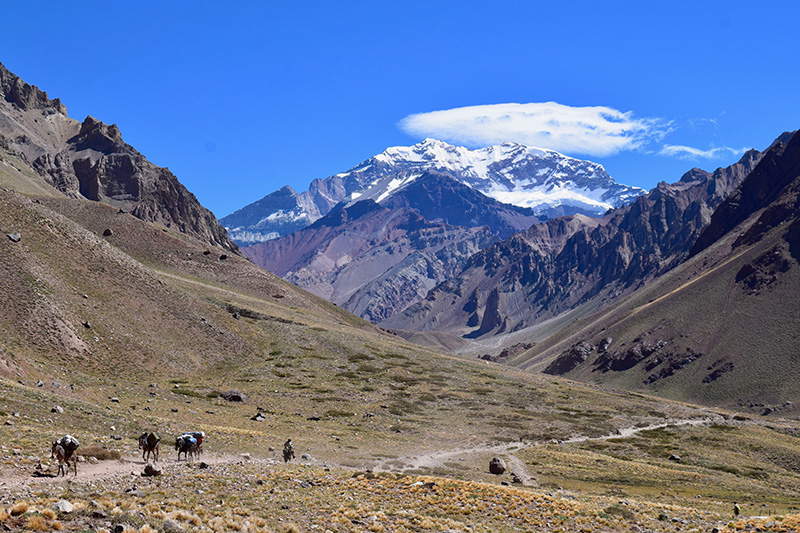
Aconcagua is not the highest mountain in the world, but, at 22,837 feet/6,961 meters, it is the tallest peak outside the Himalaya and Karakoram ranges. It is the loftiest mountain on the continent of South America, earning it a place among the Seven Summits. It is not a technical climb but walking in crampons and using an ice ax is necessary. Mountaineering expert Alan Arnette says the mountain is a relatively simple climb in that the approach is short and easy.
Travel writer, military veteran, endurance athlete, chef and Global Rescue member Amanda Burrill had summited Denali, Mount Kilimanjaro and Mount Elbrus before taking on Argentina’s Aconcagua. Despite her experience, the Aconcagua ascent included a major surprise.
The unexpected lack of snow was a shock. “If I couldn’t melt snow to make drinking water and cook food, it was going to really mess up the expedition. I almost felt like I was in an alternate universe — it was so cold and windy, but where’s the damn snow?” she wondered. Burrill found an alternative water source and successfully summited.
Make no mistake, it’s a tall mountain and it holds several challenges for high-climbers, including many from the recent winter season. In a typical 30-day period, Global Rescue executes hundreds of operations in dozens of countries and principalities. But for this special edition of Global Rescue’s Mission Briefs, we are exclusively highlighting a few of the many Aconcagua rescue operations completed in January.
Blindness at High Altitude
“I am at Aconcagua and have suffered partial blindness at my right eye due to prolonged hypoxia at altitude.” That was the emergency message from a Global Rescue member from Aruba. The Global Rescue medical operations team immediately launched an airborne field rescue and ground transport to the closest appropriate medical center. The member was successfully evacuated and was evaluated by an eye specialist who diagnosed a hemorrhage of the right eye. Retinal hemorrhages are a component of high-altitude retinopathy (HAR) in association with altitude illness. Fortunately, incidents of HAR generally resolve spontaneously without adverse visual outcomes. The member was discharged with a tomography report to present to his eye doctor when he returns home.
Nepalese Resident Gets Acute Mountain Sickness
A Nepalese member was diagnosed with severe Acute Mountain Sickness after persistent diarrhea and coughing. His oxygen saturation level was dangerously low at 50%. He was given supplemental oxygen and a dexamethasone injection in advance of a helicopter evacuation. The member was successfully medevaced and later transported to a nearby hospital for further evaluation. The member’s oxygen saturation improved to 97% and he was discharged in stable condition.

While not technical, Aconcagua is a highly underestimated climb | A 2019 Global Rescue Photo Contest submission
Post-Summit Stroke Symptoms
After summiting Aconcagua, a Salt Lake City member was discovered semi-conscious and demonstrated symptoms similar to stroke — including facial droop, non-normal speech and upper extremity weakness— during his descent. Global Rescue conferred with the member following his helicopter evacuation from the mountain. The member received a brain scan at a nearby medical center and was initially diagnosed with a Transient Ischemic Attack — a temporary period of symptoms similar to those of a stroke that usually lasts a few minutes without permanent damage. The member remained under observation and received a further neurological assessment. He continued routine evaluations and displayed no further symptoms. He was discharged and has been asymptomatic.
Knee Injury During Ascent
A member suffered a knee injury while climbing Mount Aconcagua. He was seen by a base camp physician and was ordered to evacuate. Global Rescue initiated a helicopter air evacuation for the member to the closest appropriate medical center where he was diagnosed with a sprained left knee and was given medication and medical care instructions by the treating physician.
New York Member Suffers HAPE
High Altitude Pulmonary Edema (HAPE) is a potentially life-threatening form of non-cardiogenic pulmonary edema that occurs in otherwise healthy people at altitudes typically above 8,200 feet/2,500 meters. Unfortunately, a New York member needed to evacuate Aconcagua after base camp physicians identified his symptoms as consistent with HAPE. Global Rescue ordered an airborne field rescue via helicopter. The member’s condition improved at the lower altitude and, soon after, he was able to resume his travels.
Fatigue and Shortness of Breath
Suffering from shortness of breath and fatigue, a member from Germany was airlifted off Aconcagua for medical attention related to moderate Acute Mountain Sickness. Following the successful field rescue, the member was transported to a lower altitude. She reported sustained shortness of breath, a sore throat and exhibited an inability to speak in full sentences. She was tested for COVID-19 and rested. After a few days, she recovered and learned her COVID-19 test was negative. The member’s flight was rescheduled and she returned home.

Sunrise on Aconcagua | A 2019 Global Rescue Photo Contest submission
High Altitude Illness for a Canadian Member
Outfitters leading an Aconcagua summit expedition discovered a Canadian team member was experiencing symptoms consistent with high-altitude sickness. Physicians at the base camp diagnosed the member with HAPE and moderate gastrointestinal pain. Global Rescue initiated an airborne field rescue and ground transport to a lower altitude. Following the evacuation, the member showed significant improvement. He was evaluated at a nearby hospital and received a prescription for antibiotics for diarrhea. He was discharged in stable condition with orders to rest before returning to Canada.
An Arizona and Florida Climber Grounded by HAPE
Two Global Rescue members, one from Arizona and the other from Florida, suffered symptoms of High Altitude Pulmonary Edema (HAPE) and were immediately recommended for an airborne field rescue. The two members were successfully transported off the mountain to a lower altitude and evaluated by a local physician. Following a day of rest and recovery, the members were feeling well and set to return to the U.S.
COVID-19 Field Rescue
A Global Rescue member from Brazil suffering from shortness of breath and a mild cough registered a blood-oxygen saturation level of 45%, well below normal. She also tested positive for COVID-19 and needed immediate evacuation. Global Rescue ordered a helicopter field rescue and ground transportation to a nearby hospital. The member was evaluated, prescribed medications and released from the hospital to quarantine at her hotel. Global Rescue monitored her condition while she isolated. Following a negative COVID-19 test result and no symptoms, the member was able to return home.
Texas Climber Gets HAPE
A Texas climber needed a helicopter evacuation off Aconcagua after being diagnosed with High Altitude Pulmonary Edema (HAPE). The member was initially evaluated by a base camp physician who noted some fluid in the member’s lungs and recorded a blood-oxygen saturation level of 65%. Global Rescue launched an airborne field rescue for the member and ground transport to a nearby hospital. The member was given an injection of dexamethasone and diphenhydramine. Following significant improvement and registering a blood-oxygen saturation level of 96%, the member was discharged and advised to avoid high-altitude climbing for the next three months.
Categories:
Health & SafetySecurity & IntelligenceTravelFebruary 15, 2022
What does “Do Not Travel” really mean? That’s what a well-traveled customer asked Global Rescue recently.
“I just checked the ‘Do Not Travel’ list. Basically the entire world has been put on a ‘Do Not Travel’ advisory. A few countries, like Sierra Leone, are not on this ‘Do Not Travel’ list, whereas countries like Switzerland and Antarctica are. I am not quite sure who makes this confusing ‘Do Not Travel’ list. Sierra Leone is a country with high crime and high levels of civil unrest, which you can’t really say of Switzerland. How would Global Rescue’s product fit into this unpleasant global blanket of ‘Do Not Travel’?”
Global Rescue’s Perspective
It’s a valid question, and one we’ve been hearing more and more with the rise of omicron and other variants. What takes precedence when making travel plans: security risks, health risks, coronavirus risks, or a combination? And what warnings do you follow: The Department of State (DoS), the Centers for Disease Control and Prevention (CDC), the country’s consular warnings or Global Rescue?
Here’s what travelers need to know about “do not travel” warnings according to Global Rescue travel experts from three departments — intelligence, operations and member services. We break down who is doing the warning, how to balance the information, and how Global Rescue creates its travel warnings.
Who Does The Warning?
The Department of State, established in 1789, is responsible for the nation’s foreign policy and international relations. To maintain diplomatic relations with 180 countries, the Department of State compiles and analyzes reports from overseas, provides logistical support to diplomatic posts, and issues passports and travel warnings. Travelers can access safety and security information about every country in the world on their website: travel.state.gov.
Understanding CDC Travel Health Notices
The CDC also offers Travel Health Notices and, more specifically, COVID-19 Travel Recommendations by Destination. Travel Health Notices, which have four levels of warning, inform travelers and clinicians about current health issues that impact travelers’ health — disease outbreaks, special events or gatherings, and natural disasters — in destinations around the world. The COVID-19 Travel Recommendations, with four levels of warning, are based on the number of COVID-19 cases in a destination.
“CDC risk levels and DoS Travel Advisories are not the same thing, although they sometimes match and they sometimes don’t,” said Kent Webber, senior manager of Intelligence Products and Services at Global Rescue. “There was a movement at the peak of the pandemic to synchronize the two, but this appears to be reverting back to separate ratings as merited.”
How Should Travelers Balance Warnings?
You’re researching your travel destination, say Kyrgyzstan, and you’re finding conflicting answers about the area’s safety. The CDC gives the country a Level 1 (Low Level of COVID-19) Warning — as does the state department (Exercise Normal Precautions). Dig a little deeper and the U.S. Embassy of The Kyrgyz Republic notes the country’s medical services have struggled to provide adequate care for serious cases of COVID-19.
As you investigate the security risks of Kyrgyzstan, you find muggings are commonplace — and sometimes violent. There’s also tension over the recognition of the Kyrgyz/Tajik border with clashes in May and December 2021, prompting Australia to give Kyrgyzstan a Level 4 Warning. And there could be hidden landmines.
How should travelers balance this safety and security information?
“The answer to this question varies from person to person, what they consider is important and what affects them most,” said David Koo, associate director of Operations at Global Rescue. “Personally, I evaluate security risk first, then health risk. Why? I can take measures to mitigate personal health risks — not interacting with stray dogs or cats so I don’t get bitten — unlike taking a trip to a high-security risk area where I cannot control external factors like the location, timing or actions of the perpetrators.”
As for COVID-19, you can’t avoid it, but you can reduce your risk of getting infected. Koo suggests following standard safety protocols — wearing face masks in public or crowded places, maintaining social distancing and practicing good personal hygiene — and consider vaccination in order to travel safely.
“The COVID health alerts will also alert you to travel restrictions,” he said. “This will help you adjust your trip plans.”
Global Rescue Looks at the Big Picture

Global Rescue has a team of intelligence experts researching travel destinations and tracking possible health and security risks 24/7/365. The team culls information from a variety of global sources: news outlets, social media feeds, individual government alerts, Department of State and CDC health alerts, nature newsletters, global organizations, podcasts, broadcasts and blogs.
“It seems like rating countries should be an easy process but it’s not. We have the same difficulties with Global Rescue country ratings where we try to quantify health and security risks to come up with an overall risk,” Webber said. “Is it an art or science? Does one type of risk (or one of its components) weigh more than another? Is it the relationship between components constant or relative? At what point does medical supersede security or visa-versa?”
[Related Reading: Survey: Revenge Travel Continues Despite War; Riskier, Immersive Trips Increase]
There is no perfect solution, but members benefit from Global Rescue’s deep dive into all sources of travel information and on-the-ground travel experience to determine the big picture of a destination’s risk.
“It’s best to avoid reliance on a single source of information. It’s better to try and balance several sources to reach our own conclusions,” Webber said. “At Global Rescue, we try to come up with a defensible, logical conclusion so our customers don’t have to.”
The Global Rescue Intelligence Team adds another important layer of detail to their extensive research: The information isn’t one size fits all; it is context-based. So what may be considered an extreme safety threat in one country — civil unrest with protests and demonstrations — may not be so unusual in another country.
Even after you’ve researched and selected your destination, Global Rescue keeps travel risk information at your fingertips. You can set up real-time alerts to keep you apprised of any health or safety issues while you are on your trip.
What Does a Global Rescue Membership Cover?
“Medical advisory and evacuation services are available regardless of the travel advisories,” said Danielle Ferguson, manager of Member Services at Global Rescue.
The Do Not Travel warnings come into play if members have added security to their membership.
“If you are ill or injured in a Do Not Travel country, Global Rescue will still arrange and pay for a medical evacuation as the Do Not Travel restrictions only apply for security evacuations,” Ferguson said. “If someone travels an area rated Do Not Travel by the U.S. State Department, and has a security membership, Global Rescue can still arrange for an evacuation, however, the member is responsible for the cost.”
The Global Rescue Advantage
Global Rescue members are always able to access data compiled and evaluated by the intelligence and security teams. From daily event bulletins, monthly destination reports and specific information requests, a Global Rescue travel membership is a perfect way to travel prepared.