Article Highlights:

  • Accelerated Everest expeditions shift acclimatization off the mountain through hypoxic training and xenon gas protocols.
  • Reduced rotations decrease exposure in objective danger zones like the Khumbu Icefall.
  • Logistics become front-loaded, increasing precision requirements and Sherpa technical responsibility.
  • Summit window decisions become more data-driven with stricter abort thresholds.
  • High-altitude risk remains unchanged at 8,848 meters, regardless of expedition duration.


As reported in National Geographic, in 1978 Austrian physician Oswald Oelz served as team doctor when Reinhold Messner and Peter Habeler became the first climbers to summit Mount Everest without supplemental oxygen — a feat many physiologists believed impossible at 29,032 feet, where atmospheric pressure leaves humans breathing roughly 30 percent of the oxygen available at sea level.

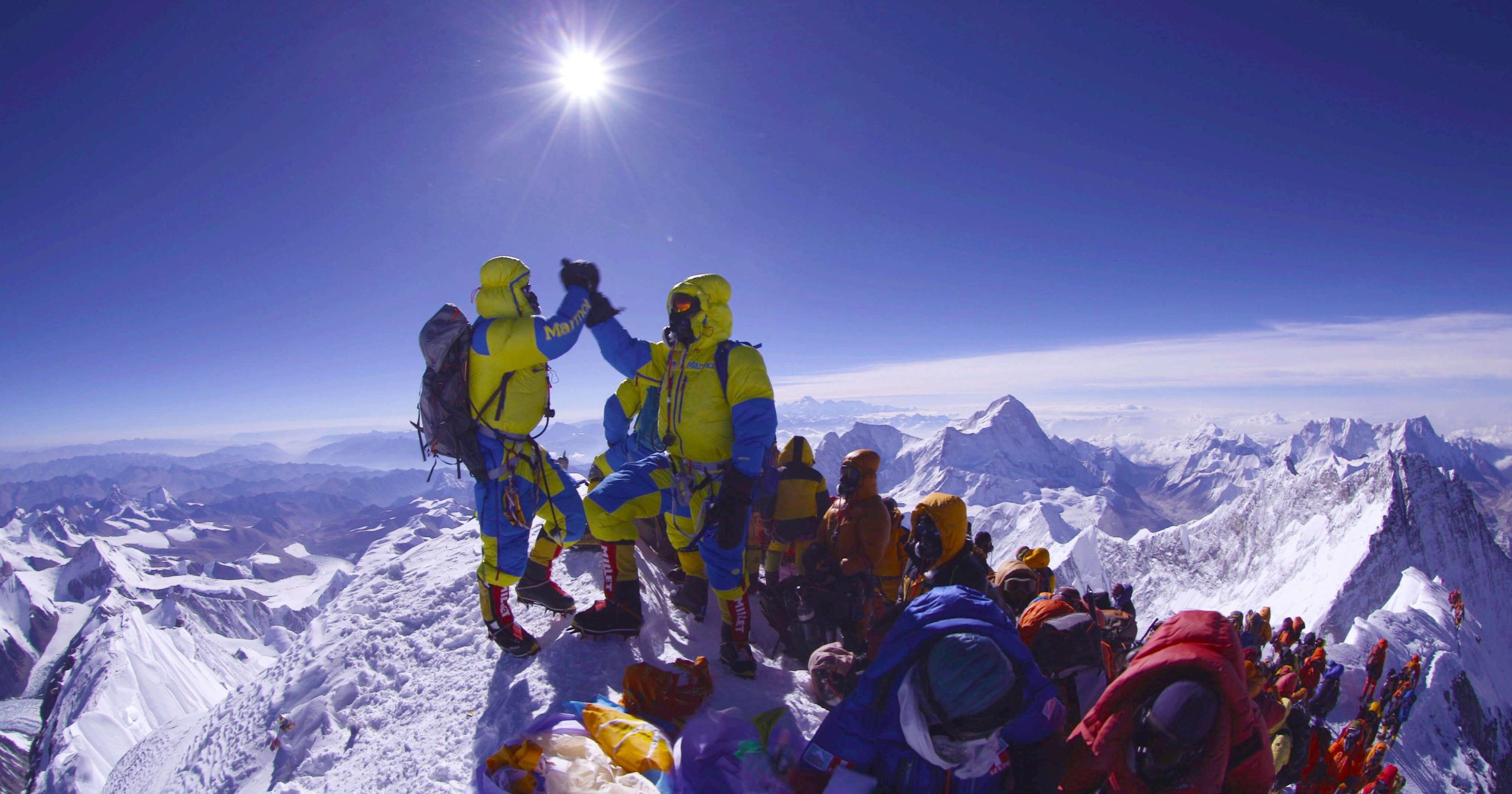
Nearly five decades later, Oelz’s grand-nephew, Austrian guide Lukas Furtenbach, has advanced a different high-altitude breakthrough. In May 2025, four clients and five Sherpas summited Everest just five days after leaving London, relying not on weeks of gradual acclimatization but on pre-acclimatization systems and xenon-assisted physiological preparation.

The shift from oxygen-free ascents to xenon-assisted acclimatization captures the evolution of modern mountaineering: not just physical endurance, but biochemical intervention.


Understanding Xenon Gas and How It Works

Xenon gas is sometimes used in hospitals as a safe anesthetic. In mountaineering, it has drawn attention because of how it affects the body’s response to low oxygen at high altitude.

When you climb high into the mountains, your body senses that oxygen levels are lower than normal. In response, it produces more of a hormone called EPO, which helps create additional red blood cells. More red blood cells allow your blood to carry more oxygen, which is one of the key ways the body adjusts to altitude over time.

Supporters of xenon say it can “trick” the body into starting that process earlier. By stimulating the body’s low-oxygen response, xenon may increase EPO production without requiring weeks of exposure to thin air. Some also believe it may help protect the brain and lungs from the stress caused by extreme altitude.

But altitude adaptation is not just about red blood cells. Over time, the body also changes how you breathe, how efficiently your cells use oxygen and how fluids shift throughout your system. These adjustments develop gradually through real exposure to high altitude.

Xenon may influence one piece of that puzzle, but it does not recreate the full, complex process of natural acclimatization.


Traditional vs. Accelerated Acclimatization Architecture

According to Lukas Furtenbach, owner at Furtenbach Adventures, the difference between a classical six-to-eight-week expedition and a two-week xenon-assisted expedition is structural rather than cosmetic.

A traditional Mount Everest expedition follows a gradual biological rhythm. Climbers conduct multiple rotations through the Khumbu Icefall and Western Cwm, progressively spending nights at Camps 1, 2 and 3. This “climb high, sleep low” strategy allows the body to adapt incrementally to high altitude while distributing load carries and camp stocking over weeks. The model builds in weather buffers and allows teams to observe jet stream patterns before committing to a summit push. The tradeoff is cumulative fatigue and repeated exposure to objective hazards such as avalanches, crevasses and serac collapse.

In the accelerated model, much of the acclimatization occurs before arrival in Nepal, Furtenbach notes. Climbers use hypoxic training systems at home to simulate altitude exposure. Xenon gas is administered in controlled settings to stimulate erythropoietin response and potentially protect the lungs and brain from hypoxic stress. On the mountain, only one short rotation — sometimes two — is conducted before the summit push. The time spent in high-risk zones such as the Icefall is significantly reduced.

“The key structural shift is that acclimatization moves partly off the mountain,” Furtenbach explains. “That reduces exposure risk but increases dependence on preparation quality and physiological monitoring.”


Logistics in a Compressed Timeline

High camp logistics also transform under acceleration. In a traditional expedition, camps are stocked progressively and loads are distributed gradually among Sherpa teams. Weather delays can be absorbed because the schedule allows flexibility. Oxygen bottles, tents and fixed lines are staged methodically over time.

In a two-week framework, explains Furtenbach, the system becomes front-loaded and tightly synchronized. Infrastructure must be prepared earlier in the season, and Sherpa teams assume higher technical responsibility before clients arrive. There is little margin for delay. Forecast accuracy becomes critical because compressed expeditions cannot afford extended waiting periods at base camp.

Furtenbach notes that summit window decision-making becomes more data-driven and less intuitive. Traditional expeditions observe jet stream behavior for weeks before selecting a broad May window. In a 14-day structure, teams must target a narrow forecast window with strict abort thresholds. If atmospheric conditions deviate from expectations, retreat is immediate.

Acceleration reduces duration, not consequence.


Sherpa Workload and Industry Structure

When asked about broader ecosystem effects, Furtenbach calls the issue “the most important question.”

Within his company, accelerated expeditions do not reduce Sherpa employment, but they change workload distribution. There is more pre-season preparation, higher technical responsibility and shorter yet more intense field phases. Efficiency per day increases, but so does performance pressure.

Across the broader Nepalese guiding ecosystem, if accelerated expeditions became dominant, several structural changes could occur. Faster rotations would compress schedules and increase operational precision demands. Companies with advanced logistics and medical monitoring capabilities might concentrate market demand, potentially stratifying the industry. Compensation models could shift from duration-based pay toward expertise-based valuation.

“The risk is not fewer jobs,” Furtenbach says, “but a more stratified market. The key question is whether the transition strengthens Sherpa leadership roles or compresses margins. That depends on how responsibly the model is implemented industry-wide.”


Physiological Observations on the Mountain

Furtenbach reports observable differences among climbers using structured pre-acclimatization protocols. Teams have documented faster recovery at Camp 2, fewer severe altitude symptoms early in the expedition and more stable oxygen saturation profiles.

Yet he emphasizes that xenon-assisted acclimatization changes the curve of physiological adaptation — it does not eliminate altitude risk. High altitude remains unforgiving. Climbers increasingly rely on pulse oximetry, heart-rate variability tracking and tighter turnaround rules. Data has become integral to risk management.

“The major shift is psychological,” he explains. “Climbers feel ready earlier. That can be positive — but it can also create overconfidence. We remain conservative in progression schedules despite acceleration.”


The UIAA Position: Controversy and Ethics

The International Climbing and Mountaineering Federation (UIAA) has taken a clear stance on xenon use in mountaineering.

“Xenon-assisted high-altitude climbs are not accredited or endorsed by major mountaineering bodies and are highly controversial. The UIAA explicitly advises against using the anesthetic gas for acclimatization, citing lack of evidence for performance benefits, potential safety risks, and ethical issues.”

The controversy centers on several factors. First, the scientific literature remains limited regarding long-term safety and efficacy in high-altitude performance. Second, there are concerns about medical risk outside controlled hospital environments. Third, ethical questions arise regarding fairness and the evolving definition of unsupported mountaineering achievement.

While xenon is not classified as doping under traditional sporting frameworks in this context, its use challenges long-standing norms around what constitutes self-powered adaptation in the Himalaya.


Essential Advice for Himalayan Climbers and Trekkers

Reflecting on recent seasons, Furtenbach offers practical guidance applicable to both traditional and accelerated expeditions.

He stresses that expedition quality is determined months before arrival in Nepal. Preparation — including hypoxic training, medical screening and logistical planning — outweighs last-minute adjustments. He urges climbers to respect increasing weather volatility, noting that jet stream dynamics have become less predictable and contingency planning is essential. He cautions that cardiovascular fitness does not equal altitude resilience; VO₂ max does not predict acclimatization capacity, and hypoxic tolerance must be trained specifically. Finally, he emphasizes that operator selection matters. Logistics, medical oversight and risk culture are more consequential than marketing narratives.

He closes with a principle that transcends models and methods:

“The mountain does not negotiate. Time compression does not reduce seriousness. Whether you climb in two weeks or eight, the altitude remains 8,848 meters/29,028 feet. Efficiency must never replace humility.”


The Global Rescue Connection

High-altitude mountaineering and trekking in the Himalaya continue to grow in popularity, with more climbers operating above 15,000 feet (4,600 meters) than ever before. Regardless of expedition duration, emergencies at high altitude require specialized response capability.

Global Rescue’s High-Altitude Evacuation Package provides services to members 16 years of age and older who travel above 15,000 feet during any part of their trip (excluding airplane travel) and require emergency transport due to injury or illness.

“High-altitude outdoor activity worldwide is reaching unprecedented heights of curiosity and participation and Global Rescue’s High-Altitude Evacuation Package supports the expanding interest with longer deployments of medical and rescue operations personnel in more regions,” said Ed Viesturs, the only American to have climbed all 14 of the world’s 8,000+ meter peaks and the fifth person to do so without using supplemental oxygen.

Operational examples underscore the realities of high-altitude risk. A member from Bandar Utama, Malaysia suffered snow blindness, weakness and inability to descend from Himlung Himal Camp 2.5. She was evacuated by helicopter to Kathmandu and diagnosed with superficial punctate keratitis, high-altitude retinopathy and high-altitude pulmonary edema before receiving IV fluids and supportive treatment. In another incident, a U.S. member fell near Gorak Shep at approximately 17,717 feet, sustaining facial injuries and brief loss of consciousness. He was evacuated for imaging and monitoring, stabilized and later discharged.

Global Rescue provides field rescue from the point of injury, medical evacuation to appropriate facilities, 24/7 medical advisory services and detailed Destination Reports that help climbers assess healthcare access and regional risk before departure.

Xenon is currently an experimental substance for mountaineering. As a result, Global Rescue services may not apply if a member uses xenon — or any other experimental substance — and that use contributes to or causes a medical condition requiring hospitalization. “The use of xenon gas is not necessarily a disqualifier for Global Rescue services unless a medical condition that occurs during the climb is related to the use of xenon gas,” said David Koo, director of operations for Global Rescue and a former combat medic and emergency nurse.

Whether through traditional acclimatization or xenon-assisted acceleration, mountaineering at high altitude remains inherently serious. Innovation may compress timelines, but it does not change the physics of extreme altitude.

Above 8,000 meters, biology, weather and consequence still rule.