Categories:
Missions & Member TestimonialsMay 28, 2020
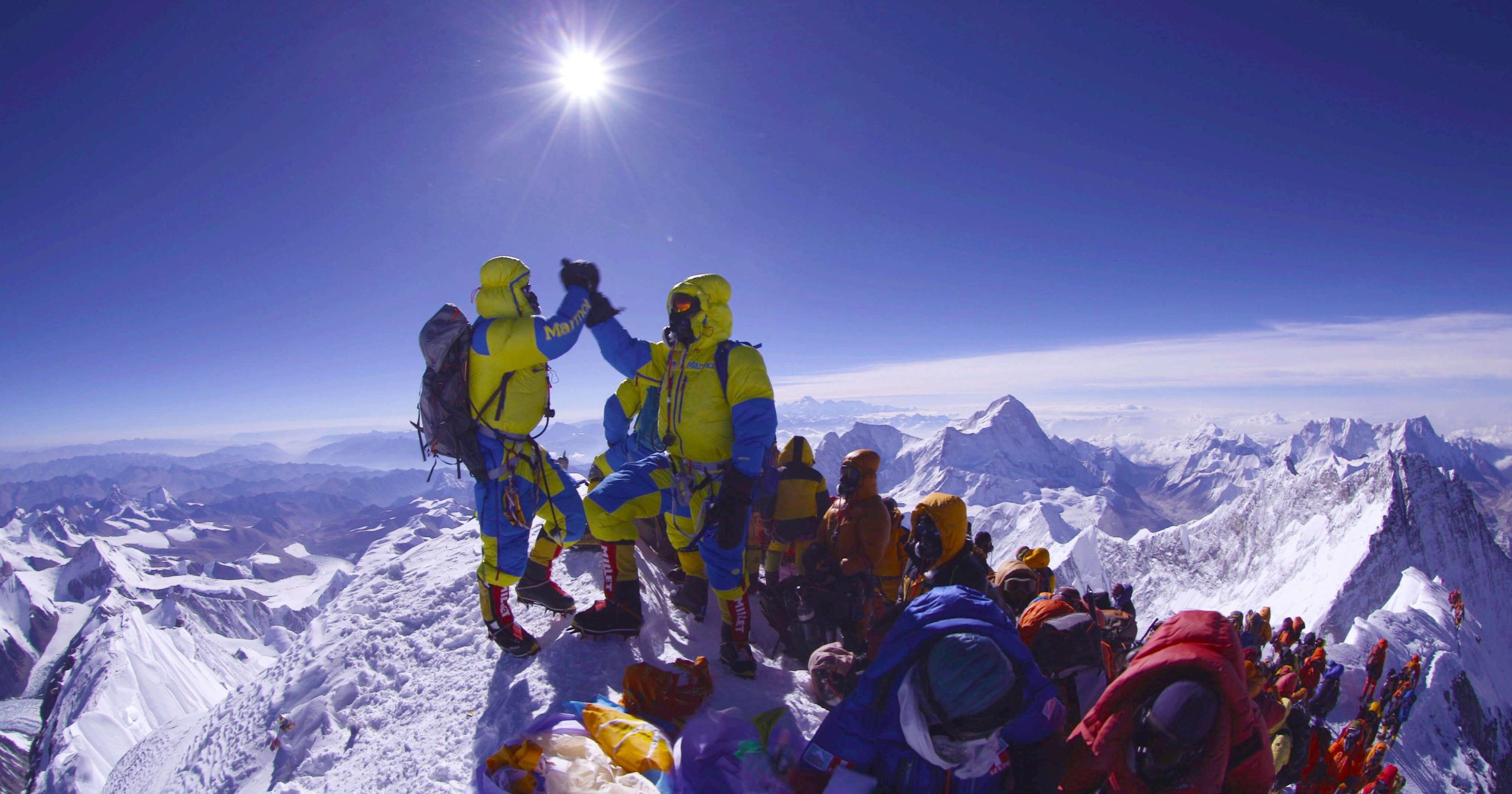
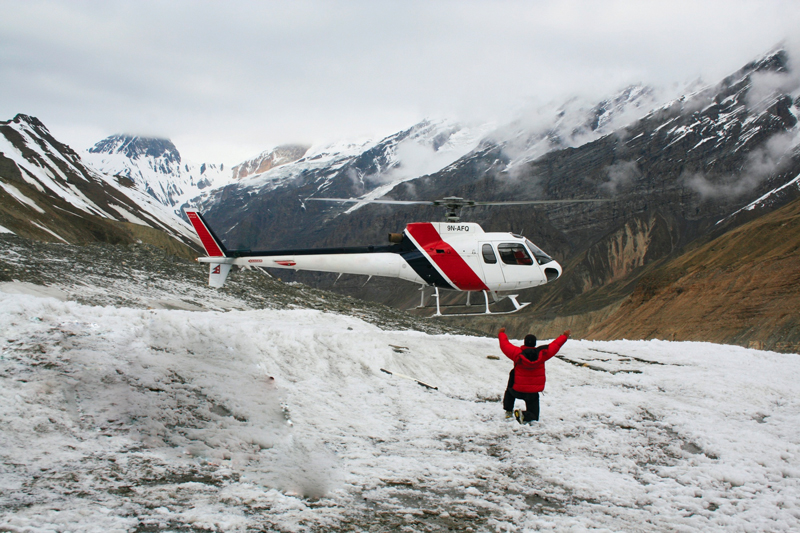
“I couldn’t walk and then the helicopters came shooting over the mountain at the exact same time. It was a Hollywood moment,” said Alastair Swinton, an experienced climber who needed rescue from the Koyo Zom mountain in Pakistan.
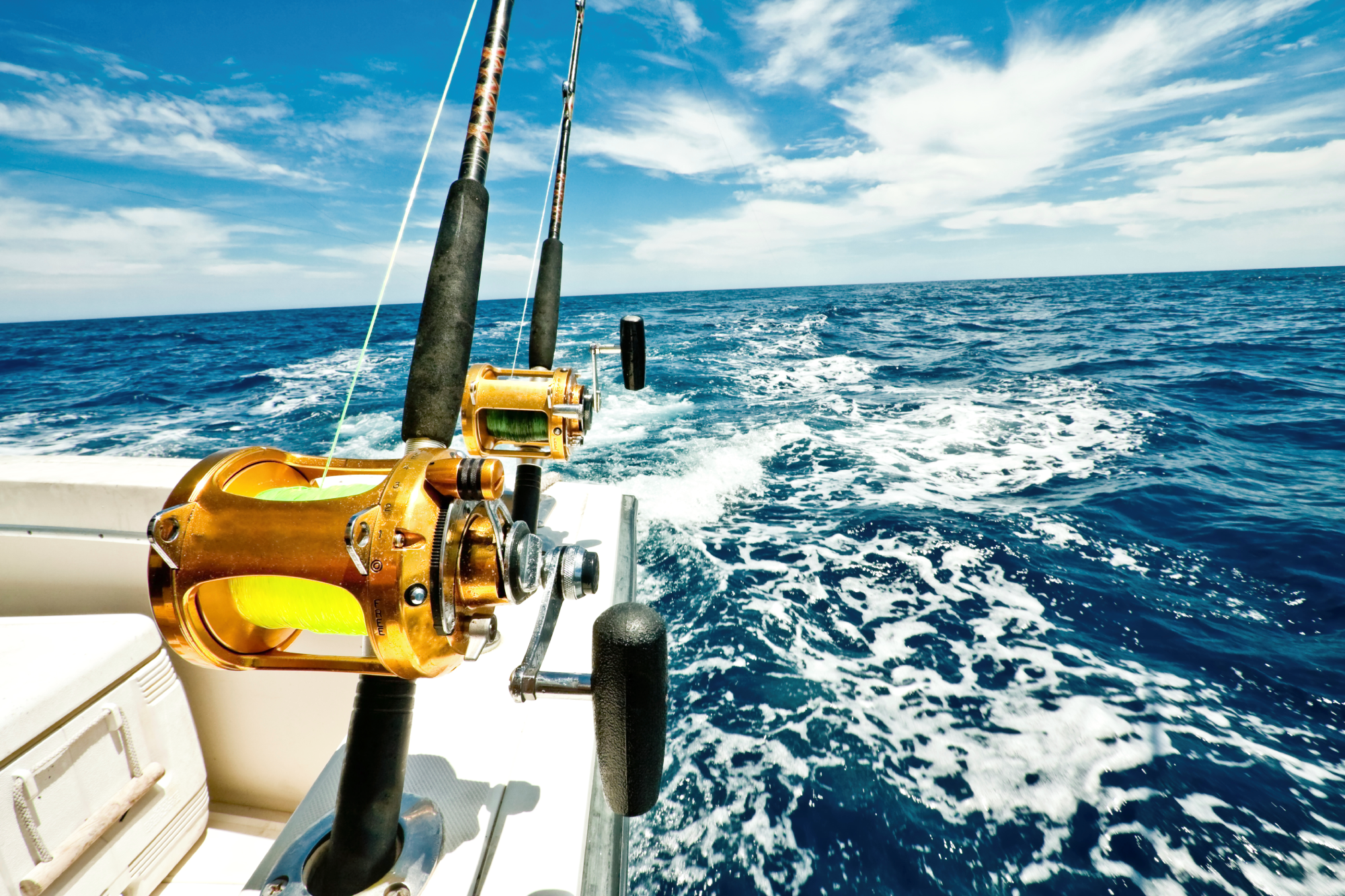
“I knew if I stayed here, I might lose my arm — or my life,” said Scott Sirles, a fly fisherman in Kamchatka who suffered a horrible dog bite.
“In Africa, when your guide screams ‘run,’ it’s bad,” said Daniel Core, a veterinarian who was attacked by a giraffe in Zimbabwe.
“I was as broken as a person could be,” said Richard Jorgensen, who sustained multiple broken bones following a terrible heliskiing accident in British Columbia.
These are authentic reactions from real people who learned firsthand why a Global Rescue membership was the best choice for them. The experiences of Global Rescue’s members are the best source to define five of the most significant qualities that differentiate its services from all others.
1. Rescue from the Point of Illness or Injury
CEO Dan Richards wanted to build a company that would be there for members and their families during a time of crisis. It had to be better than what other firms were doing.
“When the chips were down, these other companies didn’t have the ability to deliver in the way you’d want for yourself or a loved one,” he said.
That was 15 years ago. Since then Global Rescue has grown into the world’s leading membership organization providing medical, security, evacuation and travel risk services. Part of that growth comes from pioneering worldwide field rescue capability that’s able to evacuate members from the point of illness or injury to the nearest appropriate health care facility.
Richards recounts an early rescue of a member who fell 50 feet into a cactus in a remote area.
“He calls me on the anniversary of his rescue to thank me and remind me that what I’m doing is important,” Richards said. “Global Rescue responds when people are having, in many instances, the worst day of their lives and we do what’s necessary to make it better.”
2. The Right Hospital, Not Necessarily the Closest
If you’re traveling away from home and need to be hospitalized, Global Rescue has the proven capability to direct, or transport, members to any of its global network of medical centers of excellence or back to their home hospital of choice.
“I could not have had better care even if I was home,” said Dr. Harris Silverman, whose sore throat and cold turned into something much more serious while traveling from the Sea of Japan to the South China Sea.
“My oxygen saturation level started to plummet, so I suggested we take a chest X-ray” he said. “The results showed a collapsed right lower lung lobe with what appeared to be a fluid level.”
The ship’s doctor told Silverman his condition prohibited further travelling or flying back to his Florida home. The ship’s doctor said, “It’s time to call in Global Rescue.”
Dr. Silverman was impressed.
“The doctor Global Rescue recommended was outstanding in every way. Her care was spot on.”
If you do have to be hospitalized and you’re far from home, Global Rescue’s in-house staff can deploy to your bedside to help support your care and coordinate your evacuation – no matter what the situation. That was the case for Dr. Silverman when Global Rescue arranged for a local nurse to assist with his care.
“She tracked everything with great attention to detail. She made sure nothing was lost in translation,” he said.
3. Integrated Medical and Security Services
“When you find yourself in a scenario and you need to hit that red button, these are the folks you want on the other side,” said Dan Davala, Fly Fishing Specialist at Orvis.
The Global Rescue operations centers are staffed by experienced physicians, nurses, paramedics and U.S. military special operations veterans. Team members have experience with hazardous environments, peacekeeping operations, Himalayan expeditions and protection services, as well as wilderness skills and crisis response training. The company has more than 20,000 operations under its belt.
That’s the experience that made an impact on a member whose college-age daughter was caught up in the Hong Kong civil unrest.
“The specifics from Global Rescue made the difference,” Daniela Shields said. “I learned things about the Hong Kong protests from Global Rescue that I didn’t hear until the next day on the news. I felt like we were ahead of the eight-ball at every turn.”
4. Call Global Rescue, Not a Call Center
No one wants to navigate through a call center, pressing a series of numbers on the dial pad in the middle of a crisis. When a Global Rescue member calls, a Global Rescue employee picks up the phone and engages with personalized communication, recommendations and responses until the emergency is resolved.
“I was so impressed with the communication and the professionalism. For something minor, I was treated as if I had a major catastrophic issue,” said retired registered nurse Linda Quinn. “The team at Global Rescue was back and forth with me, following along until I was at the point where I said, ‘I can take it from here.’”
5. Travel Prepared
Travelers — adventure, business, personal, solo or otherwise — don’t have to puzzle together a patchwork of sources to sort out entry requirements, immunization updates, safety levels, weather disruptions, civil unrest, or local holiday impacts. Global Rescue’s Destination Reports offer all three components: medical, security and intelligence.
“I carry a Global Rescue membership not just for medical evacuation but security as well,” said Oliver White, professional angler and world traveler. “When I’m going somewhere a little riskier, I call Global Rescue and walk through my itinerary. They give me a country debriefing and local contacts, should I have any issues.”
May 27, 2020
When Michael Blease-Shepley left his home in the United Kingdom on March 14th, 10 days before widespread restrictions were enacted by the British government, it was for a three-week work assignment in Nigeria. He didn’t know the outbreak was going to turn into a pandemic.
“I was basking in the sunshine with 80,000 people in the U.K. at Cheltenham horse racing festival. It’s fair to say I had no idea the outbreak would reach the levels it did, especially in the U.S. and the U.K.,” he said.
Fifty days later, Shepley emerged from an international odyssey of multiple quarantines, civil unrest, coronavirus fears and xenophobia with a renewed appreciation for the complexities associated with a global outbreak of a contagious disease.
“I had a three-week work assignment in Nigeria. My return flight was set for April 3rd,” he said.
Unfortunately, by that time the coronavirus was disrupting everyone’s plans. Flights in and out of Nigeria were canceled and the international airport was closed.
“I was supposed to be home in time for my wife’s 40th birthday party.” He didn’t make it.
Blease-Shepley left the U.K. without seeing any evidence of the seriousness of the troubles looming. He experienced no issues during his trip from the U.K. to Nigeria.
“There was nothing going on at the airports. I went from my house to Heathrow Airport and there were no precautions anywhere. Nothing was different,” Blease-Shepley said.
He checked his bags and waited in the lounge – everything seemed normal. On the flight it was business as usual.
“It all looked normal. No masks, no gloves, no precautionary seat spacing,” he said.
The normal look of things didn’t change after arriving at the Nigerian airport where Blease-Shepley collected his luggage and hopped into his company car service.
“I had armed security detail – but that’s routine in Nigeria – even during normal times.”
Again, he saw no evidence of pandemic fears or precautions anywhere, particularly in Lagos, the country’s largest city.
“I arrived at the apartment, showered, changed and went to work.”
That’s when things changed for Blease-Shepley. When he arrived at the office, he was briefed on the client project. Then one of his client leaders asked if he had arrived from the U.K. When he confirmed he had, he was immediately ordered into a two-week isolation, working from his apartment.
“Within hours of arriving in Lagos I was asked to do self-isolation.”
It was his first experience where the outbreak was more serious than he previously thought.
Blease-Shepley returned to his apartment and self-isolated for almost two weeks. But during that time things got gradually worse. The virus had been identified as a pandemic. Countries everywhere were issuing travel restrictions, stay-at-home orders, closing roads, airports and businesses.
“Seven days into my initial isolation everything shut. It was a complete, forced lockdown.”
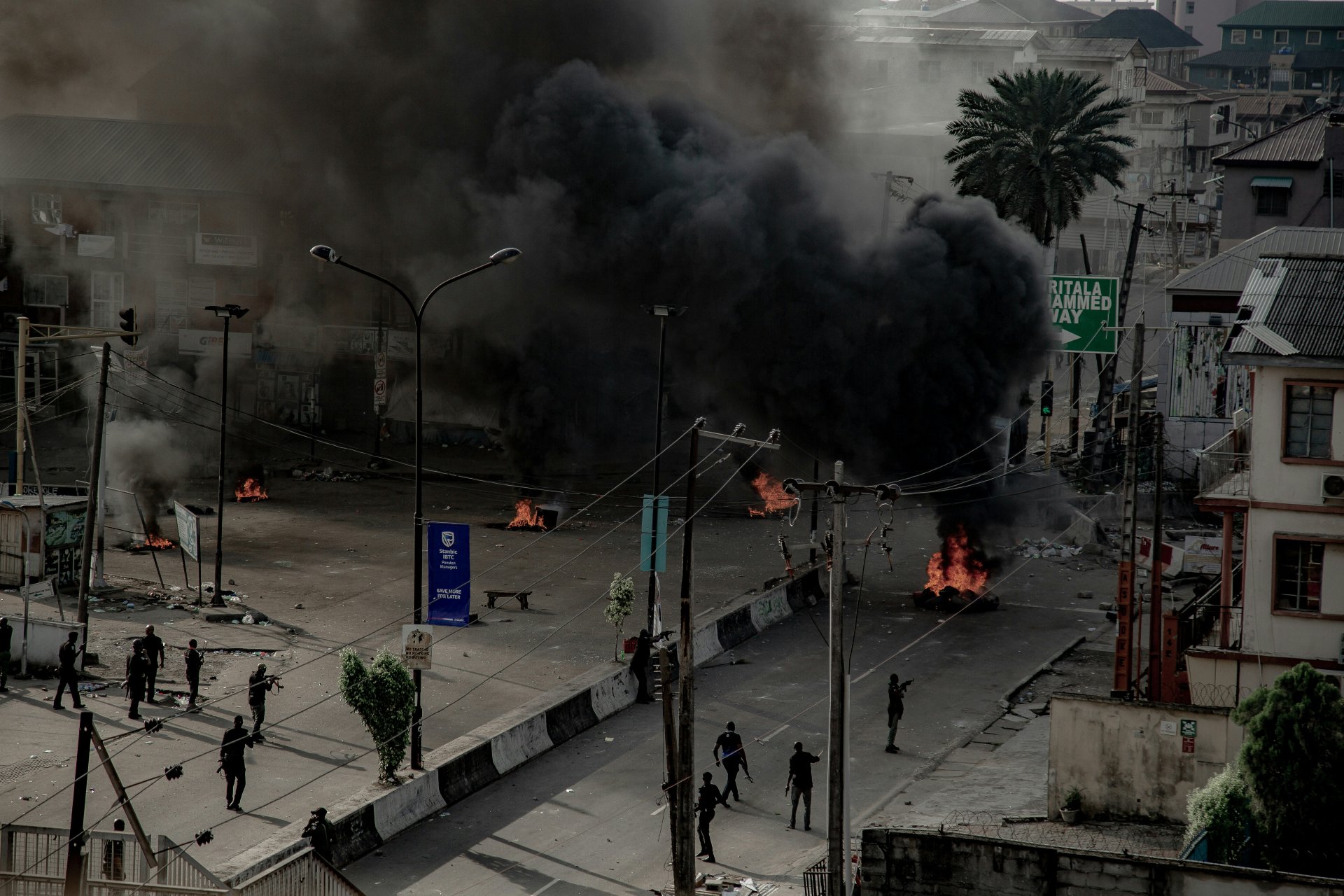
“The social unrest was escalating daily with limited law and order. Road blocks were put up everywhere. The Military and Police were on the streets in Lagos to control organized gangs. There were running battles in the streets,” he said.
Blease-Shepley’s security detail at his apartment was visibly compromised. Guards were lacking proper protective equipment and were insufficiently armed.
“Guards were supposed to have bullet resistant vests. They didn’t have any magazines for their rifles. I knew I needed to move to a safer location.”
Blease-Shepley found an alternative apartment at a fortified compound after coordinating with his network of colleagues. He quickly relocated into a building that housed British Marines as residents and guards.
“I stayed there for about four weeks. That’s when I started to engage Global Rescue. I needed to get out of Nigeria and back home,” he said.
Blease-Shepley was meticulous about isolation. He knew if he was infected with coronavirus his chances of getting out of Nigeria and back to the U.K. would be severely limited.
“I hunkered down. I was screened for the virus every other day and thankfully, I had no fever or any other symptoms.”
But the developments outside were changing rapidly. It was getting more and more dangerous day by day.
“We were hearing Westerners were being targeted, robbed, even kidnapped and held for ransom. We heard of at least four or five expats that had been seriously compromised.”
Global Rescue’s operations team kept in frequent contact with Blease-Shepley – daily and sometimes more frequently. An intense and time-consuming, international scramble kicked in as multiple plans were formulated for a repatriation flight out of a locked down country.
It would take time for government, health and transportation officials from multiple countries— including Nigeria, the U.K. and the U.S. — to coordinate how and when jets would be permitted to land, load expat passengers and depart, while simultaneously taking an abundance of caution to prevent exposure to – or spread of – coronavirus.
Global Rescue officials kept Blease-Shepley appraised. He realized he would likely need to remain sheltered for about 10 days.
“During the next week and a half there were no government repatriation flights. Global Rescue had a team of special operations experts working to obtain a private aircraft to get me out – but the permitting was troublesome and could not be obtained from local officials. I was also running out of food,” he said.
Global Rescue stepped in to help on that front, arranging for the pickup and delivery of a five-day supply of groceries for Blease-Shepley.
“I really don’t know how my guy at Global Rescue did that. It was pretty nice getting those steaks and other provisions.”
At the end of 10 days, numerous calls, meetings, planning and a few false starts brought on by the unprecedented circumstances, Global Rescue managed to get Blease-Shepley on a repatriation flight.
“It was crazy. It came from nowhere,” he said.
It was late Tuesday night and Blease-Shepley received a phone call from a top official at the British-Nigerian Mission.
“She had spoken to someone at the American Embassy and – I believe – the Global Rescue operations team and then next thing I knew I was on a repatriation flight set for Wednesday afternoon – in a business class seat no less.”
The late-night notification gave Global Rescue less than 12 hours to arrange for an armed security team to collect Blease-Shepley and transport him to the airport.
“I was picked up by a private security team. The lead vehicle was manned with several armed guards. I was in the middle car. The trailing vehicle also had several armed guards in the back. I’m used to armed security details but this was a bit more firepower than I’d seen before,” he said.
The added security and Blease-Shepley’s British Government Diplomatic clearance paperwork was sufficient to get through all the road blocks.
“There was just one where we were stopped but after some pushing and shoving, we were on our way.”
Blease-Shepley made it home safely and was immediately ordered into a seven-day isolation. His final quarantine day was May 2nd. Blease-Shepley had spent the better part of 50 days in isolation in Nigeria. He never had a coronavirus symptom and still does not. He credits key personnel at Global Rescue for all the assistance, especially the peace of mind during an unpredictable time of insecurity and health threats.
“They kept me settled, calm and informed. That was the best,” he said.
When Blease-Shepley finished talking with Global Rescue for this article, he celebrated the end of his final quarantine by going outside to take a walk with his wife and young children.
Welcome home, Global Rescue member Michael Blease-Shepley.
Categories:
NewsMay 27, 2020
Categories:
Health & SafetyTravelMay 20, 2020
How many items do you touch during the day? If you’re at home, the list might include door handles, faucets, counters, light switches, knobs, drawer pulls, chairs, tables, utensils, pens and pencils, your phone, television remote, computers, to name just a few.
If you venture outside of the house, the list gets longer — add elevator buttons, door handles, ATM screens, check out key pads, gas pumps — and more people are touching the things you are touching.
A study by The New England Journal of Medicine found the coronavirus lasted on plastic and steel for up to 72 hours, cardboard for up to 24 hours and copper for up to four hours. Of course, it’s not the main way the virus spreads — that’s due to coughs and sneezes — but it’s part of the problem.
An April 2020 Global Rescue survey found that 77% of respondents are planning a trip by October. Even if travelers follow protocols, protection is the key to reducing personal infection and prevent the spread.
Global Rescue experts have compiled some suggestions to reduce the risk of coronavirus contagion and increase your pandemic preparedness. Emergency supplies for the pandemic include a local travel kit (for your purse or pocket), an airport emergency kit to increase public health safety and a hotel supply kit to increase personal safety.
Travel Pandemic Kit
These three items are a must-have on any trip in today’s coronavirus world.
Masks
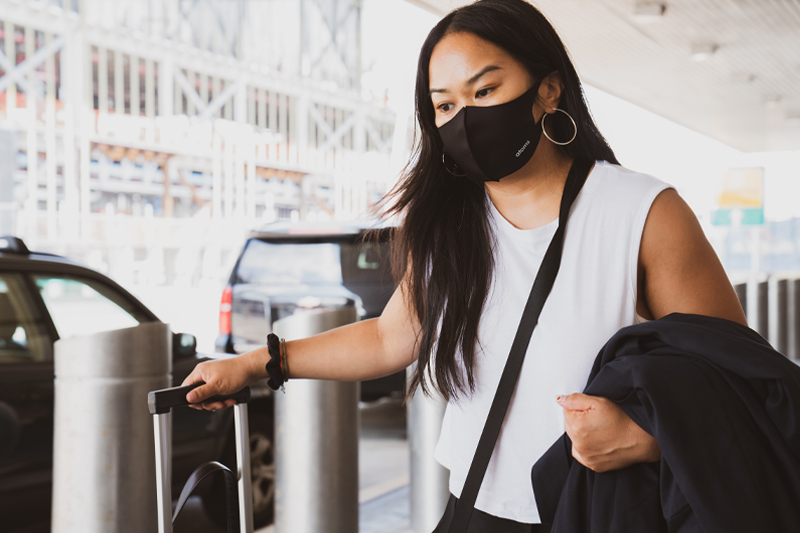
You’ll be wearing one and you should carry a few spares with you. According to The Today Show, you should wash your fabric mask every two wears. But, if you are near someone who is infected or contagious, you should wash it immediately.
Hand sanitizer
If you have to touch a surface, use hand sanitizer immediately after. According to the CDC, effective hand sanitizer is at least 60% alcohol.
You can now bring more with you when you fly. The Transportation Security Administration eased the 3-ounce limit and is allowing passengers to bring up to 12 ounces of liquid hand sanitizer in carry-on bags.
Disinfectant wipes
You can remove the virus from surfaces by using bleach-based cleaners or hydrogen-peroxide based cleaners. The New York Times has done research on which wipes are the best. You can make your own travel packs by stacking wipes into Ziploc bags.
Airport Pandemic Emergency Kit
The airport is full of high-touch surfaces. Keep these items in your purse, jacket pocket or carry-on bag:
More disinfectant wipes
Avoid touching surfaces with fingertips. Your fingertips are most likely to transmit a virus, because they’re the part most often used to touch your face, eyes, nose or mouth. You’ll be using disinfectant wipes throughout the airport as well as once you board the plane to wipe down your seat, arm rests and tray table.
A pack of single-use tissues
If you need to grab a handle or open a door, use a tissue to touch the surface, then discard it.
Q-tips
Use a Q-tip instead of your finger to press buttons on a key pad or elevator. Discard after use.
Hotel Pandemic Supply Kit
Your hotel room will be your safe place to disinfect your mask, evaluate your health and check in with family, friends and co-workers.
Soap and water
As soon as you can, wash your hands with soap and water for at least 20 seconds. Wipe down the faucet handles and door handles (whatever you touched as you entered your room) with disinfectant wipes.
More wipes and a microfiber cloth
You might touch your phone as much as you touch your face. The major smartphone manufacturers say you can use isopropanol alcohol wipes to clean your phone, or you can use soap, water and a microfiber cloth.
Travel laundry detergent
Soak your extra cloth mask(s) in a sink full of water and scrub with laundry detergent. Wring out excess water and hang dry.
Thermometer
COVID-19 symptoms include shortness of breath, fever, coughing and a sore throat. A travel thermometer will help you keep tabs on your temperature.
Digital oximeter
If you are in the high risk category for coronavirus, you’ll want to make sure your lungs are getting enough oxygen. A digital pulse oximeter, available at most pharmacies or online stores for less than $30, will track your real-time oxygen levels. Normal pulse oximeter readings usually range from 95 to 100%, according to The Mayo Clinic.
Other travel tips and tricks:
- Use an object such as a pen to press an elevator button.
- Open doors with an elbow or pull your hand into your sleeve so only the cloth touches the handle.
- If possible, use touchless payment (pay without touching money, a card or a keypad).
- If driving or flying, plan as few stops as possible.
- Wipe down utensils (if they aren’t wrapped in plastic) before using.
- TSA recommends placing items from your pockets into your carry-on bag before you go through the security checkpoint. Remove keys, tissues, lip balm, loose change, breath mints, mobile phone and anything else from your pockets and add them into your carry-on bag so you don’t have to place them in an unsanitized bin.
- Bring enough supplies. You’ll need a day’s supply for state and local travel, for example, and extra pandemic preparedness supplies for international travel.
Get a price estimate
Estimate
$0.00
Please answer all questions for estimate.
Categories:
NewsMay 19, 2020
Categories:
NewsMay 13, 2020
Categories:
Missions & Member TestimonialsMay 11, 2020
Medical and security operations for Global Rescue consumer and enterprise members often focus on individual advisory and evacuation. But there’s another side to the Global Rescue mission that isn’t often highlighted. Our crisis management services include supporting the humanitarian efforts initiated by partners, clients and key stakeholders.
Our track record includes more than 20,000 operations worldwide saving lives and protecting our members. These include evacuations during some of the world’s most challenging crises, including the earthquake in Haiti and now the COVID-19 pandemic. In each instance, Global Rescue supported a variety of humanitarian efforts.
When earthquakes struck Haiti, Global Rescue provided needed cargo space on board private aircraft for food, water and medical supplies coming into the county. During the COVID-19 pandemic, Global Rescue assisted enterprise clients delivering humanitarian assistance here and abroad.
When the coronavirus sparked in China, government and medical officials took quick steps to shut down businesses, cities and travel to contain the outbreak. But the effort also crippled the country’s ability to scale production of medical supplies such as protective masks and decontamination suits since local plants didn’t have enough time to ramp up production.
When aid was offered by a Global Rescue enterprise client, we provided essential sourcing, acquisition and delivery expertise. It sounds simple, but when officials from multiple international governments and health organizations are simultaneously locking down borders and issuing restrictions on movement by air and ground resources – it gets a lot more challenging.
The Global Rescue operations and intelligence teams tapped their vast experience and deep network of contacts to provide logistics, help obtain permits and secure authorization to acquire and transport aid to support families affected or displaced by the virus.
More than $1 million worth of humanitarian relief materials, including face masks, gowns and sanitizer, were sourced, shipped and delivered across several international borders.
Global Rescue provided additional humanitarian initiative support when the same client donated $2.5 million in aid for public schools and food insecurity relief efforts in Chicago, Illinois as the effects of the coronavirus pandemic took hold. The contribution includes $1 million for schools, which will be closed through April 20 and $1.5 million for the food bank, according to Chicago Mayor Lori Lightfoot. The donations will help make meals available at more than 500 temporary school food distribution sites for 355,000 students.
The COVID-19 pandemic was unprecedented, but that’s what Global Rescue prepares for.
Categories:
NewsMay 8, 2020
Categories:
Health & SafetyTravelMay 7, 2020
Travel experts have already started to speculate on how travel will change in the future. Once the threat of the coronavirus pandemic subsides, expectations of trust among travelers and travel providers will be greater than ever before. Alongside rising expectations, travelers are also open-minded to a new level of health and safety measures that might have once been considered extraordinary.
In a recent survey, our members revealed a range of support for a variety of new measures if it meant a return to leisure travel and business trips domestically and abroad.

Support for Screening, Testing and Tracing
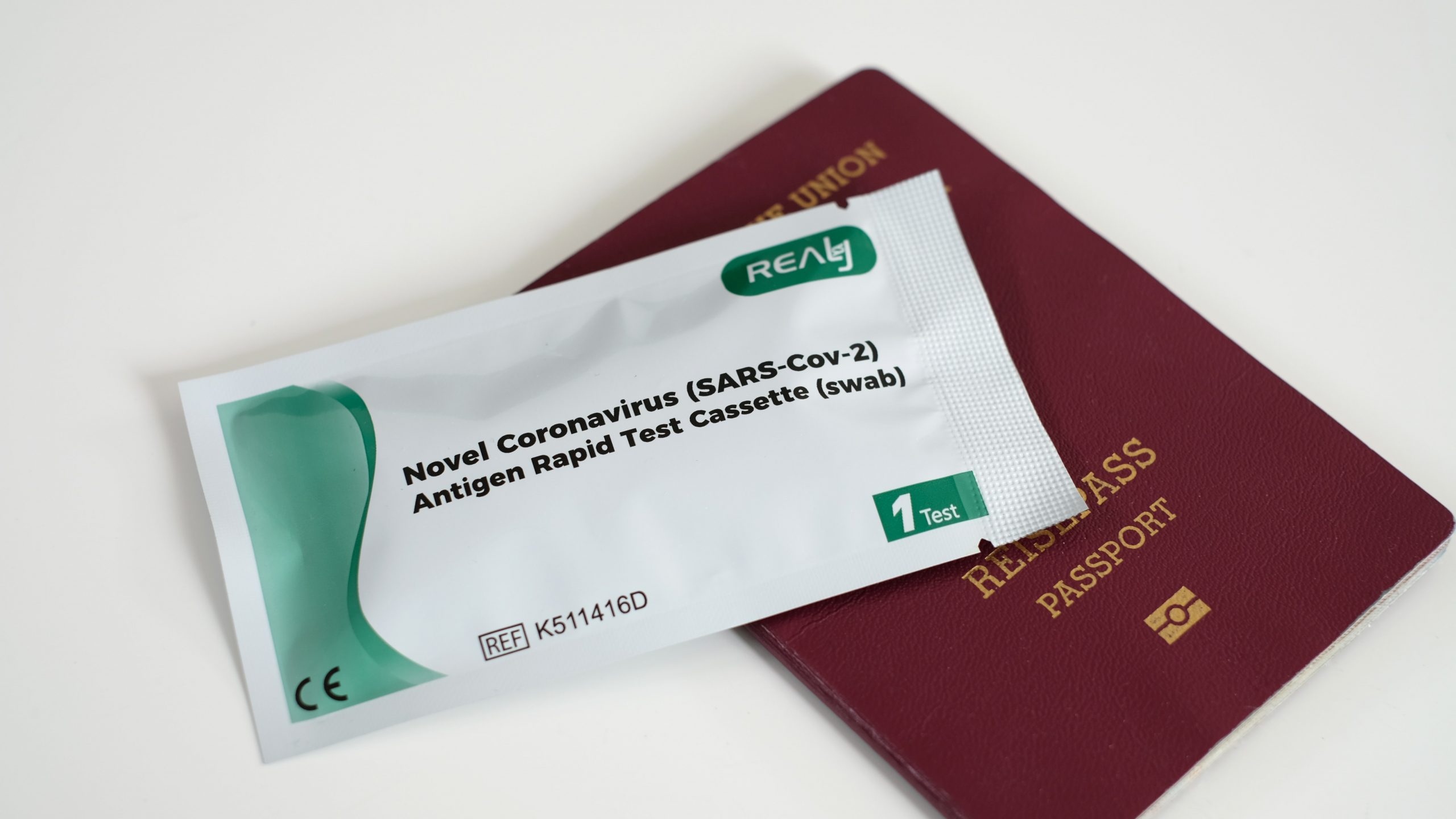
Overwhelmingly, travelers of all demographics reported they are willing to subject themselves to screening and testing, as well as disclose certain medical conditions and even provide their 14-day travel history.
Coronavirus screening and testing has already made it past the consideration stage for some commercial airlines. In mid-April Emirates became the first airline to conduct on-site rapid COVID-19 tests for passengers when it tested all air travelers on a flight from Dubai to Tunisia. The blood tests were conducted by the Dubai Health Authority (DHA) and produced results within 10 minutes. Emirates is reportedly planning to scale up testing capabilities to extend to other flights with passengers traveling to countries that require COVID-19 test certificates.
In early April, Utah Governor Gary Herbert signed an executive order requiring anyone entering the state through the Salt Lake City International Airport or major state highway entry points to complete an electronic declaration form or survey within three hours of entering the state, detailing travel history and health symptoms. Utah initially used its Wireless Emergency Alert system to alert travelers but pivoted to electronic message cards and airport postcards for notification in mid-April.
Disparity Among Traveler Willingness for Tracking
The greatest disparity is when travelers are asked if they would be willing to have their physical location tracked during a trip and temporarily retained. Not all travelers are as uniformly in support of the measure.
Only 35% of travelers age 65 and older said they would not be willing to have their physical location tracked and retained while on a trip.
But among millennial (age 24-37) and Gen X travelers (age 38-56), 50% said they were not willing to have their location tracked and retained.
There’s no way to be certain if any of these new health and safety measures will become widespread, but travelers are absolutely open to new ways of keeping themselves and those around them safe as they plan to get back to traveling again.
In the same survey, our members reported they expect to begin making trips again no later than early fall. While 77% reported they expect to make a trip by the end of October, not all travelers are eager to get back on the road quickly – and they’re not all planning the same types of trips either.
Domestic Travel
When travelers do take their first trip, nearly 60% reported they’ll opt for domestic trips rather than international travel. Travel experts have already been pointing to domestic trips being the first to take off, especially within the airline industry. A recent piece in Travel+Leisure quoted aviation expert Henry Harteveldt, who said, “expect airlines to begin with flights out of their most important hubs and cities where public health conditions are best and demand is strongest.”
[Related Reading: A Member’s Domestic Rescue from DC to NH]
Wait and See, or Book Again?
The coronavirus caused 70% of survey respondents to either postpone or forcibly cancel their trips. Not all travelers are keen to book another trip as soon as they can. Sixty-two percent of Boomer travelers reported they’d book another trip as soon as they felt safe to travel. Millennial travelers are opting to take a more wait-and-see approach, with 47% reporting they’ll save their money, even when asked if they’d book sooner for discounts and deals.
Gen X travelers are a little more in the middle in their decision, but tend to take a more Boomer approach to getting back to travel. Fifty-two percent said they will book another trip as soon as they feel safe to travel but 28% also said they’ll take a wait-and-see approach and save their money for now.
Destination Trips and Solo Travel
Nearly 40% of millennial travelers said their first leisure trip will most likely be a destination or a “bucket list” trip. Second to destination trips were solo trips, which 35% of millennial travelers reported they’ll take. Among those who were specific about the types of trips they’ll take, nearly all involved outdoor activities like climbing or trekking.
It’s easy to make the connection as to why outdoor activities might be something the travel industry sees gaining in popularity. With social distancing protocol in place, outdoor activities often involve wider open spaces with less opportunities to be confined in a highly populated area.

Travel to See Family and Friends
Leisure trips to see family and friends were much more popular among Gen X and Boomer travelers. About 30% said their first trips will be to see family and friends, while also reporting more outdoor-based activities like the younger millennial segment. From visiting national parts to opening family cottages and birdwatching, travel demand is high and our members have high expectations for getting back out there.
Survey results are based on 1,400 responses collected from Global Rescue members April 22-28, 2020.
Categories:
Missions & Member TestimonialsApril 27, 2020
A German Shepherd stands alert at the sound of gunshots. With the ranger’s go ahead, the dog is released from his leash and races across the grassy field of the game reserve, hot on the trail of an animal poacher.
The dog, wearing protective body armor and a tracking collar, takes the poacher down and holds him on the ground until rangers arrive with handcuffs.
The German Shepherd is part of a nonprofit organization called Canines for Africa, created by Vianna von Weyhausen in 2016 to help stop the annihilation of vulnerable animals by poachers.
“I am originally from Zimbabwe, so Africa and animals are in my blood and I have been involved in conservation in one form or another my whole life,” said von Weyhausen, a Global Rescue member. “About five years ago, I heard about the use of dogs in wildlife protection and anti-poaching work. At the time few people were using K9 units and I thought it made sense to use an animal to help save wildlife.”
The Poaching Problem
One wildlife ranger is killed every three days. Three rhinos are killed every day. Four elephants are killed every hour. One pangolin is taken from the wild by poachers every five minutes, according to the International Union for Conservation of Nature.
Although there is more awareness of illegal poaching today, Africa’s endangered species and other wildlife are still being exterminated at a catastrophic rate.
“Everyone is aware of the crisis with rhinos and I am glad to see increased awareness about the plight of pangolins — reclusive, cute, armadillo-like insectivores that are slaughtered for their scales for use in traditional Chinese medicine,” von Weyhausen said. “They are being killed at a rate of more than 100,000 each year, which is sure to lead to extinction unless the poaching is stopped.”
Poaching is big business. Tusks made of ivory are sold at a high profit to make ornaments and jewelry. Rhino horn, sold for $15,000 to $30,000 a pound and pangolin scales, at $270 per pound, are used in medicines in Asia, “despite research showing they have no curative properties,” says von Weyhausen.
According to the United States Fish and Wildlife Service, illegal wildlife trafficking throughout the world brings in approximately $20 billion per year, “putting it in the same league as drugs, arms and human trafficking,” said von Weyhausen. “Organized crime syndicates, even terrorist groups, are now the main perpetrators.”
Because elephants are becoming so scarce in some countries, poachers are turning to killing hippos for their tusk-like canines and incisors. Elks, with two incisors made of ivory, are also at risk.
“Poaching activity varies greatly between African countries. Where there is foresight and political will to stem the massacres, the success rate can be high,” von Weyhausen said. “But where corruption rules, it can be disheartening for anti-poaching organizations trying to save the fauna, flora and ecosystems.”
Dogs to the Rescue
The mission at Canines for Africa is twofold: train specialized dogs and their ranger-handlers and bring educational programs about conservation to schools.
Von Weyhausen ground operations are handled by Conraad de Rosner, a South African who has been running anti-poaching units with canines for more than 26 years.
“He is totally dedicated to both dogs and to saving wildlife,” she said.
Dogs are trackers by nature and breeds are chosen for their skills. Shepherds are trained to track human, firearm and ammunition scent and to disable armed poachers, while Weimaraners are trained to search for live or dead animals (an elephant injured by a poacher or an orphaned baby rhino) or contraband (elephant tusks, rhino horn or pangolin scales). Canines for Africa also uses other breeds, like hounds (cold scent trackers), as the situations warrant.
The training center in South Africa typically houses 20 dogs in various stages of training. The ranger is educated through a 60-day residential course. The dog and the ranger complete instruction together and when both are ready, the team is transported to their new home. Canines for Africa schedules two week-long visits to assess and fine tune the unit’s performance.
“The canines work effectively at night, when most poachers are active,” von Weyhausen said. “They can track for many hours, abseil from a helicopter, lay in wait for a criminal, protect the handler and apprehend a suspect.”
The dogs are extraordinary, tracking down poachers before they commit a crime. Most South African National Parks now use canine units.
Canines for Africa has supplied the dogs and the training for 10 operational units in South Africa, Namibia, Mozambique, Zimbabwe, Mali and India.
This new concept is proving extremely powerful in the capture of poachers. According to an official statement issued by South African National Parks, the effort is indeed making a difference: “Over the past 10 months the canine units have successfully tracked and taken down 90% of the poachers arrested in the Kruger National Park.”
“We at Canines for Africa are having similar results,” von Weyhausen said. “We are also finding that poaching syndicates often move out of a reserve as soon as we deploy K9 units, so we act as a deterrent as well as a proactive and reactive force.”
How Global Rescue Helps
Von Weyhausen joined Global Rescue the same year she founded Canines for Africa.
She learned about Global Rescue while attending a tradeshow/the Dallas Safari Club Convention. Because she travels between the organization’s London base, the training center in South Africa, operational units in six countries on two continents and visits sponsors in the United States and around the world, it made good business — and personal sense — to become a member.
“Given I spend so much time in remote areas of far flung countries (many without advanced medical facilities) running an organization that is the target of poaching syndicates, Global Rescue made so much sense,” she said. “Your personnel were well informed and friendly and the service so inclusive, I joined instantly.”
Creating and deploying anti-poaching wildlife conservation units is dangerous work, but von Weyhausen is more confident with a Global Rescue membership.
“It really does give me great peace of mind, especially when I am in the bush visiting my frontline anti-poaching units.” she said. “My base staff has Global Rescue’s details and I know they will contact Global Rescue the moment they hear there is a critical situation.”