Loading...

Categories:

Health & Safety
Share This:

Top-10 Risky Birding Destinations

Don’t let location prevent you from crossing the rarest birds off your list.

If you’re an avid birder, you probably have a bucket list of rare birds you dream of seeing one day. But like any bucket list, the distance between dreaming and doing can feel greater than the distance a Bar-tailed Godwit travels while migrating, especially when there is an element of risk involved.

The following destinations, though home to some of the rarest, most breathtaking birds on earth, might give even the most daring birder pause, especially given their travel advisory status from GRID – the Global Rescue Intelligence Delivery system, which is informed by the most recent and relevant resources, including the U.S. Department of State.

And yet these trips are not impossible. With smart research and planning, an abundance of persistent awareness, a Global Rescue membership with a security add-on and a lot of courage, you have the best chance to realize those birder bucket list dreams.


The close-up face of a Night Parrot.
Night Parrot – Photo by Kimberly Collins

1. Australia

It’s no surprise that Australia is very safe for traveling and has a low-risk rating (exercise normal precautions) by GRID. But you would need to embark on some daring adventures to spot the Night Parrot, only found in the Outback once the sun sets.


Two Beautiful Nuthatches perched in a tree.
Beautiful Nuthatches – Photo by Lee Alloway

2. Bhutan

Bird Spot lists Bhutan as one of the top birding destinations in the world.

“Unlike many other countries in the Himalayas, which have undergone massive deforestation programs, the kingdom of Bhutan has protected large areas of forest which means many species of birds thrive here that do not elsewhere,” according to Bird Spot.

Although GRID gives Bhutan a low-risk rating as well, we strongly advise that travelers have evacuation services for their trip due to the mountainous, remote nature of the country. In general, medical resources are scarce, especially outside populated areas. But if you’re willing to take the risk, you will be richly rewarded with the opportunity to see a wide variety of birds, including several endangered species like the Baer’s pochard, the Black-necked Stork, or the Beautiful Nuthatch.


A raptor soars high above the mountains in Peru.
An enormous bird of prey soars above the Peruvian mountains – Photo by Belinda Grasnick

3. Peru

Rated as having a moderate risk (exercise increased caution) by GRID, travel to Peru gets more dangerous the more remote you are. And you will need to get remote to see the more than 1,800 birds native to this South American birding paradise, said Nicholas Lund, expert birder and writer.

“Peru has one of the largest species lists of any country on Earth,” he said. “But to see them, you will need to travel to every region of the country, traversing the Humboldt Current, the Andes Mountains and the Amazon Basin.”


A Dulit Frogmouth perched in a tree at night.
Dulit Frogmouth – Photo by Ross Tsai

4. Indonesia

“This tropical nation is one of the most storied birding destinations in the world, with hundreds of islands to explore and thousands of species to discover,” Lund said.

An increased level of caution is advised due to terrorism and natural disasters. But if you’re willing to take the trip, you may be lucky enough to see:

The Sunset Lorikeet, found on the islands neighboring Indonesia.

The Bronze Parotia of the Foya Mountains, which lives in West Papua, Indonesia.

The Dulit Frogmouth of Borneo, a mountainous island in the Indonesian archipelago.


Two Lear's Macaws perched on branches in captivity.
Lear’s Macaws – Photo by Jan Helebrant

5. Brazil

GRID also rates Brazil as a moderate risk country. There’s heightened risk as you travel through forests and encounter tropical birds, but it may be worth it to see:

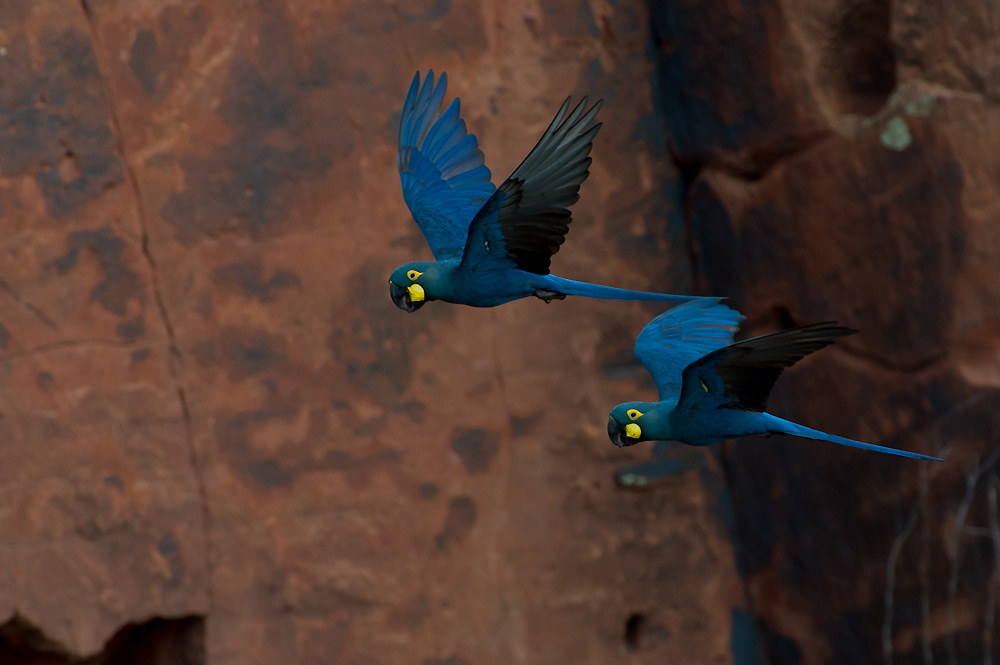
The Lear’s Macaw. Although endangered, this bird, also known as the Indigo Macaw, can still be found in northeastern Brazil, especially at a reserve called the Canudos Biological Station. There you can find guided tours through the sandstone cliff habitat where they live.

The Scaled Ground-Cuckoo, which lives in the lower Amazon in northern Brazil. The Matador Network reports the bird is very hard to spot, and you must be prepared to “access some very inhospitable terrain and endure the stinging bites of the army ant swarms the species habitually follow.” reports the bird is very hard to spot, and you must be prepared to “access some very inhospitable terrain and endure the stinging bites of the army ant swarms the species habitually follow.”


The green and light yellow head and brown upper body of a Raggiana Bird of Paradise.
Raggiana Bird-of-Paradise – Photo by Mark Gillow

6. Papua New Guinea

GRID rates Papua New Guinea as high risk because of civil unrest, crime and piracy. Medical care is spotty, and birding adventures will take you to remote, hard-to-reach places. A trip here would require serious consideration and planning, and a Global Rescue membership with a security add-on would certainly provide the additional protection needed as you attempt to see:

The Raggiana Bird-of-Paradise, which is native to Papua New Guinea.

The Dwarf Cassowary—one of the world’s most elusive birds.

The Greater Bird-of-Paradise, which lives in inaccessible, dense rainforest habitats in Papua New Guinea and surrounding islands.

The Vogelkop Superb Bird-of-Paradise, which is found only in the Bird’s Head Peninsula in the far west. According to Nature Anywhere, this is a brand-new species!


The brilliant emerald green and ruby red of the Resplendent Quetzal
Resplendent Quetzal – Photo by Ryan Acandee

7. Guatemala

The Resplendent Quetzal lives in the mountainous tropical forests of Central America and is the national bird of Guatemala. Bella Falk for BBC’s Discover Wildlife reports that the quetzal is extremely elusive, and to see it in Guatemala, “you have to go to one of just four protected cloud forest reserves, which means getting up before dawn and hiking for several hours into the jungle.”

Crime levels are high in Guatemala and although medical services are available in Guatemala City, emergency medical care would be spotty on a remote trip to find this bird. For these reasons, we urge travelers to reconsider their trip to Guatemala (GRID rates it as a high-risk country).


A Golden Pheasant walks along the grass.
Golden Pheasant – Photo by Peter Trimming

8. China

The Golden Pheasant is native to the mountainous areas of western China. Due to political instability, GRID gives China a high-risk rating, and we urge people to reconsider travel. Medical care in China is also unpredictable, which is a critical emergency care gap especially since many China birding adventures would be in higher altitudes where the likelihood of Acute Mountain Sickness, HAPE or HACE is a serious threat.


9. The Democratic Republic of Congo

A trip to find the Congo Bay Owl is extremely dangerous, not to mention extremely rare. The last one seen was in 1996, the Matador Network reports. Could you be the next to lay eyes on one? Only if you’re willing to travel to the Itombwe Mountains in a high risk-ranked country fraught with politically motivated, violent conflicts, civil unrest, terrorism and kidnapping.


A Shoebill stork in the daylight.
Shoebill Stork – Photo by Eric Kilby

10. Senegal

This is the only non-extreme risk (“do not travel”) country where you may be able to spot the Shoebill Stork, White-crested Turaco and the Blue-bellied Roller.


Should You Stay or Should You Go?

As with any travel, we strongly advise our members always to abide by Global Rescue’s GRID-informed guidance. As you plan your next birding trip, always consider the risks involved. The best place to start is by reaching out to our team of experts who will help you identify and understand the potential dangers of a trip anywhere, and help you prepare to minimize the risks involved.

Categories:

Press Release
Share This:

Global Rescue Announces GRID 2.0 – The Global Rescue Intelligence Delivery System 

(Lebanon, N.H. – September 26, 2023) Global Rescue, the world’s leading provider of medical, security, evacuation and travel risk management services, announced the release of GRIDSM 2.0, The Global Rescue Intelligence Delivery System. “GRID 2.0…

(Lebanon, N.H. – September 26, 2023) Global Rescue, the world’s leading provider of medical, security, evacuation and travel risk management services, announced the release of GRIDSM 2.0, The Global Rescue Intelligence Delivery System. “GRID 2.0 is revolutionizing business travel safety,” said Dave Leopold, Global Rescue director of enterprise sales 

GRID 2.0 is the only integrated travel risk, asset tracking, intelligence delivery and crisis response platform available in the world today. It is designed to minimize traveler risk when the unexpected happens and get business travelers to safety.   

During a preliminary launch in recent months, the GRID 2.0 system was used to coordinate evacuations of travelers from war-torn Ukraine and Sudan’s violent conflict, help students and faculty get out of Russia, and provide security advisory for foreign news correspondents working for several major U.S. news outlets.   

“GRID 2.0 helps keep track of people. It makes the needle bigger and the haystack smaller,” said Harding Bush, former Navy SEAL and Global Rescue security operations manager.   

“I rely on GRID to keep our worldwide workforce safe. With real-time tracking and emergency alerts, GRID gives me the visibility and response capabilities to protect our travelers anytime, anywhere. This innovative platform is essential for globally minded organizations like ours,” said Eric Cioè-Peña, MD, MPH, FACEP, vice president of global health center for Northwell Health. 

GRID 2.0 features five specific traveler safety attributes that make it a ‘must-have’ app for the health and safety of business travelers.    

  1. Instant Communication: The updated traveler-tracking feature allows users to share links directly from the portal with colleagues to enhance safety and peace of mind.   
  2. Smart Alerts: An augmented algorithm computes travel data visualization and determines which travelers are impacted by events at destinations and informs them through alert notifications.    
  3. Visualize the World: state-of-the-art integrated map functionality enables users to visualize real-time traveler data dynamically and interactively.    
  4. Enhanced Experience: Enhanced user experience (UX) and user interface (UI) upgrades improve seamless dissemination of information.   
  5. Global Insights: The redesigned control center provides near-to-real-time global event updates customized to the needs of travelers who potentially may be impacted.    

“Beyond all its capabilities, we built GRID 2.0 as an extension of our best-in-class medical, security, evacuation and travel risk management services. GRID 2.0 isn’t just software; it’s an indispensable companion app to everything Global Rescue offers in worldwide travel protection services,” Leopold said. 

“This one-of-a-kind system includes innovative traveler safety features, advanced traveler-tracking capabilities, and an enhanced user interface to keep business travelers safe, informed and connected,” Leopold said. “GRID 2.0 provides travelers with real-time background, analysis, and advice about what to do in the event of an emergency in the country they are visiting.”  

Most business travelers lack immediate access to travel intelligence information or communication capabilities that may be lifesaving in the event of a medical or security emergency.   

GRID 2.0 changes that.   

The GRID 2.0 system distributes Event Notifications and Alerts for civil unrest, disease-related developments, safety issues, transportation disruptions, communications blackouts, and natural disasters including floods, hurricanes, earthquakes, and volcanic activity.   

In an emergency, the GRID 2.0 app puts its members in immediate contact with the medical teams and military special operations veterans who staff Global Rescue’s Global Operations Centers.    

GRID 2.0 Connects Users With Business Chief Security Administrators 

The GRID 2.0 system is comprised of two parts to reduce traveler risk. The Individual Traveler Mobile App and the Desktop Administrator Control Center work together to help individuals, organizations, companies and universities protect, track and communicate with remote travelers, employees and students.    

Travelers using the GRID 2.0 Individual Traveler Mobile App can research medical and security risks by destination, obtain automatic Destination Reports, receive active security alerts including analysis and advice, connect for GPS “check-ins” with real-time location tracking, and stay in touch with in-app communications both internally and with Global Rescue.    

Administrators managing the GRID 2.0 Desktop Administrator Control Center receive comprehensive situational awareness of global risks 24/7/365, monitor real-time global threats and analysis with Event Alerts, audit a dynamic global risk map to identify regions of increased risk, manage communications using the in-app messaging that allows direct contact with individual or group GRID 2.0 Mobile App users.   

“The GRID mobile app places critical medical, security and other essential travel intelligence at fingertips of my traveling workforce, and the GRID Administrator Control Center gives us access to global risks 24/7/365 so we can monitor and respond for the safety of our business travelers,” said Sherri Hersh, senior manager, International Accreditation, ABET. 

GRID 2.0 mobile application is designed for ease of use and includes six essential user functions:   

  1. Emergency Function: During an emergency, tap and hold the Emergency button at the top of the landing page for three seconds. This will automatically send a message to the Global Rescue’s Operations Center, which will start working on your case immediately. You can choose to add details if appropriate.    
  2. Alerts Function: The Alerts Function allows you to view Event Alerts that meet the specific criteria you’ve selected via the online GRID 2.0 platform for unique Alert Profiles.   
  3. Check-In: If you choose to check in, tap the “check-in” button on the landing page, and then the “check-in” button on the next page. You can include a message if you would like. By checking in, you are sending your GPS coordinates to Global Rescue and your company.   
  4. Events: The Events Function shows all Event Alerts that Global Rescue’s in-house Intelligence team publishes. The titles of the Event Alerts are visible on the first page, along with the risk rating of the country affected. You can select any of the Event Alerts that interest you and read a summary and analysis of the situation and advice on what actions to take if affected.   
  5. Destination Reports: The Destination reports cover everything from currency and common scams to travel health and personal security advice in 215 countries and principalities worldwide.   
  6. Contact Global Rescue: Global Rescue is available 24/7/365 for questions or concerns. Get real-time access to doctors, paramedics, nurses and intelligence experts.   

### 


Contact Bill McIntyre at bmcintyre@globalrescue.com or 202.560.1195 (phone/text) for more information.   

About Global Rescue    

The Global Rescue Companies are the world’s leading provider of medical, security, evacuation and travel risk management services to enterprises, governments and individuals. Founded in 2004, Global Rescue has exclusive relationships with the Johns Hopkins Emergency Medicine Division of Special Operations and Elite Medical Group. Global Rescue provides best-in-class services that identify, monitor and respond to client medical and security crises. Global Rescue has provided medical and security support to its clients, including Fortune 500 companies, governments and academic institutions, during every globally significant crisis of the last two decades. For more information, visit www.globalrescue.com. 

Share This:

GRID 2.0 – The Most Advanced Travel Risk Intelligence Delivery System to Date

The industry’s premier travel risk, asset tracking, intelligence delivery and crisis response management platform gets a major upgrade.

The new and improved Global Rescue Intelligence Delivery system (GRID 2.0) isn’t just the world’s only integrated travel risk, asset tracking, intelligence delivery and crisis response management platform. It’s an indispensable companion app to our best-in-class medical, security, evacuation and travel risk management services.

Our team of medical, security, operations and tech experts optimized this one-of-a-kind system with new, innovative traveler safety features, advanced traveler-tracking capabilities, and an enhanced user interface to keep travelers safe, informed and connected.


What’s New

GRID 2.0 features five specific upgrades that make it a ‘must-have’ tool for the health and safety of business travelers.

  1. The updated traveler-tracking feature allows users to share links directly from the portal with colleagues, friends and family to enhance safety and peace of mind.
  2. An augmented algorithm computes travel data visualization and determines which travelers are impacted by events at destinations and informs them through alert notifications.
  3. A state-of-the-art integrated map functionality enables users to visualize real-time traveler data dynamically and interactively.
  4. Enhanced user experience (UX) and user interface (UI) upgrades improve seamless dissemination of information.
  5. The redesigned control center provides near-to-real-time global event updates customized to the needs of travelers who may be impacted.


Global Rescue GRID Screenshots GIF

The GRID System Improves Travel Industry Health and Safety

Most travelers lack immediate access to travel intelligence information or communication capabilities that may be lifesaving in the event of a medical or security emergency.

Global Rescue’s GRID 2.0 changes that.

The GRID 2.0 system distributes event notifications and alerts for civil unrest, disease-related developments, safety issues, transportation disruptions, communications blackouts and natural disasters including floods, hurricanes, earthquakes, and volcanic activity.

In an emergency, the GRID 2.0 app puts its members in immediate contact with the medical teams and military special operations veterans who staff Global Rescue’s global operations centers.

The GRID mobile app places critical medical, security and other essential travel intelligence at fingertips of my traveling workforce, and the GRID Administrator Control Center gives us access to global risks 24/7/365 so we can monitor and respond for the safety of our business travelers. – Sherri HershSenior Manager, International Accreditation, ABET


How It Works

The GRID 2.0 platform comprises two parts to reduce traveler risk: the Individual Traveler Mobile App and the Desktop Administrator Control Center. These tools work together to help individuals, organizations, companies and universities protect, track and communicate with remote travelers, employees and students.

Travelers using the GRID 2.0 Individual Traveler Mobile App can research medical and security risks by destination, obtain automatic destination reports, receive active security alerts including analysis and advice, connect for GPS “check-ins” with real-time location tracking, and stay in touch with in-app communications both internally and with Global Rescue.

Administrators managing the GRID 2.0 Desktop Administrator Control Center receive comprehensive situational awareness of global risks 24/7/365, monitor real-time global threats and analysis with event alerts, audit a dynamic global risk map to identify regions of increased risk, and manage communications using the in-app messaging that allows direct contact with individual or group GRID 2.0 Mobile App users.


iPhones displaying Global Rescue's GRID on the screens.

Global Rescue’s GRID 2.0 mobile app is designed for ease of use and includes six essential user functions:

  1. Emergency function – During an emergency, tap and hold the Emergency button at the top of the app’s landing page for three seconds. This will automatically send a message to the Global Rescue Operations Center, which will start working on your case immediately. You can choose to add details if appropriate.
  2. Alerts function – View event alerts that meet the specific criteria you’ve selected via the online GRID 2.0 platform for unique alert profiles.
  3. Check-In – If you choose to check in, tap the “check-in” button on the landing page, and then the “check-in” button on the next page. You can include a message if you would like. By checking in, you are sending your GPS coordinates to Global Rescue and your company.
  4. Events – See all event alerts published by Global Rescue’s in-house intelligence team. The titles of the event alerts are visible on the first page, along with the risk rating of the country affected. You can select any of the event alerts that interest you and read a summary and analysis of the situation, and advice on what actions to take if affected.
  5. Destination Reports – Comprehensive reports that cover everything from currency and common scams to travel health and personal security advice in 215 countries and territories worldwide.
  6. Contact Global Rescue – Global Rescue is available 24/7/365 for medical or security questions. Get real-time access to doctors, paramedics, nurses and intelligence experts.


A screenshot of Global Rescue's GRID's control center.

GRID 2.0 by the Numbers

More than 150 companies have used Global Rescue’s GRID 2.0 system. In the past 18 months, the system has distributed nearly two million alerts to member company staff and their contractors, as well as journalists, business travelers, faculty and students. GRID 2.0 provides travelers with real-time background, analysis and advice about what to do in the event of an emergency in the country they are visiting.

In recent months, the Global Rescue GRID 2.0 platform was used to coordinate evacuations from war-torn Ukraine and civil unrest in Sudan, help students and faculty get out of Russia, and provide security advisory for foreign news correspondents working for several major U.S. news outlets.

GRID 2.0 helps keep track of people. It makes the needle bigger and the haystack smaller. – Harding BushFormer Navy SEAL and Global Rescue Security Operations Manager


GRID 2.0 places critical medical, security and other essential travel intelligence in the hands of leisure and business workforce travelers from Fortune 500 companies, colleges and universities, NGOs, government agencies and organizations.


In the first half of 2023, there were a total of 5,564 global events reported:

  •     2 were categorized as Extremely Severe
  •     52 were rated as Highly Severe
  •     2,880 were classified as Medium Severity
  •     2,630 were ranked as Low Severity

Event Alerts Sent Q1 2023 to business and leisure travelers:

  •   193,247 total event alerts distributed
  • 58,747 low severity event alerts distributed
  •   127, 925 medium severity event alerts distributed
  • 6,575 high severity event alerts distributed

Event Alerts Sent Q2 2023 to business and leisure travelers:

  •   175,941 total event alerts distributed
  • 64,345 low severity event alerts distributed
  •   108,421 medium severity event alerts distributed
  • 2,987 high severity event alerts distributed
  • 188 extreme severity event alerts distributed


Our mission at Global Rescue is to minimize traveler risk and to be there when the unexpected happens and get you to safety. Since 2004 we’ve been providing the world’s leading medical, security, evacuation, travel risk and crisis management services. Whether you’re traveling for business or combining work and leisure on a trip, we will rescue you from the point of injury, illness or threat and get you to a safe place or medical care facility capable of providing the care you need.

Categories:

Press Release
Share This:

Global Rescue Salutes Former Team Member and Congressional Gold Medal Recipient Glen Doherty

(Lebanon, N.H. – September 22, 2023) – Global Rescue, the world’s leading provider of medical, security, evacuation and travel risk management services, welcomes the posthumous awarding of the Congressional Gold Medal to its former team member,…

(Lebanon, N.H. – September 22, 2023) – Global Rescue, the world’s leading provider of medical, security, evacuation and travel risk management services, welcomes the posthumous awarding of the Congressional Gold Medal to its former team member, Glen Doherty. H.R. 310 honors all four Americans who were killed in the attack on the U.S. Consulate in Benghazi, Libya in September 2012.

Glen Doherty, a former Global Rescue Operations Specialist and U.S. Navy SEAL, was killed in the Benghazi terror attacks while working for the U.S. Department of State.

“Prior to his death, Glen was an outstanding member of the Global Rescue team for several years and a joy to work with. We are privileged to keep his lasting memory alive,” said Dan Richards, CEO of the The Global Rescue Companies.  “We will continue to honor his memory by supporting the Glen Doherty Memorial Foundation (GDMF) and the important work being done for veterans” Richards added.

“It is an honor and a privilege to salute the Doherty family for Glen’s deserved and overdue recognition for his service and sacrifice, especially on the eve of the GDMF Road Race taking place September 24, 2023 at Winchester Town Hall, Winchester, MA. The Annual Glen Doherty Memorial 5K/10K Road Race is a fundraising event to help U.S. special operations veterans transition to civilian life.

The GDMF provides scholarships for current or former special operation professionals and their families to be used for traditional education, vocational and non-traditional training. “Our mission helps special operations professionals transition out of the military and back into civilian life by means of education and vocational scholarships,” said Kate Quigley, Glen’s sister and GDMF President.

The Congressional Gold Medal is the highest civilian award in the United States. Posthumous recipients include Doherty, Tyrone Woods, J. Christopher Stevens, and Sean Smith, in recognition of their contributions to the Nation.

“Doherty and Woods were former Navy SEALs who served as security personnel in Libya. As the attack in Benghazi unfolded, they bravely attempted to defend American property and protect United States diplomatic personnel. In so doing, they selflessly sacrificed their own lives,” according to the text of the law. Stevens was the U.S. Ambassador to Libya at the time, Smith was an officer in the Foreign Service.

###

About Global Rescue

Global Rescue is the world’s leading provider of medical, security, evacuation and travel risk management services to enterprises, governments and individuals. Global Rescue has provided medical and security support to its clients, including Fortune 500 companies, governments and academic institutions, during every globally significant crisis since 2004.

About the Glen Doherty Memorial Foundation

The Glen Doherty Memorial Foundation mission is to ease the transition from military life and work to that of a civilian by helping fund educational costs for Special Operation individuals and their children. GDMF is a 501(c)(3) charity organization dedicated to honoring and preserving the memory of Glen Doherty and all those who have paid the ultimate sacrifice in defending our nation in the Global War on Terror.

Contact Bill McIntyre at bmcintyre@globalrescue.com or 202.560.1195 (phone/text).

Share This:

Mission Briefs: Global Rescue In Action – September 2023

Highlights from Global Rescue's September 2023 operations.

As the travel rebound continues, traveler worries are shifting dramatically, and their appetite for exploring the world is increasing. Before the pandemic, people were more content with traditional tourist attractions. Viewing the Mona Lisa in the Louvre and taking a River Seine cruise in Paris, visiting India’s Taj Mahal, or soaking up the sun on the Guanabara Bay, Rio de Janeiro, during Carnival, were historically go-to vacation activities.

Today’s travelers, however, are increasingly seeking out less touristy destinations, thanks in large part to a mindset shift of avoiding crowds, triggered by the post-pandemic travel rebound. Now, places that are less accessible and a little riskier are gaining interest.

Which is why Global Rescue membership is more important today than ever. A membership isn’t only for emergencies off the beaten path (or on). There might come a time when you have a question about a symptom like a twisted ankle that’s getting worse, an upset stomach from potentially bad food or even a bug bite from a strange insect. Members call us to get real-time access to doctors, paramedics and nurses who help sort out the do’s and don’ts based on your unique situation and symptoms.

“Our team of medical professionals includes paramedics, nurses and doctors,” said Michael Lovely, operations supervisor at Global Rescue. “We handle calls for cuts and stomach upsets to more severe illnesses and injuries, like chest pains and serious trauma.”

In a typical 30-day period, Global Rescue performs hundreds of operations in dozens of countries and territories. Following are highlights of a few rescue operations completed in August.


A sailboat heels at sea on a brilliantly sunny day.


Sailboat Slip in The Bahamas

During a sailing excursion in The Bahamas, a U.S. member slipped and fell. His nephew contacted us and reported that his uncle was feverish, confused, weak, unable to walk or stand and had watery diarrhea. Our medical operations physician provided input and agreed this member required immediate further evaluation at an appropriate medical facility. Our operations leaders initiated an airborne medical evacuation. He was successfully transported from the Norman Cay Airstrip to a hospital in Nassau where treating physicians evaluated and diagnosed him with COVID and viral pneumonia. His condition improved significantly following a course of treatment.


A paraglider sails high above an Alpine mountainside with snow-covered peaks in the background.


Paragliding Crash in Switzerland

A U.S. member paragliding in Switzerland crashed and suffered severe injuries to his hip and shoulder. His friend contacted us and reported the member was being transported to a hospital for evaluation and treatment. He was diagnosed with hip and shoulder fractures, but no surgery was recommended. Our medical operations staff reviewed the medical report and provided business class seating for him with luggage and wheelchair assistance for his return flight from Geneva, Switzerland, to his home in Arizona. He arrived home safely following a successful transport.


[Related Reading: Cross Country Paragliding: What Is It and Is It Safe?]


Sunrays beam through the clouds over the Rwenzori Mountains of Congo.


Malaria While Trekking in the Rwenzori Mountains

A member from Zimbabwe became ill while trekking in the Rwenzori Mountains in the Democratic Republic of the Congo. Trekking company personnel contacted our medical operations reporting that the member showed signs of fatigue and flu-like symptoms. Unable to walk, he was carried by stretcher to base camp before a successful ground transport to a medical facility in Kasese, Uganda, where he was diagnosed and treated for malaria before he was discharged with medication to continue his recovery and rejoin his trekking group.


[Related Reading: How To Use a Global Rescue Membership]


Flamingoes wade in reflective water as a large mountain stands solitary behind them.


Bad Fall in Bolivia

A U.S. member was trekking in Bolivia when he suffered several injuries after a fall. His trekking group leaders contacted us and reported the member had sustained multiple injuries, including an open fracture on his right ankle, a broken finger and a bleeding head laceration. Due to the remote location, challenging terrain and lack of helicopters, an airborne rescue wasn’t available. Global Rescue coordinated with a search and rescue team and members of the trekking company who carried him to basecamp before transporting him by ground ambulance to a medical facility where he was treated and stabilized. Due to the severity of his condition and the need for a medical facility capable of a higher level of care, our medical operations experts concurred with treating physicians to transport the member via air ambulance to a hospital in Philadelphia. He successfully arrived at the hospital for ongoing treatment.


A couple stands in a field high up in the Swiss Alps.


Abdominal Distress in Switzerland

A U.S. member contacted us to report his wife was vomiting with abdominal cramps and chills while traveling in Switzerland. Our medical operations personnel determined the severity of the pain and possible abdominal or gynecological conditions indicated emergency response. Paramedics connected with her at her hotel and evaluated her condition. Medics provided her with primary care treatment and advised her on self-care measures.

Categories:

News
Share This:

A Remote Road Trip

Categories:

News
Share This:

How to Take in Fall Foliage Without the Hidden Dangers of Leaf Peeping

Categories:

Health & Safety
Share This:

The Leaf Peeper’s Guide to Health and Safety This Fall

Fall is here and with it, a new set of seasonal challenges. From stinging insects to slippery leaves, explore how to stay safe on all of your outdoor adventures this autumn.

While Global Rescue excels at technical emergency responses like long-line helicopter mountain rescues, third-world country medical evacuations and dangerous security extractions – that’s only a part of what we do.

A lot of what we do is proactive guidance to keep a simple walk in the woods from turning into an emergency field rescue. The expert information we share can keep you safe, even when you’re out for an afternoon of leaf-peeping.

A favorite season for many, whether you’re an outdoor enthusiast or just outside to enjoy a daily walk in the crisp air, fall comes with its own — and often hidden — hazards that can make a day hike to view the leafy explosion of color riskier than the proverbial walk in the park.


A wasp lands on a red and yellow apple.


Wasps, Yellowjackets and Ticks

Of all the things you think of when you picture fall, stinging insects probably isn’t one of them. But every autumn there’s an uptick (pun intended) in the aggressive nature of such insects. If you’re not careful, you could find yourself on the wrong end of an attack – and what you think is the right thing to do may be the worst plan of all.

Yellowjackets, bald-faced hornets and paper wasps are much more active during the fall season because hive development is completed and colonies are at their maximum size, leading to increased activity in and outside their homes, according to Joe Boggs, an entomologist with Ohio State University’s Buckeye Yard and Garden Online.

“The populations are very high. Their behavior is only bad late in the season,” he said, noting that, stings aside, these insects are beneficial because they eat plant pests.

Yellowjacket stingers are not barbed, making them capable of repeatedly pricking their victim without killing themselves. Honeybees have barbed stingers. After the sting, the honeybee tries to pull out the stinger and ends up rupturing its lower abdomen and dying.


[Related Reading: How To Survive Animal Attacks]


Anaphylaxis or a deadly allergic reaction to a sting is a limited threat, according to Jeff Weinstein, a medical operations supervisor at Global Rescue with 16 years of combined experience in emergency and disaster response, critical care paramedicine, and emergency management. “It is rare, but some people are extra sensitive to stings. If you know you are at risk for anaphylaxis from a sting you should be carrying your prescribed epinephrine auto-injector with you any time you go outdoors during spring, summer or fall,” he said.

Weinstein recommends hikers throw a bottle of Benadryl into their bag when hiking. “If you get stung and start to become itchy or have some hives appear, you can take some and mitigate your body’s histamine response,” he said.

The best way to prevent unpleasant encounters with social wasps, such as yellowjackets, is to avoid them, according to Marcia Anderson, EPA’s Center of Expertise for School Integrated Pest Management.

Anderson advises avoiding wearing bright colors and sweet-smelling shampoos, lotions, perfumes and soaps that attract yellowjackets. “Avoid swatting and squashing yellowjackets because it is counterproductive. When a yellowjacket is squashed, a chemical (pheromone) is released that attracts and incites nearby yellowjackets,” she added.

Ticks thrive in humidity. If you have a wet year, mild winter and early spring then you have ideal conditions for an increase in the tick population. Tick populations are growing across many parts of the U.S. and abroad in places like Europe, Africa, the Middle East and Asia. That translates to higher possibilities of tick-borne diseases — most notoriously Lyme disease — and the need to be ever vigilant to spot these arachnids, often as small as a sesame seed, before they attach to you or another host in your household, like a child or a pet.

Consider using a tick repellent, especially if you’re going to be in the backcountry for a few days. It’s a good idea to apply insecticide permethrin to your gear and clothing as it will remain protected after several washes (in case things get damp out there). You can also use repellent sprays on skin not covered by clothing but make sure they’re EPA-registered repellents.


Pretty Leaves Camouflage Trail Dangers

When leaves fall from tree branches and litter the ground, they can turn your trekking route into a hiking hazard.

Leaves on the ground hide rocks, roots and holes, and they’re slippery, especially when wet. Hiking enthusiast and author Aislinn Sarnacki admits when she falls it’s usually when she’s descending mountains, and not climbing up.

“I think a lot of factors play into that: tired legs, a faster pace, downhill momentum plus gravity. And I don’t think I’m the only one,” she said. “I’ve witnessed a few hiking buddies fall on their butts, and it always seems to be while heading downhill.”


[Related Reading: Happy Trails: Pro Tips for Hiking Safety]


John “Jed” Williamson agrees. He’s a member of the Global Rescue Mountain Advisory Council and has been collecting data on climbing and trekking accidents in North America for 40 years.

“Wet leaves are slippery — even without rocks underneath. They also hide sticks that you might catch with a boot at ankle height – and could cause you to trip easily. Mud and wet ground are seasonal hazards, too,” he said.

When the trail is covered with leaves, the best course of action is to tread carefully. Wearing appropriate hiking footwear with good ankle support can mitigate the risk of ankle injury from hidden obstacles. “Adjustable trekking poles are a good idea. Running shoes are a bad idea for wet, slippery conditions. I prefer hiking boots that come above the ankle,” Williamson said.


Late-day sunlight creates dark shadows in a forest in the fall.


The Dark Trail

Fall brings earlier sunsets, blinding trail paths sooner and making your “on-the-trail” time shorter — unless you’re prepared for nighttime conditions.

If it’s fall then, it’s getting darker sooner and that means less daylight to reach your endpoint, faster temperature drops, increased likelihood of getting lost and a higher probability of stumbling over unseen objects on the path.

“Darkness comes earlier, so plan your trip accordingly, and bring a few extra items just for safety: a headlamp, extra clothing, food and water,” said mountaineering legend and Global Rescue Mountain Advisory Council member Ed Viesturs.

Adapting your outdoor climbing, trekking and hiking for the fall season is essential for safety and ensuring a good time. Basic tactics include modifying your outings to match the shorter day, improving your lighting resources and including extra layers for temperature drops.

“Fall weather can be deadly if you become lost or have to spend a night in the elements,” said Global Rescue’s Weinstein “If you are going remote, make sure you have the appropriate gear and equipment to navigate, call for help and survive the cold if needed.”

Weinstein’s emergency rescue experience is compelling. “Most people who I’ve treated for exposure to the elements and hypothermia did not expect to become lost and did not prepare to be. In most cases, if they had the means to obtain water, call for help and stay warm they would have been in a much better condition when we found them,” he said.


Prepare and Protect Yourself This Fall

For many people, fall is the best time to explore the outdoors. The weather is cooler than the dog days of summer; there are fewer crowds on the trails; wildlife is much more active as they prepare for the winter. Take advantage of this time of year by planning your excursions around the shorter days and preparing with the right attitude, appropriate gear and a Global Rescue membership.

Global Rescue medical and evacuation services recently expanded its membership services to include within 100 miles of home — as well as everything beyond 100 miles. No matter where you are this season – outback or in the backyard – a travel protection services membership will ensure that you and your loved ones will stay safe and are protected if there’s an emergency.

Share This:

Peace of Mind: The Quiet Benefit of a Global Rescue Membership

How traveler protection services create the reassurance, fortitude and mental calm to travel with confidence.

From time immemorial, people have employed a wide variety of methods and practices to achieve peace of mind. Religious devotion and prayer, meditation and mindfulness, creative expression, physical exercise, or even just a quiet walk in the woods.

For the modern-day traveler, however, there’s one essential ingredient necessary to put your mind at ease: a Global Rescue membership.

Sure, there are the services we provide to our members if there’s a need: field rescue, medical evacuation, medical and security advisory, to name just a few.

But it’s the benefit of peace of mind, inspired by those services – and the emergency experts who deliver them 24/7/365 – that resonates most with our members.


A woman in a purple winter jacket poses for the camera atop a snowy hillside.


“It makes me feel less worried about what could happen,” said Bianca Heinrich, a member since 2020. “What I highly appreciate about Global Rescue is the ease of communication and quick response rate. You guys respond to every inquiry and request very fast. It’s amazing.”

A vacation, for example, becomes an opportunity to escape and relax with a travel protection services membership. Travelers have access to a virtual team of experts – a doctor, a paramedic, a translator, a logistics expert, an intelligence analyst and a security advisor – should any issues or emergencies arise.

And should you encounter a violent situation caused by civil unrest or even a terror attack, our security team with years of military special operations expertise under their belts, are one call, email, or in-app message away to provide the best guidance for the situation.

“Global Rescue kept me settled, calm and informed,” said UK businessman and Global Rescue member Michael Blease-Shepley regarding a dangerous situation in Nigeria with sporadic civil unrest.

Penny Garza, a recent member, agreed. She gets a sense of security since joining. “I go to Europe a lot, and the farther east I go, the more nervous I get as of late.”


Boundless Travel, Endless Possibilities

Some providers refuse traveler protection if they think your activities are too risky. With Global Rescue, there are no activity restrictions. It doesn’t matter if you’re climbing the Matterhorn, paragliding in the Everglades or scuba diving off a remote island shore.


A man with sunglasses, beard, hat, winter jacket, backpack, and trekking poles sits and admires the view of the mountains behind him.


“For my kind of outdoor travel, I enjoy the peace of mind that Global Rescue will always be there to assist when the situation is dire and needs an urgent intervention,” said Shadi Joweihan, a new member.

We have rescued injured climbers stuck in a remote Pakistan mountain range, an adventure racer suffering a dangerous infection in Fiji, a surfer with a serious eye injury in Indonesia, and a traveler on safari attacked by a leopard in Botswana. Your Global Rescue membership covers your adventure activities with no limitations.


Extraordinary Help for Ordinary Travel Situations

But peace of mind doesn’t only come from knowing that you have expert help in a potentially life-threatening emergency. It also comes from knowing the big and small questions stemming from travel troubles and inconveniences are taken care of, too.

Did you lose your passport? Are you looking for the nearest pharmacy that speaks your language? Do your travel destinations have the medical infrastructure you may need? Is the dangerous weather event going to impact you? With your Global Rescue membership, our in-house experts will answer these travel questions on your first call.

Maredith Richardson’s passport was stolen in France and the process of getting an appointment for passport replacement could have taken weeks. “The Global Rescue team handled it completely, got it hammered out within a couple of hours and got me into the embassy for an urgent passport replacement appointment,” she said.

“The one travel membership I don’t leave home without is Global Rescue,” says Joanne Herd, a travel advisor for Girasole Travel. “After leading humanitarian trips to Haiti for several years and purchasing a membership each time, I highly recommend them.”

Peace of mind isn’t a service you can buy, but rather an outcome members enjoy thanks to our team of paramedics, nurses, physicians and military special forces veterans who consistently provide life-protecting medical, security and intelligence services for travelers.

It’s why Global Rescue was named “Best Travel Membership” by Forbes magazine. Dr. John Hertner, a member since 2016, summed it up best. “Having a Global Rescue membership means the elimination of worry about what if.”

Categories:

Press Release
Share This:

Hurricane Lee Intensifies; Global Rescue Outlines Five Survival Tips 

(Lebanon, N.H. – September 7, 2023) Hurricane Lee is quickly intensifying and likely to become a Category 4 or 5 catastrophic storm by the weekend. Weather experts predict the hurricane will bypass Florida and will continue…

(Lebanon, N.H. – September 7, 2023) Hurricane Lee is quickly intensifying and likely to become a Category 4 or 5 catastrophic storm by the weekend. Weather experts predict the hurricane will bypass Florida and will continue to track its progress closely as the storm advances.

National Oceanic and Atmospheric Administration officials predict an above-normal level of hurricane activity this year putting residents and travelers in the coastal and island storm paths on notice to prepare.

“Weather tracking technology allows people to track hurricanes well in advance of landfall, giving them ample time to prepare their homes and evacuate, if needed,” said Dan Richards, CEO of The Global Rescue Companies, the leading provider of medical, security, evacuation and travel risk management services. “Nevertheless, every year there’s a handful of people who stay put, facing the storm head on, either because they are unwilling or unable to do otherwise.”

The following five tips will help residents and travelers prepare for a hurricane and post-storm survival:

  1. Evacuate if you can. If officials issue an evacuation order, don’t ignore it. Follow instructions issued by local officials.
  2. Know where to get hurricane information. You can receive Wireless Emergency Alerts (WEA) on your mobile phone from the National Weather Service.
  3. Pack a small “go bag” that is easily carried, such as a small backpack, in case you are forced to leave quickly. Make sure it includes a change of clothes, toiletries, extra medications and important personal documents and identifications. Have cash in small denominations on hand. Be sure to inform friends and family of your plans.
  4. Know your shelter options. If you do have to evacuate, make sure you know your evacuation routes and your destination. Airports, inland hotels on high ground are good options. If you are sheltering in place, be prepared. Stay away from windows, close the heavy drapes to protect from shattering glass and take refuge in a small interior room, closet or hallway.
  5. Keep your devices charged. Power could go out for days, or longer, following a hurricane. It all depends on the local infrastructure. Wherever you are, it’s imperative to have multiple backups for charging your phone, tablets or laptops so you can stay connected to emergency services.

A Category 1 hurricane generates tropical winds of 74 miles per hour or more along with torrential rain, thunder and lightning. In a Category 5 hurricane, wind speeds can easily double to devastating gusts of nearly 160 miles per hour.

Storm surge is the leading cause of hurricane-related deaths. As water from the ocean pushes toward the shore from the force of the winds, storm surges can demolish buildings, undermine roads and erode coastlines. “Even if you’re not located directly on the coast, damage from a storm surge can occur more than 100 miles inland. The results can be catastrophic,” Richards said.

###

Contact Bill McIntyre at bmcintyre@globalrescue.com or 202.560.1195 (phone/text) for more information.

About Global Rescue  

Global Rescue is the world’s leading provider of medical, security, evacuation and travel risk management services to enterprises, governments and individuals. Founded in 2004, Global Rescue has exclusive relationships with the Johns Hopkins Emergency Medicine Division of Special Operations and Elite Medical Group. Global Rescue provides best-in-class services that identify, monitor and respond to client medical and security crises. Global Rescue has provided medical and security support to its clients, including Fortune 500 companies, governments and academic institutions, during every globally significant crisis of the last two decades. For more information, visit www.globalrescue.com.


Share This:

From Trepidatious to Intrepid: Global Rescue Takes the Travails Out of Travel Anxiety

A few of our members explain why they always pack their Global Rescue membership when traveling.

The more travel rebounds, the more people are exploring remote destinations. Which means they’re likely to go to places that may not have sufficient medical care.

“The closest medical facility isn’t always the right one,” said Dan Stretch, operations manager at Global Rescue. “We get you to the most appropriate hospital for your illness or injury.”


A man wearing sunglasses stands on a massive beach with skyscrapers in the background.


A travel protection membership can transport members to a vetted medical center or their home hospital of choice. It’s the reason why U.S. resident Jacob Dickson joined.

“I no longer am concerned with the quality of health care when traveling,” Dickson said. “I know that Global Rescue will get me to quality medical care in the U.S.”


Your Global Rescue membership, however, isn’t only for emergencies. There might come a time when you have a question about a symptom like a twisted ankle, an upset stomach or even a bug bite. Members call us to get real-time access to doctors, paramedics and nurses who will help sort out the do’s and don’ts based on your unique situation and symptoms.

“Our team of medical professionals includes paramedics, nurses and doctors,” said Michael Lovely, operations supervisor at Global Rescue. “We handle calls for cuts and stomach upsets to more severe illnesses and injuries, like chest pains and serious trauma.”

Available any time, any day, your Global Rescue travel protection membership team will direct you to the best local medical resources around the world, so you’re not left guessing about how to best address your health concerns.


A white-haired man poses against a wall with trees and a city in the distance behind him.


During a trip to Cameroon, a longtime member, Rick Steiner, received a medical advisory phone call from a Global Rescue physician. “I got a food or waterborne illness. It was extremely helpful to properly medicate myself. The doctor called me back 12 hours later to see how I was doing. That’s why I’ve had a Global Rescue membership for at least a decade.”


Diseases and Pandemics

Since the onset of the pandemic, a travel protection membership continues to help members locate appropriate hospitals and testing facilities for infectious diseases. Even in the U.S. One member traveling in the U.S. with his family called on us to help identify local urgent care centers where he and members of his family could be tested for virus antibodies and infection.

“The Global Rescue medical operations team investigated the area, vetted multiple resources and provided the member with the needed information,” said Jeff Weinstein, a paramedic and medical operations supervisor for Global Rescue.


A woman wearing sunglasses poses with a river and mountains in the background.


Suzanne Blowers, a member for nearly a decade, chose to join for the peace of mind we provide if medical care or advice is warranted in any situation during international travel. “We used Global Rescue to find medical care since we were positive with COVID-19 and had another underlying disease [that added complexity to treatment],” she said.

Whether it’s a medical evacuation by speedboat for a member who needed emergency eye surgery following a surfing mishap or an air ambulance transport for a member on safari who was attacked by a leopard, it only takes one call, email or in-app message to get in touch with our in-house medical professionals for immediate help.

When David Helland, a Global Rescue member since 2018, called us for the first time he was immediately impressed. “I was talking to somebody who actually knew something. At most companies, the person you talk to doesn’t know what they need to know, and you have to keep going further to get the real help you need,” he said.


Intensifying Wanderlust

Travelers are catching up on trip opportunities lost due to the pandemic, and they’re planning multiple trips this year, according to the summer 2023 Global Rescue Travelers Sentiment and Safety Survey. In fact, half of the world’s most experienced travelers are planning four or more trips in 2023. But travel plans look a bit different than they did pre-pandemic. Today’s travelers are increasingly more interested in exploration and cultural immersion, and less interested in some of the more traditional tourist activities (think surfing instead of sunning on the beaches of Rio de Janeiro).

This growing enthusiasm for places beyond the traditional can mean less accessibility and more risk. Which makes a Global Rescue membership an even more essential item to “pack” for all your trips.

“Travelers are demonstrating a growing desire for authentic experiences in an increasingly globalized and connected world,” said Dan Richards, CEO of The Global Rescue Companies. “While pent-up demand is playing a role in the adventure travel boom, we don’t expect to see it subside anytime soon.”

For nearly 20 years, Global Rescue has answered the needs of travelers at home and abroad without any disruption of service, and we will continue to do so. We expect more than 100,000 calls from members this year and more than 2,000 rescue missions in scores of countries and territories.


A man with a hat poses before the Taj Mahal on a sunny day.


Howard Burkart, a member of nine years, puts it best. “It eases me knowing that I have planned for the unexpected. With a Global Rescue membership, nothing is really unexpected.”

Categories:

Health & SafetyTravel
Share This:

Women in the Wilderness and the Great Outdoors

What moves women to seek the outdoors? Reasons why, told from the perspective of three female-led Global Rescue partners.

For centuries, women hiking, women traveling solo and women in the wilderness have been rarities. According to the 2018 Outdoor Recreation Report by the Outdoor Foundation, only 20 percent of women continue to enjoy outdoor recreation by the time they are 66, including activities like hiking, camping, fishing, climbing and more. This is in marked contrast to the 40 percent of men still participating in their 60s. But, as access to education and the outdoors has increased, women are donning their hiking boots, backpacks and waders in droves, forever changing the landscape of outdoor recreation travel.

But it’s not just education and access that have increased women’s participation in hiking, solo travel and general outdoor recreation. Something powerful happens when a woman explores the wilderness. And it’s that uniquely special experience that keeps her coming back.

What is that experience? Our women-owned Global Rescue partners see it all the time as they lead women-only trips to breathtaking new places. What moves their clients to get outside? What are their favorite trips? How does a Global Rescue membership help travelers navigate the potential pitfalls of outdoor adventures? Let’s find out.

 
A group of woman hike up a steep, rocky hillside with green bushes surrounding the trail.


AWExpeditions

Breaking down societal stereotypes

Sunny Stroeer founded AWExpeditions (AWE) following her 2014 solo-climb of Aconcagua in Argentina. Struck by how often she was asked, “Where is your guide? Are you here with your husband?” Stroeer realized that while the presence of women in the wilderness has increased over the years, “there seems to be a lingering assumption that, on average, the mountains are for men.”

Shea McCrary joined AWE in 2022 as a part-time operations manager and shared that her experience lined up with Stroeer’s.

“Before working with AWE, every climbing mentor I had learned from had been a man and my regular climbing partners were predominantly older white men as well,” she shared. “I struggled to find consistent female adventure partners.”

McCrary believes in outdoor adventure travel for women because it “has the potential to break societal stereotypes and empower women by showcasing their strength, independence and leadership in traditionally male-dominated environments. By embracing physical and mental challenges in outdoor adventures, women gain self-confidence, develop resilience and find empowerment in pushing their limits.”

Favorite Trip

McCrary loves planning trips in Central and South America.

“We have trips that span from glaciated volcanoes outside of Mexico City like Pico de Orizaba all the way to the high peaks of Peru and Argentina,” she said. “There is something so transformative about the landscape.”

How Global Rescue Helps

For McCrary and the teams she leads with AWE, a Global Rescue membership provides emergency medical protection and peace of mind.

“Even with a solid plan, an undeniable skillset and an organized team, it’s still possible for family and friends to worry,” she said. “But with Global Rescue, our travelers are able to share their peace of mind with loved ones.”


[Related Reading: Safety Tips for Safety Tips for Solo Women Travelers]


She also notes that AWE recommends an annual policy to bring that peace of mind to training challenges, longer hikes or solo adventures throughout the year.


WHOA: Women-Powered Adventures

“I never knew how strong I was.”

Allison Fleece and Danielle Thornton started WHOA: Women Powered Adventures in 2013 after climbing Mount Kilimanjaro in Tanzania for the first time.

After returning home, Fleece said, “we were physically back in New York, but our minds were back on Kilimanjaro. We quit our jobs, started this nonprofit and six months to the day of our first trip, we were going back and had organized other scouting trips.”

WHOA now takes thousands of women on hundreds of trips in 13 locations around the world.

It’s that addictive sense of empowerment that inspires Fleece as she plans and takes women on these adventures.

“A common theme we hear is ‘I never knew how strong I was,’” she said. “Women come back feeling they can truly do anything. The confidence was always there, but doing something like the Kilimanjaro hike brings it out.”

And it has “real life” implications, Fleece said. “Women feel they can ask for that promotion, quit a toxic job, advocate for themselves or a cause they believe in.”

Favorite Hike

“Probably Kilimanjaro, but it’s hard to pick!” she said. “We take the Machame route, which has five unique climate zones; it never gets boring. And our local team – our guides, porters and cooks – make it truly spectacular. The hospitality is second to none.”

How Global Rescue Helps

Fleece said Global Rescue has given them reassurance and confidence to travel to remote regions, knowing they can call Global Rescue if they are in a predicament.


[Related Reading: What Traveling Women Want]


She also notes when it comes to medical evacuations, which can cost hundreds of thousands of dollars, it’s worth the comparatively small price of a membership to have the peace of mind that you are protected.

 
A fishing woman standing in the water holds a large silver fish she caught.


Finatical Flyfishing

Expanding our minds

Stephanie Albano founded Finatical Flyfishing because she often found resources for women scarce in this male-dominated sport.

“I wanted to offer a fun environment for women to pursue flyfishing and experience new destinations,” Albano said.

It’s those new destinations – and their people and cultures – that make her excited about creating women-only fishing trips around the world.

“Travel teaches us about new people, cultures and ideas, which expand our minds,” she said. “It also gives us the confidence-building opportunity to meet our fishing goals in a foreign country, while discovering new gratitude for all we have back at home.”

Favorite Flyfishing Spot

Albano said she considers herself blessed to fish in beautiful international destinations, but her favorite spot is still Henry’s Fork of the Snake River in Idaho.

“The challenging fishing, the beautiful landscape, wildlife and amazing people make it a very special place,” she said.

How Global Rescue Helps

“Being in a foreign country with a different medical system isn’t always the easiest situation,” she said. “Knowing you can pick up the phone and someone will handle all of the logistics, medical care and other emergency needs for you is very reassuring.”


Bring Your Protection Team

No matter who you are, how you travel, or who you might travel with, a Global Rescue membership is always a good idea. There’s no doubt that women-only trips unlock confidence and inspire the next generation of women travelers. But a Global Rescue membership boosts that sense of adventure with the mental security that there’s someone there who’s always got your back in case something goes awry.