Article Highlights:

  • Satellite phones and communicators are illegal, restricted or permit-controlled in several countries.
  • Smartphone satellite features are creating new regulatory questions because laws often predate direct-to-device technology.
  • Apple, Google, Samsung and mobile carriers now support varying combinations of SOS, messaging, location sharing and limited satellite data.
  • Direct-to-cell networks increasingly connect ordinary smartphones to satellites without requiring a traditional sat phone.
  • Satellite communication can help travelers summon assistance, but it does not replace field rescue, medical evacuation or emergency planning.


A satellite phone can be a lifesaving communications tool in one country and a legal problem in another. That matters more than ever because satellite communications are no longer limited to bulky dedicated handsets carried by expedition teams, journalists and remote workers. Ordinary smartphones can increasingly send emergency messages, share locations and communicate through satellites when cellular networks disappear.

The technology is advancing faster than many international regulations. Some countries prohibit satellite phones outright. Others require permits, registration or use through approved networks. Rules may extend beyond traditional satellite phones to satellite communicators, GPS-enabled messaging devices or other radio equipment.

The newest complication is the smartphone already in your pocket. An iPhone, Google Pixel or Samsung Galaxy may contain satellite capabilities that look nothing like a conventional Iridium or Thuraya phone. Whether governments treat those devices differently is not always obvious, particularly in countries where communications laws were written before satellite connectivity became a standard smartphone feature.

For international travelers, the most important lesson may be the simplest: before carrying or activating any satellite communications device abroad, verify the rules at your destination.


Where Are Satellite Phones Illegal or Restricted?

Satellite communication equipment is not universally legal. Restrictions typically fall into several categories: outright prohibition, prior government authorization, registration, import restrictions or limitations on specific satellite networks.

India is one of the clearest examples. Indian authorities warn foreign travelers not to carry or use satellite phones without prior government approval. Unauthorized Thuraya, Iridium and similar devices can be confiscated and possession may lead to prosecution. China also regulates satellite phones. US State Department guidance warns travelers that an unpermitted satellite phone may be confiscated and that possession can result in fines or detention.

North Korea prohibits satellite phones and GPS equipment. Chad considers unauthorized satellite phones illegal, creating the possibility of confiscate on or arrest. Nigeria requires government approval for satellite phones. Ethiopia similarly requires authorization for satellite phones and certain other communications equipment. Russia requires advance approval for satellite telephones and regulates other radio-electronic devices brought into the country. Saudi Arabia allows satellite phones only through licensed providers and under applicable telecommunications rules.

Some countries regulate particular networks rather than all satellite communications identically. Moldova, for example, distinguishes between providers, demonstrating that legality can depend on the technology or operator rather than simply whether a device communicates with a satellite.

Garmin also warns travelers that its inReach satellite communicators may be restricted, regulated or prohibited in a number of countries and territories, including Afghanistan, Belarus, China, Cuba, India, Iran, Myanmar, North Korea, Russia, Sudan, Syria, Thailand and Vietnam, among others.

The rules can change as quickly as your destination. A satellite communicator that was legal on one trip may require authorization on the next. Travelers should check destination-specific guidance from government authorities, customs agencies, embassies and the device manufacturer immediately before departure.


Why Are Governments Concerned About Satellite Phones?

The issue is usually not the physical device itself. Governments often regulate satellite communications because these systems can bypass domestic telecommunications networks. That can create concerns involving national security, intelligence gathering, unauthorized broadcasting or communications that cannot easily be monitored through local infrastructure.

For travelers, the intended purpose may not matter. You may be carrying a satellite phone solely for wilderness safety, but local authorities may still classify it as regulated telecommunications equipment. The same can be true for satellite messengers and other devices that transmit location data or messages independently of local cellular networks. That creates a critical distinction between what a device is designed to do and how local law defines it.


What About an iPhone or Android Phone With Satellite Capability?

This is where the legal landscape becomes more complicated. A dedicated Iridium handset is obviously a satellite phone. A modern smartphone may look identical to any other consumer mobile device while containing satellite communications capabilities that activate only when conventional networks are unavailable. That raises a regulatory question governments around the world are still addressing.

Some manufacturers manage the issue by disabling satellite functionality geographically. Apple, for example, limits satellite services in countries where the feature has not received regulatory approval. Carrier-based systems also require local authorization. A smartphone may technically support direct-to-satellite communication, but the feature may remain unavailable until a carrier and satellite provider receive permission to operate in that country.

Travelers should not assume that carrying a smartphone with satellite capability is automatically equivalent to carrying a dedicated satellite phone. But they should not assume the opposite either. In countries where laws broadly cover satellite communications, radio transmitters or satellite-enabled equipment, a smartphone’s satellite feature may fall into a legal gray area.

The safest approach is to verify the status of both the device and the service before traveling. This is particularly important for journalists, business travelers, expedition teams, aid workers and adventure travelers who may also be carrying dedicated satellite communicators or backup equipment.


Satellite Communication Is Moving Into Ordinary Smartphones

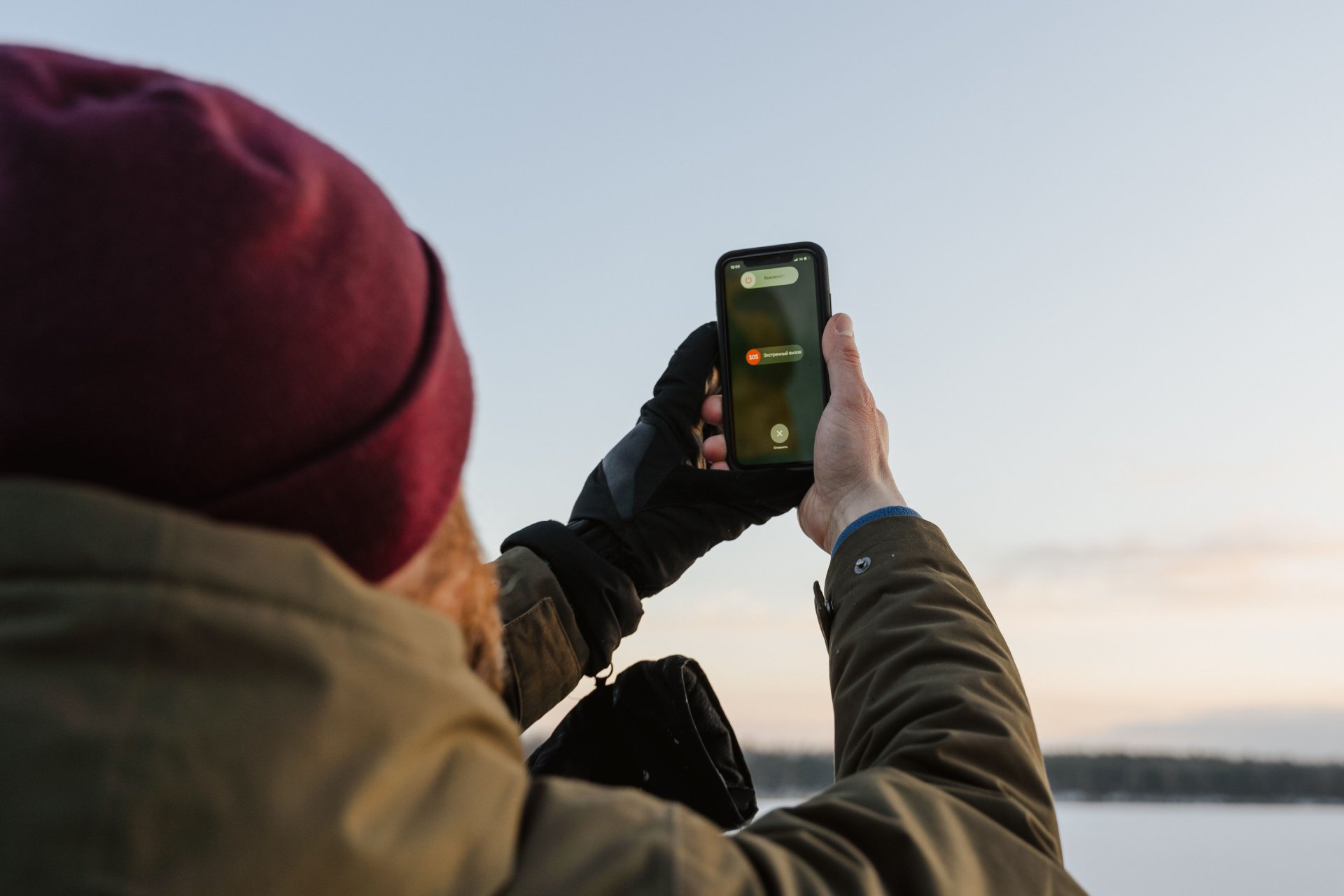
The legal questions are becoming more important because satellite communication is no longer a niche capability. Apple helped push the technology into the consumer mainstream when Emergency SOS via satellite appeared on the iPhone 14. The original concept was relatively narrow. If a user had no cellular or Wi-Fi service during an emergency, the phone could establish a satellite connection and transmit compressed information to emergency responders.

Since then, capabilities have expanded. Compatible iPhones can now use satellite connectivity for Emergency SOS, roadside assistance, location sharing through Find My and, in supported areas, Messages via satellite. That means a traveler may be able to tell family members that a hike is running late, update a location or communicate during a cellular outage without declaring an emergency.

That is an important shift. Satellite communication is evolving from a last-resort emergency tool into an increasingly practical off-grid communications layer.


Android Is Expanding Satellite SOS, Too

Google has taken a similar approach with Pixel smartphones. Satellite SOS is available on newer compatible Pixel devices in supported countries and is designed to work when cellular and Wi-Fi networks are unavailable. During an emergency, the phone guides the user through a series of questions, helps establish a satellite connection and transmits information to emergency services.

Samsung is also integrating satellite connectivity into newer Galaxy devices, with availability depending on model, carrier and country. Some Galaxy users can access emergency satellite messaging, while others may have access to broader satellite-enabled texting or limited data through carrier partnerships. This means satellite connectivity is moving away from being a feature associated with a single brand.

It is becoming part of the broader mobile communications ecosystem.


What Is Direct-to-Cell Satellite Service?

Direct-to-cell technology may be the most significant development of all. Traditional satellite phones use specialized hardware designed specifically to connect to satellite networks. Direct-to-cell satellites instead function more like cell towers in orbit. T-Mobile’s T-Satellite service, developed with Starlink, is one example. Compatible smartphones can connect to satellites when ordinary terrestrial coverage disappears, without requiring the user to carry a traditional satellite handset.

Current capabilities focus on texting and selected low-bandwidth applications, but the long-term implications are much broader. As satellite constellations expand, the difference between “cell service” and “satellite service” may become much less noticeable to the traveler. A phone could automatically move between terrestrial towers and satellites depending on which network is available. That is fundamentally different from the traditional model of carrying a separate satellite phone for emergencies.


Satellite Connectivity Is Moving Beyond Emergency SOS

Another important change is that smartphone satellite communication is expanding beyond emergency response. Location sharing is already becoming a practical tool. Travelers may be able to send routine check-ins, share their position with family or colleagues and maintain basic communication while traveling through remote areas.

Third-party developers are also beginning to build satellite-enabled services around smartphone hardware. Apps such as LNKT Satellite Check-In are intended to let users send simple “I’m okay” messages and location updates through supported smartphone satellite services without carrying a separate communicator. This kind of capability could be especially useful for hikers, hunters, anglers, overland travelers, sailors and anyone traveling beyond dependable cellular networks.

Wearables are joining the trend as well. Satellite connectivity has begun appearing in premium watches and other devices, creating another potential emergency communication pathway if the user’s primary smartphone is unavailable.


What Are the Limitations of Smartphone Satellite Service?

Satellite connectivity is powerful, but it is not unlimited. Most current systems work best outdoors with a clear view of the sky. Mountains, deep canyons, buildings, heavy vegetation and other obstructions can interfere with satellite connections. Messages may also transmit much more slowly than conventional texts. In favorable conditions, communication may take tens of seconds. Under more difficult conditions, sending a message can take several minutes or fail entirely.

Coverage is not universal either. A device may support satellite communications in one country but not another. Manufacturer support, local telecommunications regulations and carrier agreements all influence availability. Battery life is another vulnerability. Satellite communication becomes irrelevant if the phone is dead. Travelers heading off-grid should carry a high-capacity power bank and protect their phone from water, impact and extreme cold.


Satellite Communication Is a Lifeline, Not a Rescue Team

The biggest misconception may be assuming that successful communication guarantees a successful rescue. It does not. Satellite communication solves one problem: letting someone know you need help. It does not automatically solve the logistics that follow.

A traveler with a severe fracture in a remote mountain range may successfully send an SOS but still require a helicopter, ground team or technical rescue unit to reach the location. A sailor may communicate perfectly from offshore but remain hours from medical care. A traveler in a country with limited infrastructure may reach emergency services only to discover that local ambulances, hospitals or specialists cannot provide the necessary level of care.

The question is not simply, “Can I send an SOS?” It is, “Who receives that message and what can they actually do next?”


The Global Rescue Connection

Satellite-enabled smartphones represent one of the most important advances in traveler safety technology in years. They reduce the communications gap that has historically separated remote travelers from emergency assistance and increasingly provide ordinary travelers with capabilities once reserved for specialized expedition equipment.

But communication is only the beginning. A smartphone can transmit your location. It cannot perform a field rescue. It can send an emergency message. It cannot determine whether the nearest hospital has the capabilities required to treat your injury. It can connect you with another person. It cannot independently coordinate an international medical evacuation.

A Global Rescue membership provides field rescue from the point of illness or injury, medical evacuation, 24/7 medical advisory services and Destination Reports that help travelers understand medical infrastructure, security conditions and other destination-specific risks. Global Rescue’s Security Add-On provides additional security advisory and extraction services during qualifying emergencies.

Those services become especially important when travelers deliberately venture beyond established infrastructure. The rise of satellite-enabled smartphones makes it easier to ask for help. Travelers still need to know who will answer, what happens next and whether their satellite device is legal where they are going.

Before departure, check the destination’s communications laws, confirm that your satellite service is supported, practice using it, carry backup power and understand the capabilities of the organization you expect to help when something goes wrong.