Loading...

Categories:

Health & Safety
Share This:

Five Reasons To Consider TotalCare

As coronavirus crosses borders and oceans, Global Rescue’s TotalCareSM telehealth membership has quickly become the best option for travelers, even if they are temporarily benched by social distancing and self-quarantines.

As coronavirus crossed borders and oceans, Global Rescue’s TotalCareSM membership quickly became the best option for travelers, even if they were temporarily benched by social distancing and self-quarantines.

Why? It provided direct access to urgent care consultations with board-certified, licensed physicians.

Here are five reasons why a TotalCareSM membership is the best telehealth option for travelers — from work, from home, on the road, abroad or on an average day or during a pandemic.

[Related reading: TotalCare the Complete Telehealth Solution]

Speak to a Person

When you call Global Rescue for a TotalCareSM consultation, the call is answered by Global Rescue’s in-house operations team. From there, medical experts collect basic information, including a medical history before setting up a real-time video consultation with a board-certified, licensed doctor from Elite Medical Group (EMG).

TotalCareSM members can activate an urgent care consult three ways: the My Global Rescue Mobile App, on the phone or on the web. 

The Same Care Team

Some telehealth companies are set up as a giant network of doctors. They may or may not work together, or even know each other. TotalCareSM members always speak to an EMG physician.

EMG doctors are part of the same practice, which ensures continuity of care. EMG also works closely with Global Rescue’s operations team, in the event advisory services are needed.

“Because we function as a practice, our team can more efficiently address a variety of needs for our members. We follow up on every encounter to be sure people are recovering, or assessing any new needs or asks,” said Dr. Claudia Zegans, medical director at Elite Medical Group. “This leverages the power of our medical operations team and provides continuous care for the member. We have done this many, many times and it works.”

Global Experience

Most U.S.-based telehealth companies do not have experience with the complexities of health care while traveling.

“Other telemedicine services might be able to connect patients around the world with doctors, but how are the recommendations implemented? How does a teledoctor in Texas know which hospital in Rwanda to recommend to the patient?” Zegans said.

TotalCareSM ’s members have direct access to physicians well versed in travel health consultations — and the experience and expertise of Global Rescue, with an operations team that manages medical and security cases all around the world. It’s a unique combination that gives travelers the edge when looking for access to care while away from home.

Shorter Wait Time

There’s a shortage of doctors and in the bigger cities, like Boston, Massachusetts, where you’ll wait an average of 29 days to see a primary care doctor, according to physician recruiting firm Merritt Hawkins.

Once a member initiates a TotalCareSM consult, they will be connected with a physician within 30 minutes.

It’s a great time-saver for a stay-at-home mom, a student away at school, a family on vacation, or a business with remote employees — and gets everyone one step closer to healthy that much faster.

Pandemic Care

With a TotalCareSM membership, you have immediate access to a doctor — during a coronavirus pandemic and during seasonal outbreaks of influenza, RSV and the norovirus.

“These illnesses are highly infectious,” said Scott Hume, vice president of operations at Global Rescue. “All travelers should consider acquiring services that provide access to video consultations with physicians to avoid coming into contact with those infected in hospitals.”

Calling from the safety and security of your home can reduce the likelihood of infection. In fact, the CDC advised Americans to make arrangements for telehealth so they can receive medical information even if they are unable to physically travel to a doctor. And telehealth may be your only option in the event of a mandatory quarantine.

“I would prefer a doctor in person but, by the very nature of a quarantine, receiving medical attention or prescriptions remotely by phone or Internet would be the sensible thing to do,” said one Global Rescue member.

“It’s better to be safe than sorry,” said TotalCareSM member Mark Horton of Texas. “I don’t want to not have that option if/when my circumstances dictate that I really need it.”

Whether you’re at home, work or traveling, immediate access to telehealth services through a Global Rescue TotalCareSM membership is one important way travelers — and non-travelers — can get peace of mind.

Categories:

Health & Safety
Share This:

TotalCare: A Lifeline In The Midst of a Pandemic

The last thing you want to do when you are sick is drag yourself out of bed, get dressed, get into the car, drive to the doctor’s office and wait. Wait times can swell to…

The last thing you want to do when you are sick is drag yourself out of bed, get dressed, get into the car, drive to the doctor’s office and wait. Wait times can swell to more than an hour, as you’re often seated in a crowded waiting room, all to see a doctor.

And you certainly don’t want to do that in a pandemic.

“Social distancing due to COVID-19 highlights the need for remote access programs such as TotalCare,” said a Global Rescue TotalCare member from Texas.

Virtual Visits First

As social distancing changes to self-isolation and mandatory quarantines, telehealth is quickly becoming the first line of defense against coronavirus, reports NBC News.

According to the American Academy of Family Physicians, telemedicine (also known as telehealth) is defined as “the practice of medicine using technology to deliver care at a distance.”

Although telehealth has been around for decades, it is seeing a resurgence of interest as the coronavirus spreads and grows worldwide. The CDC has long recommended telehealth for underserved and rural populations, encouraging usage of virtual visits at the start of the coronavirus epidemic. In mid-March, the U.S. government lifted restrictions of telehealth services for Medicare beneficiaries in an effort to slow the rate of infection.

What is TotalCareSM?

Four years ago, Global Rescue started offering TotalCare memberships to travelers who wanted immediate access to a team of medical experts for real-time video consultations and treatment.

But TotalCare garnered the interest of not just travelers — business executives, college students, retirees and families with children who also wanted a better option than waiting in an urgent care office or the emergency room.

In today’s busy world, it makes sense. If you’re feeling symptomatic, sick or you just have questions, a TotalCare membership provides an urgent care consult with a doctor without leaving the comfort of your home. In a pandemic situation, like coronavirus, telehealth services can help slow the spread of disease.

In five easy steps, here’s how a TotalCare membership works:

Step One: Call or Message

Whether you’re at home, at school, at work or in a hotel room, members can initiate a consultation at any time. All you need is access: an Internet connection or a smart phone.

“You can use TotalCare while you are traveling, or while you are at home. It’s there when you need it,” said David Koo, senior manager of operations at Global Rescue.

Step Two: Medical History

Your request is answered by an in-house Global Rescue operations team member, who will obtain your medical history and symptoms.

Step Three: Virtual Visit

After the clinical and situational information is relayed from the operations team, you are placed into a live video conference with a board-certified, licensed doctor from Elite Medical Group (EMG).

“The wait-to-connect time is usually less than 30 minutes,” said Dr. David Ashley, Associate Medical Director.

Telehealth services, not set up for consumer demand during a pandemic, are currently being swamped with calls. Requests at the University of Pennsylvania are coming in faster than the clinicians can answer them. Many telehealth companies report a 50% increase in demand.

But not with TotalCare. TotalCare was set up to help travelers all over the world, with Global Rescue in-house medical experts answering the initial call and EMG doctors providing the virtual care. The team is used to fielding a flood of requests.

Step Four: Prescriptions or Labs

Board-certified doctors are licensed in all 50 states. Doctors have the ability to prescribe medications and order labs or diagnostic imaging.

Step Five: Continuous Care

Your care is not completed when you turn off the video or hang up the phone. The team follows your case to conclusion, taking care of any after-visit administrative needs and follow-up on doctor’s orders.

“The follow up was amazing,” said TotalCare member Linda Hanks. “I’ve had brain surgery and the doctor never called me after I went home to see if I woke up the next morning or to ask, ‘How are you doing?’”

“The doctor was able to identify my son’s skin condition and prescribe a cream for him to use,” said TotalCare member Christina Roth. “She even checked on us later.”

TotalCare Background

Coronavirus Questions Answered

There’s plenty of information available about how to prevent coronavirus — washing hands, social distancing, not touching your face — but less advice regarding what to do if you are contagious or sick. CDC recommendations suggest calling ahead before visiting a doctor’s office or avoiding the emergency room to limit exposure.

“This is where a TotalCare membership will be extremely helpful — providing immediate access to a team of medical experts who will answer all your questions, right from your home,” Dr. Ashley said.

TotalCare is the perfect solution for a member in Florida, who is worried about coronavirus symptoms. “My rheumatologist said, during my visit two weeks ago, if I have symptoms, don’t call her — go to the emergency room.  Now the media is a saying don’t go to the emergency room,” she said. “TotalCare will be a great option if necessary.”

Whether you’re at home, work or traveling, immediate access to telehealth services through a Global Rescue TotalCare membership is one important way travelers — and non-travelers — can get peace of mind.

Categories:

News
Share This:

Should You Jump On Coronavirus Flight Deals?

Share This:

TotalCare Is Family Care

When Christina Roth's son developed a worsening skin condition on his nose, she knew it was probably something a doctor should look at. That's when she remembered her TotalCareSM membership.

Small businesses are the backbone of the U.S. economy. When it comes to health care, entrepreneurs don’t always get the best deal. The average monthly expense for family coverage ranges from $1,200 to $1,500.

In Missouri, the Roth family is one of those small business owners. Five years ago, Michael Roth left a full-time career in criminal justice to start a probation supervision service to help clients change their lives for the better.

It meant a switch from typical health care to membership in the Christian Healthcare Ministry, a nonprofit ministry where members submit medical bills for reimbursement. Depending on the program level and eligibility guidelines, expenses are shared between members and reimbursed by check.

The Roth’s augment that coverage with a Global Rescue TotalCareSMmembership.

“The Christian Healthcare Ministry recommended Global Rescue along with it,” said Christina Roth, a mother of two.

[Related reading: TotalCare When We Needed It]

As you can imagine, the Roths are focused on preventative care to avoid unnecessary doctor appointments. But when her son, Trenton, developed a worsening skin condition on his nose — on a Friday before a long weekend, no less — Christina knew “we should probably have that looked at.”

She remembered that TotalCare offered virtual visits with a doctor and two were included with her membership.

“We had TotalCare for a year, but never used the service before,” Christina said. “Otherwise we were looking at a late-night urgent care visit.”

She called, detailed the situation and was connected to a doctor. A video appointment was a new experience for the family.

“Trenton was reluctant to talk to the doctor at first,” Christina said. “But she was so kind and her demeanor really helped him relax.”

The only difficulty was “getting good lighting so she could see what she needed,” Christina said. Once they did, “she was able to identify my son’s skin condition and prescribe a cream for him to use. She told us that if it didn’t work to let her know and we’ll try something else.”

Christina used an app to get the prescription (and save a few dollars as well).

“The process was seamless. The cream worked and she called the next day to check in,” she said. “And I did not have to make an appointment and wait for him to get into a visit.”

Would the Roths recommend TotalCare to other families?

“We have already,” Christina said.

Whether you’re at home, work or traveling, immediate access to telehealth services through a Global Rescue TotalCare membership is one important way travelers — and non-travelers — can get peace of mind.

Categories:

Health & Safety
Share This:

Coronavirus, Telehealth And the Generational Divide 

The results of the recent Global Rescue survey about telehealth and the current pandemic revealed a few surprises.

The results of the recent Global Rescue survey about telehealth and the current pandemic revealed a few surprises.

For example, respondents 71 and older were 43% less likely to use telehealth than people in their 30s. Perhaps that outcome can be attributed to the digital divide. But the survey exposed another surprise, specifically that the same group were twice as likely to break voluntary quarantine than all younger generational groups.

The survey responses are not an aberration. Older adult conduct (in general) during the pandemic is strikingly at odds with COVID-19 protocols. Reports of people 56-plus going out to bars, socializing at restaurants, going to the office, and hitting yoga class abound. NYC Mayor Bill DeBlasio, two years shy of 60, traveled 12 miles to exercise at his gym on the same day fitness facilities across the city were shutting down. 

In a recent piece for The New Yorker, journalist Michael Schulman reported his 74-year-old father and 68-year-old mother recently had a “fun dinner at the Polo Bar, in midtown Manhattan, with another couple who were old friends.” He added that the senior parents of his friends were shopping, meeting for coffee at the mall, going to church, golfing and continuing to work at the office.

These observations match a recent Harris poll showing that 77% of adults older than 65 believe they are “unlikely” to catch the virus. But the opposite is true. The Centers for Disease Control and Prevention (CDC) says older adults (65-plus) are at higher risk for severe illness related to COVID-19, adding that data shows that eight out of 10 coronavirus deaths in the U.S. are among people 65 and older.

“Whether this senior citizen behavior is founded in a lack of awareness, a form of rebelliousness, or something else – it is at odds with the social distancing, work-from-home, skip non-essential travel protocols government and medical officials have issued to stem the spread of COVID-19,” said Anna Christensen, a wilderness first aid expert, author and Global Rescue TotalCare member. “What is ironic, and perhaps tragic, is that older Americans – the demographic at the greatest statistical risk for death by the virus – are precisely the people who are the least concerned.”

The dangers for this age group elevate when you factor in their general, albeit mistaken, distrust of telehealth. According to the National Poll on Healthy Aging, nearly 7 out of 10 older adults believe the quality of telehealth care would not be as good as a face-to-face doctor visit and nearly half admitted they would have difficulty using the technology. 

The Telehealth Reality Is Different

The reality is very different. Dr. Claudia Zegans, medical director for Elite Medical Group, an organization that provides telehealth services, says physician consultations using video can assess and identify people who are sick enough to need an in-person evaluation or specific testing.

“For others, telehealth is an effective way to address whatever their current medical concern is as much as possible without ever leaving their home,” she said.

Dr. Zegans added that in this time of COVID-19 pandemic, telemedicine is incredibly useful to decrease traffic at clinics, emergency departments and urgent care centers. “This result is not only good for individual patients, but also for the entire community.”

Telehealth is vital during a health crisis, for young and old. Coronavirus is highly infectious and could overwhelm hospitals, creating shortages of beds, medicine, medical personnel, respirators and other resources.

“People are seeking out telemedicine services for coronavirus and I think telemedicine has an extraordinary value in this time, where we’re all trying to keep people out of health care facilities unless they really need to go,” Zegans said.

With a Global Rescue TotalCareSM membership, members can access board-certified, licensed doctors for real-time video visits, right from home.

“The sooner everyone – no matter their age – taps into telehealth, the better we will manage and recover from the pandemic,” Christensen said.

Categories:

Health & SafetyTravel
Share This:

Exploring Coronavirus Myths and Facts

Sifting through travel advisories and breaking news doesn’t have to be overwhelming, so our experts help you explore common coronavirus myths.

Coronavirus has captured the world’s attention as its rapid spread has sent countries into unprecedented territory surrounding containment and safety measures.

With COVID-19 dominating headlines, it can be hard to make sense of what’s accurate. Sifting through travel advisories, symptom checkers and breaking news stories can quickly become overwhelming and even prompt anxiety.

According to Google Trends, search interest in coronavirus topics is high around the world. As the breakout spreads, Google Trends reveals people want to know how to prepare and how to protect themselves.

With so much information available, knowing what’s reliable can be hard, so we asked our experts for their advice on a few coronavirus myths to explore.

Myth 1: Isolation And Quarantine Mean The Same Thing

The two terms are interchangeable, right? Wrong.

According to the Centers for Disease Control and Prevention (CDC), the term isolation refers to the separation of a person or group of people who are reasonably believed to be infected and could potentially infect people.

The term quarantine refers to the separation of a person or group of people who are reasonably believed to have been exposed but are not yet symptomatic and may not have the virus.

Myth 2: If You Are Sick, Go To The Doctor First

If you think you have been exposed to COVID-19 or you have symptoms, the CDC recommends using a telehealth service or calling your health care provider first. According to the CDC, once you speak to a health care provider, be sure to provide information about any symptoms you might have and let them know you think you have COVID-19.

Global Rescue TotalCareSM members have immediate access to board-certified, licensed doctors for real-time video consultations and treatment.

After speaking with a health care provider, they will be able to advise you on the best course of action to get you the care you need. Calling ahead also gives your health care provider the ability to take steps to ensure other patients are not at risk for getting infected or exposed.

Myth 3: Only Older People Are At Risk For Coronavirus

The CDC and the World Health Organization (WHO) note older individuals and those with certain chronic medical conditions are at higher risk of getting seriously ill from COVID-19.

Though according to WHO, people of all ages can become infected with coronavirus. Even if you’re not at high risk for serious illness from COVID-19, be sure to take steps to protect yourself and others around you. You can start by washing your hands with soap and water or using an alcohol-based sanitizer.

Myth 4: Wearing A Face Mask Will Protect You From COVID-19

According to a JAMA Network article, face masks should be used if you have symptoms of respiratory infection. Face masks should also be worn if you’re a health care worker or taking care of someone with a respiratory infection. If you do need to wear a mask, make sure you understand how to use it and which type of medical mask is right for you.

Myth 5: You Can Catch COVID-19 From Your Pet

According to WHO, there’s currently no evidence that pets such as dogs and cats have been infected or could spread the virus that causes COVID-19. To date, the CDC has not received any reports of pets or other animals becoming sick with coronavirus. The CDC does recommend avoiding contact with pets and other animals like you would with other humans if you are sick with COVID-19.

Myth 6: Antibiotics Can Treat Coronavirus

Antibiotics are effective for treating bacteria, not viruses. COVID-19 is a virus, which comes from the same family of viruses that causes severe acute respiratory syndrome (SARS) and Middle East respiratory syndrome coronavirus (MERS-CoV). Both the CDC and a recent PubMed publication state there is no specific antiviral treatment recommended for COVID-19 and no vaccine is currently available.

Concerned About Coronavirus?

As the coronavirus outbreak continues, don’t count on a slowdown in media coverage. If that seems daunting, Global Rescue can help.

Our in-house experts are closely tracking COVID-19 developments, analyzing hundreds of sources daily. To stay informed, sign up for our daily alerts to get updates delivered directly to your inbox.

Global Rescue TotalCare memberships include immediate access to a team of medical experts for real-time video consultations and treatment, including prescriptions, labs and imaging, when medically indicated, all without having to go to a hospital.

Categories:

Health & SafetyTravel
Share This:

Coronavirus: What Global Rescue Can Do

To assist our members, we've compiled a list of answers to the most frequently asked questions related to our capabilities and coronavirus.

Earthquakes, altitude sickness, civil unrest, broken bones, lost passports and so many more crises drive operations at Global Rescue.

Including COVID-19.

“Global Rescue responds when people are having, in many instances, the worst day of their lives and we do everything humanly possible to make it better,” said Dan Richards, Global Rescue CEO.

As a leading provider of travel risk and crisis management services, Global Rescue protects enterprises, governments and its members — at home, overseas, at work, on a trip, solo or with family.

Covid-Services_web-page2

Travel restrictions may delay a trip home but there are many best-in-class services that will help a member dealing with a COVID-19 medical crisis.

“Members should call us first,” said Scott Hume, vice president of operations at Global Rescue. “Every question is a good question and our medical and security experts are standing by to provide answers.”

To assist our members, below are answers to frequently asked questions related to our capabilities and coronavirus.

I Have International Travel Planned. Should I Go?

As long as you follow reputable hygiene and social distancing precautions such as those published by the Centers for Disease Control and Prevention (CDC), the odds are in your favor that you will not contract the virus. The odds are in your favor that if you contract the virus you will survive.

What Will Happen if There’s a Coronavirus Outbreak in My Destination?

Anything could happen.

Borders can close without notice. If borders close you will be stuck.

If you contract the virus while traveling you will recover in a foreign hospital. Your family is unlikely to be allowed to visit. Are you prepared mentally and financially for that?

The global coronavirus situation is constantly changing and Global Rescue’s medical, security and intelligence teams are monitoring developments 24/7/365 to provide travelers with the most accurate information. Stay informed by signing up to receive daily alerts from Global Rescue’s coronavirus report.

If I Decide To Travel, What Is the Best Way To Arrange for Medical Assistance if I Need It?

After you’ve researched your destination, choose a company that offers travel risk and crisis response services, like Global Rescue. This could range from travel insurance to a travel protection membership to telehealth services — or include all three.

Travelers should look for plans or memberships that include medical advisory and evacuation support, medical and security guidance and referral, coordination and transmission of medical records and travel assistance.

What if I Contract COVID-19 Outside of the United States?

Evacuation home if you are infected and contagious will be extremely unlikely and difficult, if not impossible.

If you contract the virus and recover, the protocol to prove you are contagion free may not be well understood at your location and may be a low priority. Again, you may be stuck.

How Can Global Rescue Help if I’m in Quarantine at Home in the United States?

The CDC has advised Americans to make arrangements for telehealth services, so they can receive medical advice even if they are unable to physically travel to a doctor.

That’s where a Global Rescue TotalCareSM membership can help. TotalCare members don’t have to risk exposure in a hospital, with access to real-time video consultations with board-certified, licensed physicians from home. Doctors can prescribe medications and order labs and or imaging in all 50 states.

What if I’m Not Permitted To Leave a Country (Cruise Ship or Other Quarantine Area) With a COVID-19 Outbreak?

Travelers are at risk of getting stuck almost anywhere, from a country to a cruise ship or an airport. Medical evacuation is not possible during a mandated quarantine period. If a member is quarantined, Global Rescue will provide medical and other advisory services, including:

  • Health advice to decrease symptoms and prevent complications of disease
  • Information and advice for caregivers to protect their health
  • Local/regional/governmental public health directives to advise when to seek care and testing and when to remain at home
  • Hospital/clinic referral and facilitation of access, as needed
  • Medical translation services to improve communication with medical providers and facilities
  • Oversight of medical care by physicians
  • Assistance in locating and acquiring medications and/or medical supplies
  • Coordination and transmission of medical records to facilitate ongoing care with other medical providers or facilities
  • Coordination with the U.S. Embassy

What if I Contract COVID-19 in Foreign Country and After Quarantine, Want to Return Home?

In addition to advisory-level support, Global Rescue can coordinate travel on a fee-for-service basis, provided such travel meets all public health and travel restrictions in place at the time of the event.

Qualification for tests verifying the member’s health and any time frame for quarantine will be defined by the country of origin and the local public health authorities. Once movement is allowed by law, Global Rescue can help members with travel arrangements (hotels, flights, ground transportation, etc.).

Has Global Rescue Identified Air Ambulances to Transport COVID-19 Patients?

Yes. We have these services and are prepared to deploy them. However, there are relatively few specialty isolation-equipped aircraft in the global air ambulance fleet and there could be significant wait time before access is available. These services are available on a fee-for-service basis.

What if I Need a Medical Evacuation — And My Illness or Injury Isn’t COVID-19 Related?

Global Rescue can coordinate medical transport services to local hospitals and provide support for evacuation and repatriation — if allowed by governmental public health authorities in the country of origin and destination.

If you have additional questions, Global Rescue’s member services department is available 24/7/365 to assist our members.

Categories:

News
Share This:

How Small Businesses Can Manage Travel During Coronavirus

Categories:

News
Share This:

COVID-19? People Need To Protect Themselves

Categories:

News
Share This:

Just a week ago, bookings to ‘safe places’ gave hope

Categories:

News
Share This:

Better climber safety is forecast on Everest

Share This:

Continuing the Climb

David Thoenen has been climbing since 1964. But a 2019 trek to Annapurna Sanctuary in Nepal was the first time he had to use his Global Rescue membership.

David Thoenen has been backpacking since 1960. Climbing since 1964. Serious climbing since 2001.  

“In 2001, at age 55, I decided I’d rather be a rock climber and a mountaineer,” said the North Carolina resident. “So that’s what I do now: climb. Rock, ice, snow. North America, The Caucasus, Iran, Western Europe.”

He retired in 2005 after 35 years at IBM and, with his wife Maria and climbing friends, lives out his dream of international travel to climbing and hiking destinations.

But a 2019 trek to Annapurna Sanctuary — a high glacial basin surrounded by mountains on all sides — in Ghandruk, Nepal was the first time Thoenen had to use his Global Rescue membership.

Final Day of the Trek

Thoenen was on the tail end of a 28-day tour in Nepal and Bhutan, with 10 days allocated to Annapurna Base Camp Trek.

“On final half day of the trek, at lower altitudes, headed up steep hill between Chomrong and Ghandruk, I sat down to rest and immediately lost consciousness,” said Thoenen. “Maria and Lhakpa, our personal Sherpa, tried to wake me up. After about a minute I regained consciousness — but passed out again as soon as I tried to sit up. After another minute or so I regained consciousness and did not pass out again.”

The incident occurred in front of a small tea house. Thoenen was quickly brought inside to rest, and a Sherpa raced up the trail to locate the guide. In a matter of minutes, the guide and lead Sherpa returned, took Thoenen’s vitals and medical history, noted current medications, grabbed his Global Rescue card, and dialed in the call using a satellite phone.

“Global Rescue listened carefully, asked the right questions, and promised a fast call back,” says Thoenen.

Twenty minutes later, a helicopter was on its way to provide a field rescue.

Medical Field Rescue

Coordinating a landing zone turned out to be more difficult than expected.

Thoenen, with the help of the Sherpas, was moved a half mile down the trail to a small farm. There was a pasture available for the helicopter to land and several phone calls helped coordinate position.

A landing wasn’t possible with the debris blowing up into the helicopter’s path.

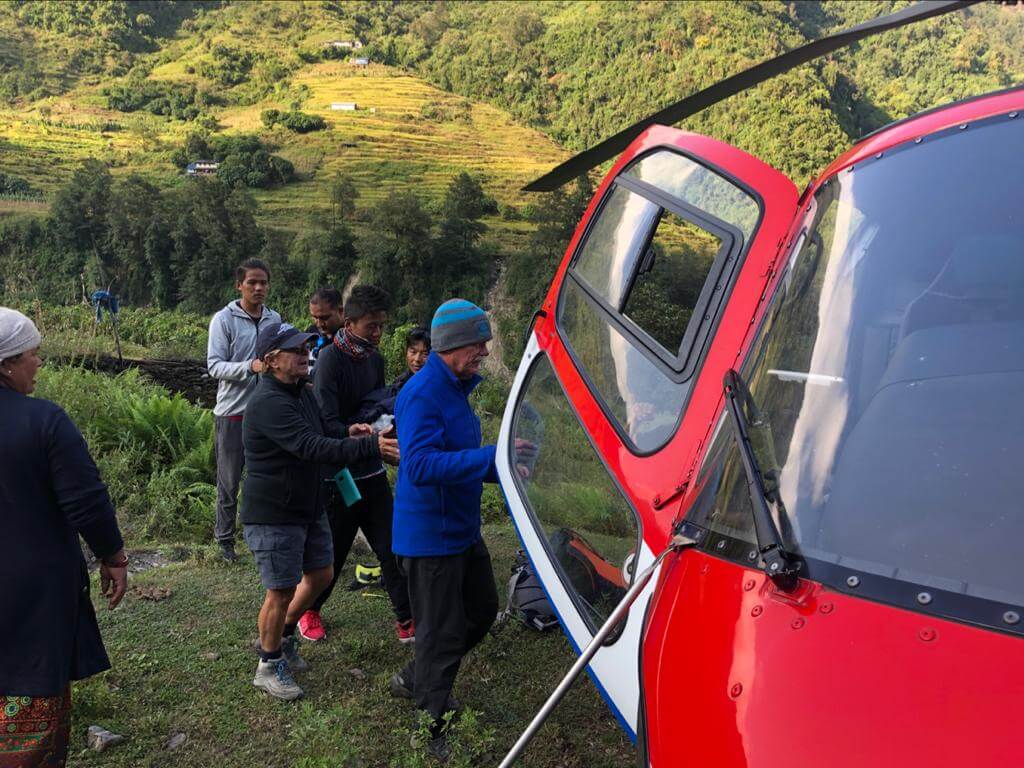
There was more conversation by phone, and a second landing option was chosen. Thoenen was moved another quarter mile to a clear area. The helicopter landed, and the villagers gathered around it for a photo opp.

“I’m not sure of the overall timing but I estimate about 90 minutes between the first call and our lift off,” said Thoenen. “While I was very, very weak, I was quite confident that Global Rescue was on the way and all would be fine.”

Care When You Need It Most

Thoenen, Maria and the guide landed 15 minutes later at Pokhara airport where an ambulance and EMS crew was waiting. In another 15 minutes, Thoenen was receiving care at CIWEC Hospital Pokhara.

“The hospital proved to be an excellent facility,” said Thoenen. “After an initial evaluation by the nursing staff, I was seen by a terrific doctor. He ordered a number of tests which were turned around in a flash. His diagnosis was fainting due to low blood pressure due to electrolyte imbalance due to dehydration. After one night in the hospital I was able to check out, go to my hotel, and flew back to Kathmandu the following day. Excellent hospital, excellent doctor, excellent food!”

Thoenen — a longtime American Alpine Club member, former chair of the Triangle Chapter and 2020 Angelo Heilprin Citation Award Winner — wasn’t surprised by Global Rescue’s speedy response.

“What did surprise — and please — me was the continuing monitoring of my status and needs until I hit the driveway in front of my house in Raleigh,” he said. “Global Rescue called frequently and made arrangements for wheel chairs at all of the airports on my way home. It was a real confidence builder that they remained essentially close at hand to help as needed.”

Thoenen has an annual family membership, so “we’re covered wherever we go,” he said. Plans for 2020 are underway, and an Everest Base Camp trek is planned for 2021.