Share This:

Tiger Burning Bright | Global Rescue Senior Director Profiled by Ski Racing Magazine

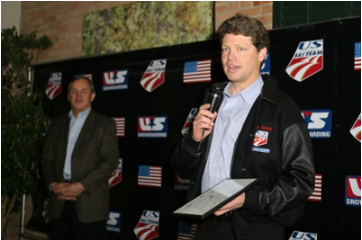
Ski Racing Magazine caught up with Tiger Shaw, senior director of response services for Global Rescue, to get his thoughts on skiing, life as a parent and his new role at Global Rescue.

USST veteran Tiger Shaw turns his talents toward a new role at Global Rescue

Tiger Shaw, a two-time Olympian and 10-year veteran of the US Ski Team and World Cup circuit enjoyed an athletic career at the highest international level. Today, several decades removed from his days on the hill, Shaw is the senior director of response services for Global Rescue — a crisis response company dedicated to redefining the evacuation services provided to corporations, academic institutions, government agencies and injured athletes, travelers and outdoorsmen all around the world.

From Global Rescue’s headquarters in downtown Boston, Shaw oversees accounts from large international corporations with thousands of employees overseas to elite teams of ski racers traveling to camps in Mount Hood, Chile, New Zealand, Europe and beyond. He says that his passion for the sport of ski racing and commitment to safety for young athletes propelled him to his current position at Global Rescue, where he believes he has an opportunity to impact medical care and safety in the ski community.

Ski Racing Magazine caught up with Shaw to get his thoughts on skiing, life as a parent and his new role at Global Rescue.

Your ski career produced a long list of achievements. What was your proudest moment as an athlete?

Making two Olympic teams was definitely a highlight, but my World Cup results are the most memorable. That’s the closest that I ever got to being best in the world — third in a run, sixth in a race, etc. Making the Olympics is an honor, but that is making a cutoff to make a particular team, not necessarily striving to be the best in the world. It’s less of an achievement to make the Olympics as an American than it is to place in the top five in the world.

Throughout your career, you must have traveled to some pretty out-of-the-way places. Global Rescue does what nobody else does, and gets to these places. What’s the most remote ski area you’ve ever been to?

Las Lenas, Argentina, no question. After a 12-hour flight to Buenos Aires, you have to drive 26 miles west to a small domestic airport. Then it’s a 45-minute 737 flight to interior Argentina. It felt like we landed on a dirt strip. Once there, we took buses to the resort where all the buildings are A-frames to withstand the 10 to 20 feet of snow that would fall between now and when we left. Not much else out there… I actually self-evacuated once after hurting my knee. Caught a flight to Buenos Aires, lugged my bags, spent three days locally trying to get a flight, all while limping around — fun!

With six knee operations under your belt, you’re no stranger to injuries. Have you ever witnessed a serious injury to a friend or teammate?

Yes, unfortunately. I was in Squaw when Joel Persone launched off a downhill jump while training, and landed on a coach who was salting the track. Luckily both survived, with one taking many years to recover, but he did. I have a few other stories like that — glaciers, accidents, car wrecks. I’m old enough to have seen a lot.

These days, you surround yourself with former athletes, paramedics, and U.S. special operations veterans at the Global Rescue headquarters. Tell us about your role.

I joined the company in the summer of 2011. My involvement here began with the rescue of my own kid — she wrecked her knee in Panorama, B.C., and Global Rescue brought her home for surgery, which, thankfully, went well and she is still racing today. We knew about Global Rescue because Burke Mountain Academy was way ahead on this preparedness curve. They required that all internationally-traveling kids have coverage. Similarly, GMVS covers every single kid and staff at the school with Global Rescue. Many clubs also stress coverage, some more than others, and as a result not all ski racers are covered, but should be.

How is Global Rescue making an impact in the ski community?

We’re trying to make it a safer sport through better preparation, and better response to problems and emergencies when they occur. I do believe that, through our work, we have significantly affected the lives of many skiers. There was no one as capable before us. Just ask anyone who has suffered because of the past deficiencies, and those that have benefited from us.

Over the past few years we’ve also formed a number of partnerships with ski clubs and academies across North America. Through these relationships, we can protect kids, members and their families, and also help clubs with risk mitigation and destination pre-planning. These are invaluable benefits for large groups traveling to race or train. Many clubs take advantage of the preparation help we can provide, some don’t. My message to them would be, “Don’t wait for a bad accident before you finally get prepared. Get coverage, get prepared!”

Now as a parent of several elite racers, it must be a bit unnerving to watch your children compete. How has your perception of risk in the sport evolved from your career as an athlete to your time as a parent?

Dramatically. As you get older, you grow more risk-averse. Smarter is safer. Even these days, when skiers are doing many and much more dangerous things (pipes, slopestyle, extreme), it is in fact safer than it used to be, because of awareness and equipment improvement. As a coach and a ski club director, I look at ski trails for safety, fencing in the proper position and place, obstacles protected, safety bars down, etc. I feel like I’m the opposite of that mayhem guy in the Allstate Insurance commercial. My kids create chaos; I try to control and mitigate it. When my kids travel to race and train, I sleep easy knowing they have one number to call in the event of an emergency.

As a parent, why would you recommend Global Rescue to the parents and coaches of athletes nationwide?

Peace of mind, security and professionals on top of it should an incident arise. One number to call, and a solution waiting to kick in. I recommend Global Rescue to parents because I know the people here, and I want them taking care of me if I need help. Plain and simple.


Share This:

Global Rescue deployed after member falls between train and platform

While in Germany vacationing with his family, a member was attempting to board a train when he fell into the gap between the train and the platform, severely lacerating his leg. Soon after the incident,…

While in Germany vacationing with his family, a member was attempting to board a train when he fell into the gap between the train and the platform, severely lacerating his leg. Soon after the incident, his son contacted Global Rescue.

After the initial call, local medics arrived on the scene and transported the member to a nearby hospital, where physicians attempted to control the bleeding and performed an x-ray. On first review, local medical staff in Germany felt that the situation was stable and that there was no evidence of any fractures or injury beyond the laceration.

After reviewing the injury with local doctors, it was decided that the best course of action would be for the member to remain in Germany for a further 5 days to determine whether the leg was stable for transport and if a skin graft would be required. The member could then be transported to his home hospital in Houston for further treatment.

Global Rescue took steps to ensure the member remained comfortable in hospital and contacted his wife, who helped obtain the release of relevant medical records. These allowed Global Rescue medical teams to better understand whether appropriate care was being received and what the next steps should be in the treatment process.

As a result of the extended stay and to monitor the patient during the onward transportation, Global Rescue deployed medical personnel to Germany who met the injured member and his wife at the hospital, arranged his discharge, and oversaw his transport.

Once on the ground in Houston, Global Rescue arranged ground transportation for the member from the airport to ER at the receiving hospital.

After an ER evaluation and diagnostics, it was determined that the member’s injury was healing well and the situation did not require further hospital admission.


Share This:

Former U.S. Ski Team member, TJ Lanning, relives his 2009 crash and medical evacuation

Former U.S. Ski Team member and 2008 U.S. downhill champion, TJ Lanning, talks to Ski Racing Magazine about his 2009 crash and subsequent evacuation by Global Rescue.

Share This:

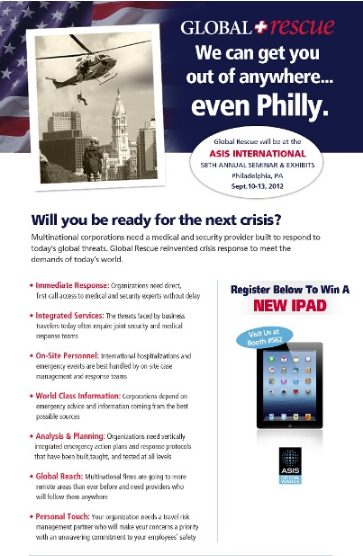
Global Rescue to attend ASIS Security Conference in Philadelphia

    To register to Win A New IPAD and to set an appointment, contact tkoeth@globalrescue.com  VISIT US AT BOOTH #562  For further information please contact Accounts@globalrescue.com or call Global Rescue at +1-617-459-4200.  www.globalrescue.com  

Share This:

Global Rescue evacuates US citizen from Greece after seizures

While vacationing in Greece, a US citizen experienced an unprovoked seizure that lasted for nearly thirty minutes. Hospitalized locally, she was placed into a medically induced coma. Shocked by this sudden episode, the patient’s sister…

While vacationing in Greece, a US citizen experienced an unprovoked seizure that lasted for nearly thirty minutes. Hospitalized locally, she was placed into a medically induced coma. Shocked by this sudden episode, the patient’s sister contacted Global Rescue.

At the request of family members, Global Rescue organized the patient’s transportation from the Greek hospital to the US in order to ensure that the patient was receiving the highest level of care possible. Global Rescue coordinated communication between the hospital in Greece, the patient’s family, and specialists at a leading US hospital. Doctors were advised to prepare a place for the patient, who would be transferred from the Greek hospital as soon as her condition was diagnosed as ‘safe for travel.’ The patient was cleared for travel aboard a medically equipped jet, and family members made plans to arrive at the receiving hospital immediately following the patient’s admission.

The patient was flown from the hospital in Greece directly to Boston. After coordinating with the flight crew, Global Rescue assured family members that the patient’s vital signs remained stable throughout the transport process and that the flight went without incident. The patient was met by two Global Rescue paramedics at the airport, who provided direct care during the ambulance transport to the hospital. All important medical information was relayed to staff members at the receiving hospital, who were fully prepared to receive the patient and begin medical procedures upon arrival.

The patient continues to make a recovery and family members thanked Global Rescue for their work and support throughout this difficult event.


Share This:

A rush to do business in the Middle East – Global Rescue featured in the…

More than a year has passed since the Arab Spring, the catchall name for the revolutions sweeping the Middle East. The political and economic changes have closed some doors and opened others for business people…

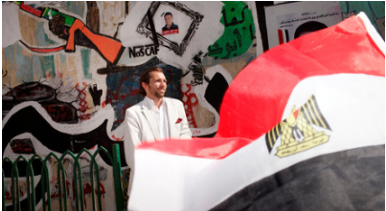
 David Degner/Getty Images

A Rush to Do Business in the Middle East

By Michael T. Luongo

More than a year has passed since the Arab Spring, the catchall name for the revolutions sweeping the Middle East. The political and economic changes have closed some doors and opened others for business people willing to tolerate risk.

“I have seen a flurry of activity because of the Arab Spring that was not happening before,” said Naava Mashiah, an Israeli who is the chief executive of M.E. Links, a consulting company that she described as working “to nurture economic relationships between Israel and other places.”

Ms. Mashiah, who works out of Geneva, said much of the activity is in soft diplomacy and informal development meetings, often coordinated with human rights and nongovernmental organizations. She mentioned helping clients develop contacts in or from locations that include Tunisia, Qatar, Egypt and Libya.

“It is bringing people together, even if it is a think tank,” she said, adding: “A lot of networking goes on in the corridors.” She described the current back-channel activity and potential as akin to the 1993 Oslo Accords between Israel and the Palestinians, which touched off an economic boom.

Chuck Dittrich, executive director of the U.S.-Libya Business Association, said he thought that American business people needed to “just get over there and get a feel for the place,” even if it did not seem immediately productive.

Mr. Dittrich said that association members were meeting Libyan government officials and business people, and that they were “not so much there to sell, as more developing relationships as they do their planning process and decide where to go now.” He mentioned Libyan trade shows focusing on oil, transportation and infrastructure development, health and education.

Mr. Dittrich said the Libyan economy had begun to be liberalized in 2005, when Muammar el-Qaddafi, then president, began courting the West. From a business perspective, he said, that means “the glass is more than half full,” adding, “The ingredients are all there for them to pull this off in a very good way.”

American businesses that wait too long, fearing the risks, could be left behind, he said. Mr. Dittrich said his group visited in April, and “we were the first organized U.S. business organization to go to Tripoli since the conflict.” But, he said, “Turkish and European delegations were there right from the early days.”

But a business traveler briefly stopping in the region has to make different preparations from someone who is based in a country in the midst of change. Marshall L. Stocker, a chartered financial analyst with the Boston hedge fund manager Emergent Property Advisors, moved to Cairo in June 2010, and temporarily fled after the mass protests began on Jan. 25, 2011.

“In Egypt, cells were off, the Internet was off. Obviously there was no business to be done. I was barricaded in my apartment,” he said, adding, “I self-evacuated to the airport with tickets for three different flights” that his wife had arranged for him from the United States.

Mr. Stocker returned in February 2011, after Hosni Mubarak resigned as president. Despite the disruptions, he said, Egypt presents business opportunities. “Now is a great time to buy assets,” he said. “Conceptually, and in practice here, assets are falling in value.”

He said his company was interested in Egypt because of the direction its business climate was moving. “One of the things that attracted us to Egypt was that the World Bank had improved its ‘ease of doing business’ rating,” he said. “Egypt had become more hospitable to investment. From 2004 to 2007, it had the single greatest improvement in ‘ease of doing business’ of any country in the world.”

While things have generally settled, he said he was prepared for emergencies. “As a result of the Arab Spring, I bought political evacuation insurance, and I have a satellite phone,” he said. He uses Global Rescue, a company that provides medical evacuation, security services and other emergency assistance. Still, Mr. Stocker said some Cairo business travel costs had decreased, including hotel rates and airfares.

Read more here


Categories:

News
Share This:

New York Times – A rush to do business in the Middle East – Global…

Share This:

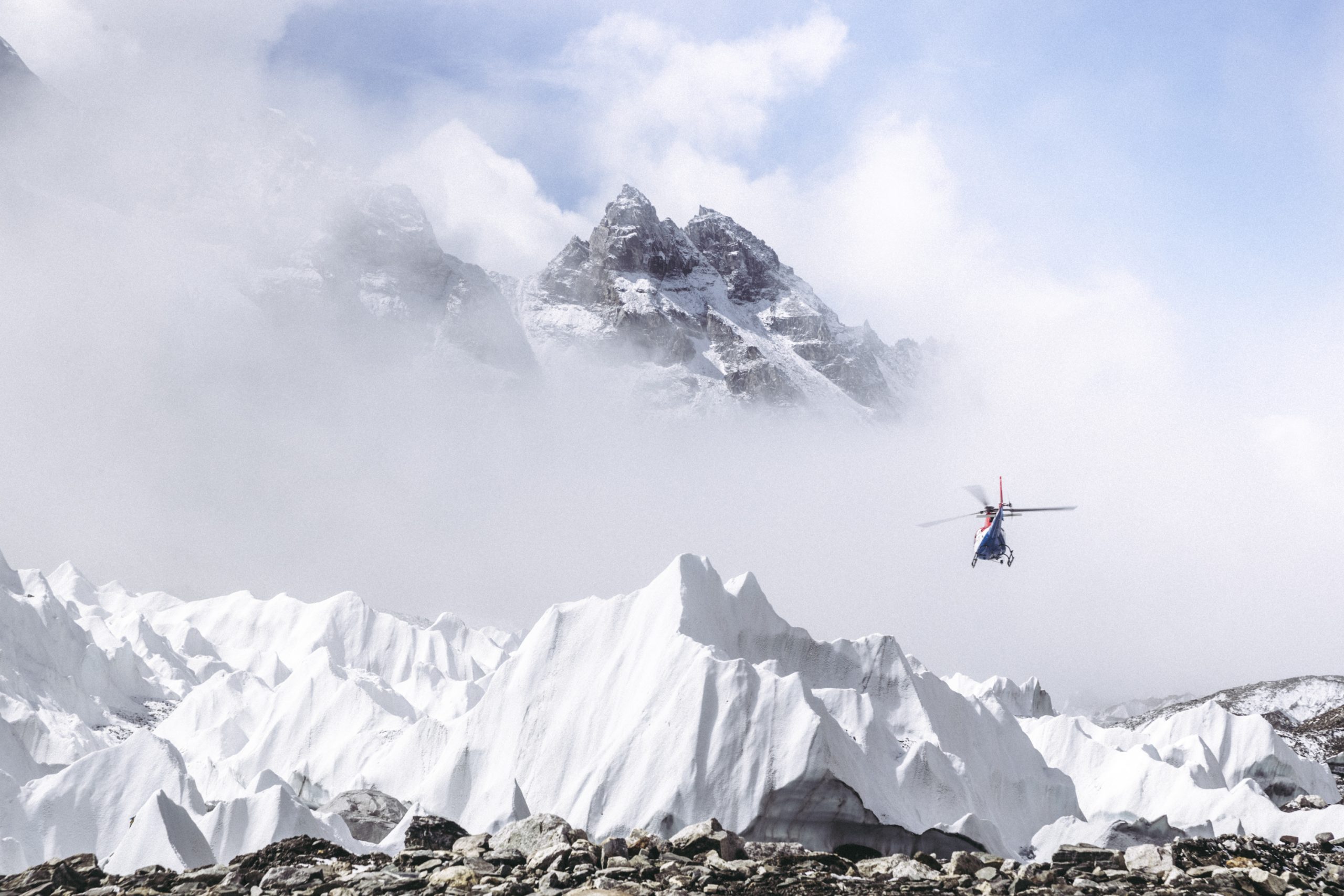
Dr. Robert Vestal recalls his helicopter evacuation from Everest Base Camp

As usual Global Rescue was kept busy assisting members during the Himalayan climbing and trekking season. One member, Dr. Robert Vestal, writes to thank Global Rescue:

As usual Global Rescue was kept busy assisting members during the Himalayan climbing and trekking season. We conducted a number of rescues in Nepal, including high altitude evacuations from Everest itself. To support operations, a Global Rescue paramedic was on the ground in Nepal during peak season.

One member, Dr. Robert Vestal, writes to thank Global Rescue:

Dear Global Rescue,

Obviously you are aware that I had to be evacuated by helicopter from Namche Bazaar on Friday, April 27. Obviously, I was hugely disappointed that I could not continue my trek to Everest Base Camp. However, I was exceedingly glad to have a Global Rescue membership. I was equally glad that Bob Veno, a paramedic in your operations group, had been deployed to Kathmandu to represent Global Rescue and assist with any and all medical problems encountered by Global Rescue members. He was there at the airport when the chopper touched down. He accompanied me in the ambulance to the hospital and stayed with me many hours during the course of my hospitalization.

Basically, Bob shepherded me through the entire hospitalization process and made sure that the necessary studies were done for evaluation and that we had copies of the medical records and reports. I also know that he performed a similar role for others during his deployment in Nepal. I was hugely impressed with his interpersonal and technical skills, as well as his valuable field experience in many diverse settings. He made a big difference to me and others while he was in Nepal. I will not hesitate to recommend Global Rescue to anyone who is contemplating a trip where an evacuation or medical transport may be needed.

Finally, many thanks to everyone at Global Rescue including the staff taking calls 24/7 in the office and your physician medical consultants, such as Doctor Eric Johnson, for providing me with the best available care and transport surrounding my injury.

Sincerely,

Bob Vestal

Member – Wilderness Medical Society 


Share This:

Global Rescue paramedic deployed to assist injured member in Ecuador

Global Rescue was alerted to an incident involving a member in Ecuador who had suffered a five foot fall onto concrete.

Global Rescue was alerted to an incident involving a member in Ecuador who had suffered a five foot fall onto concrete.  Immediately after the fall he developed shortness of breath and medical transport was arranged to a local clinic in the small town of Esmereldas. Once there, chest x-rays revealed several broken ribs. The preference of local surgeons was to wire the member’s ribs to prevent further injury. However, Global Rescue’s medical team questioned whether this invasive surgery was necessary.  Global Rescue immediately deployed a bedside paramedic to manage this complicated case and advocate for the patient.  After further consultation with both local physicians in Ecuador and specialists from Johns Hopkins Medicine, Global Rescue insisted the member be transported to a local radiology clinic for further assessment. This revealed blood and air had entered the space around his lungs due to the traumatic injury.  Due to the nature of the injury, the risks involved in transporting the patient prevented him from being moved safely.  As a result, Global Rescue’s paramedic remained on station in the hospital overseeing and coordinating care until the member could be transported. The member was ultimately able to return home under Global Rescue’s supervision and is expected to make a full recovery.


Share This:

Alpine Ontario partners with Global Rescue to protect its athletes

Alpine Ontario has partnered with Global Rescue in order to offer its athletes the same medical evacuation and advisory services provided to the U.S. Ski and Snowboard Teams, the organization announced today.

Alpine Ontario has partnered with Global Rescue in order to offer its athletes the same medical evacuation and advisory services provided to the U.S. Ski and Snowboard Teams, the organization announced today.


“Global Rescue is a category leader just like Alpine Ontario,” says James Lazor, Executive Director for Alpine Ontario.  “Partnering with Global Rescue supports our athletes all over the planet when they are training or racing and gives us the peace of mind needed in helping develop the best young athletes in winter sport.  Global Rescue helps mitigate risk for us and protects our most precious resource: the kids. Our elite athletes are training and competing with increased frequency in hard to reach mountain towns where obtaining the best care can be difficult.  Working with Global Rescue will allow us to get them the resources they need, should they need them, no matter where they are in the world.”


Alpine Ontario athletes frequently travel to South America, New Zealand and Europe as well as North American destinations for training and competitions, and have selected Global Rescue to ensure that injured or ill skiers receive the highest standard of healthcare no matter where they are in the world.


About Global Rescue


Global Rescue is a crisis response company that provides best-in-class medical, security, advisory and evacuation services for individuals, corporations and travelers worldwide.  Global Rescue is also the official provider of medical evacuation and advisory services to the U.S. Ski and Snowboard Teams, and works with ski clubs and academies all over the world.  The company’s emergency response teams are comprised of paramedics, physicians and security personnel, many of whom are veterans of elite rescue units of the U.S. Military.  Through an exclusive relationship with the physicians of Johns Hopkins, Global Rescue members benefit from the advisory services of some of the world’s finest physicians.  Global Rescue utilizes medically equipped, contracted aircraft all over the world and will fly members to their home hospital of their choice in the event of an illness or injury requiring hospitalization.


About Alpine Ontario (AOA)


Alpine Ontario Alpin (AOA) is the provincial governing body for the sport of alpine ski racing in Ontario. 

Alpine Ontario’s newly refined mission is to provide leadership and structure for high quality, sustainable and affordable programming and to communicate the competitive, recreational and lifestyle benefits of ski racing to the community.


AOA represents four divisions, 44 member clubs and over 30,000 active athletes, coaches and officials (volunteers). AOA coordinates several successful programs across the province and continues to foster the development of “state of the art” ski-racing programs from the grass roots level to the elite level.


For more information, call +1-617-459-4200 or visit www.globalrescue.com


Categories:

Travel
Share This:

Where to escape the masses in 2012

As a Global Rescue member, your travel tastes are probably a bit adventurous. So we asked Hideaways International, an exclusive travel club we work closely with, what frontiers in travel they are currently recommending to…

As a Global Rescue member, your travel tastes are probably a bit adventurous. So we asked Hideaways International, an exclusive travel club we work closely with, what frontiers in travel they are currently recommending to their members to satisfy their wanderlust.


Hideaways has been searching out the world’s most distinctive destinations for more than three decades, and they’ve just come out with their pick of places that are prime for discovery, or rediscovery. Each is on the verge of taking off as a popular vacation spot for discerning travelers who want to experience a place that’s unique, not heavily touristed, and in many cases a bit cutting-edge. Some, like the lush and little-known Caribbean island of Dominica, have retained their sense of ruggedness and seclusion, while others—most notably Myanmar—are emerging from a period of bad politics and have become much safer for exploration.


We think you’ll enjoy learning more about all of the stimulating, “not quite prime time” getaways they are recommending. Check out Hideaways International’s picks of “Dynamic Destinations for 2012”. Hint: Go now before the rest of the world discovers their little secrets!


Hideaways InternationalTM has been offering the savvy members of itsHideaways Aficionado® Club out-of-the-ordinary travel experiences, curated and best-of-kind lodgings, and VIP perks and privileges for more than three decades. They have a special membership offer for Global Rescue members.


Share This:

Global Rescue profiled by leading Australian ski and snowboard website, Mountainwatch

The Transfer Snowboard Mag guys discovered this gem of a service while planning a pretty amazing but extreme snowboarding trip.

The Transfer Snowboard Mag guys discovered this gem of a service while planning a pretty amazing but extreme snowboarding trip. It sounded almost too good to be true, for a very reasonable cost you can secure a rescue service that will literally save you in any medical – or security – emergency.

The right travel insurance is the most vital item on a snow holiday checklist. Just imagine breaking a leg off piste somewhere in the European Alps and having to choose between somehow getting yourself back on the groomers before calling ski patrol or forking out for a backcountry rescue because your insurance doesn’t cover off piste skiing.

Travel insurance doesn’t favour the adventurous, and that’s not just in the snowsports world. If you bother to read the insurance policy fine print you’ll find the ‘won’t cover’ list is disturbingly filled with the kinds of activities you’re very likely to enjoy, some of which are hardly ‘extreme’ – sailing for instance.

Global Rescue is the genius idea filling the gap. It’s an indemnity policy for anyone who does anything more exciting on holidays than lying on beaches or taking bus tours – and even for those lazy-style holidays if you’re somewhere with a dubious medical system. Basically, a Global Rescue protection plan gives you guaranteed rescue from anywhere in the world and insures you receive good quality medical treatment.

So read how it works, watch the video and next time you’re heading off somewhere a little bit adventurous seriously consider a Global Rescue package – even if only because you’re superstitious and believe the more you prepare for the worst the less likely it is to happen! Note though, Global Rescue isn’t travel insurance, you still need a travel insurance policy for medical treatment, and for all those other things, lost luggage, stolen cameras, crashing your hire car into a Maserati…